
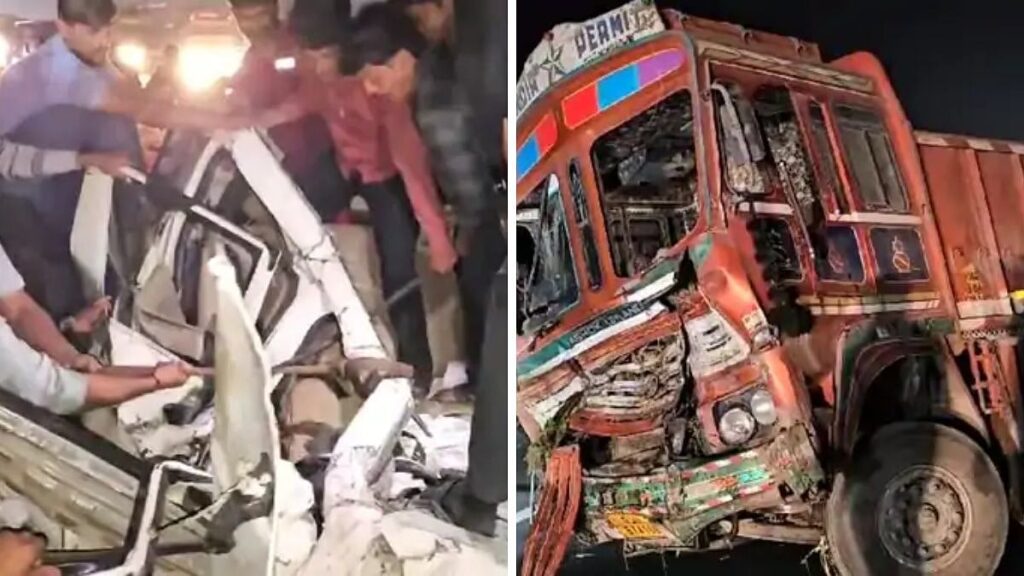
Tragic Collision on Valsad Road Claims Seven Lives
On February 20, 2026, a van traveling on a road in Gujarat’s Valsad district struck a truck, resulting in the deaths of seven occupants and leaving two others injured. The incident occurred in a district that spans 3,008 square kilometres and is divided into six talukas: Valsad, Vapi, Pardi, Umargam and two additional administrative divisions. The district’s landscape stretches from the Arabian Sea coastline inland, presenting a mix of coastal plains, fertile farmland and industrial zones.
Manufacturing and agriculture form the economic foundation of the area, and both sectors rely heavily on the local road network for the movement of goods and people. Historically known as Bulsar, Valsad district has its administrative headquarters in Valsad city, while the largest urban centre is Vapi.
These towns are not isolated settlements; they are linked by state and national highways that carry trucks transporting industrial materials and vans ferrying workers to and from factories. The crash took place on one of those thoroughfares. The van was overwhelmed in the impact, while the truck, though physically intact, became the instrument of a mass‑casualty event.
Valsad’s shoreline runs along the Arabian Sea, where various environmental programmes aim to protect natural beauty and encourage sustainable development. By contrast, the road infrastructure that sustains the district’s mobility lacks comparable protective measures.
Experts note that the asphalt ribbon can turn a routine journey into a tragedy when factors such as excessive speed, driver fatigue, inadequate lighting or simple misfortune converge. In this case, seven individuals now require funeral arrangements, while the two survivors need hospital care. Road safety has been a persistent issue across Gujarat. The state registers a high concentration of vehicles on highways that were not originally engineered for today’s traffic volumes.
Valsad’s location on the western seaboard makes it a key transit corridor: trucks move raw materials to manufacturing plants, and vans transport the labour force that keeps those plants operating. The February 20 collision represented a violent convergence of those two flows.
Following such as enforcement of traffic regulations, investment in improved road design, and broader public‑awareness campaigns. These strategies are not novel; they have been revisited after previous accidents in Gujarat and elsewhere in India. The central difficulty lies in putting them into practice consistently.
Because the district encompasses six talukas and a varied topography, no single policy can guarantee safety. Sustained engineering upgrades, diligent law‑enforcement, and responsible driver behaviour must all be maintained over time.
The two injured occupants may be able to recount what happened, though their memories could be incomplete or absent; the seven deceased cannot provide any testimony. The van involved is believed to be a typical shared‑transport model that fills gaps where regular bus service is limited. The truck is thought to be a heavy‑duty vehicle often used for overnight freight to meet delivery schedules.
Their meeting on the road resulted in seven fatalities. Valsad’s economy depends on its roads, and its residents depend on those same arteries to reach employment, markets and medical facilities.
Thus the infrastructure that sustains life also has the capacity to end it. The crash on February 20 is not an isolated oddity; it reflects a predictable outcome of a system that places vulnerable passenger vehicles alongside much larger freight carriers on the same routes. While the network will continue to operate, the pressing question remains whether this particular wreck will spur meaningful change in how the district manages road safety.




