
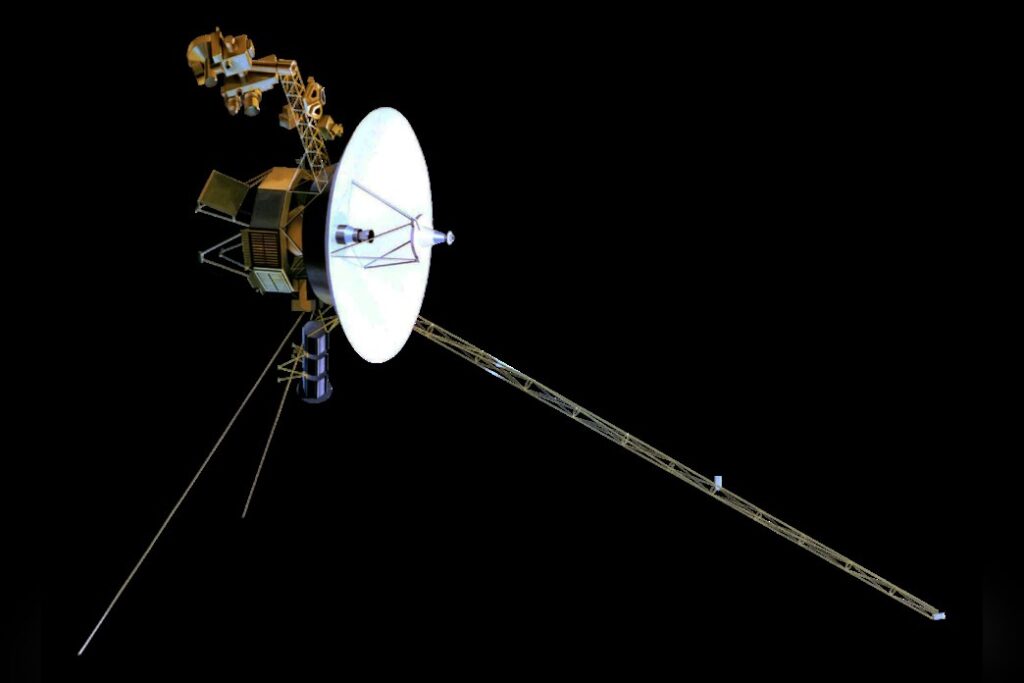
PASADENA, July 9 — Nearly five decades after they left Earth, the twin Voyager spacecraft continue to redefine the boundaries of human reach, transmitting data from a realm no other machine has touched. Strategically, these missions remain the only direct reconnaissance platforms operating beyond the heliopause, the invisible frontier where the Sun’s influence yields to the vastness of interstellar space. Launched by NASA in 1977, Voyager 1 and Voyager 2 are the sole human-made objects to have crossed that threshold.
Voyager 1, which lifted off on September 5, 1977, made the crossing on August 25, 2012, at a distance of approximately 121 astronomical units from the Sun. Voyager 2, launched on August 20, 1977, followed on November 5, 2018, at roughly 119 AU.
Each spacecraft carries a Golden Record—a curated archive of Earth’s sounds and images, a message in a bottle cast into the cosmic ocean. The broader stakes of these crossings are only now coming into sharper focus. The data they have returned provided the first direct measurements of interstellar plasma density, magnetic fields, and cosmic rays.
What the Voyagers found challenged existing models: the heliopause, the boundary layer where the solar wind meets the interstellar medium, proved thinner than anticipated. Voyager 1 traversed that transition zone in about one astronomical unit—a remarkably compact barrier.
As of 2025, Voyager 1 is approximately 160 AU from Earth, while Voyager 2 trails at about 134 AU. Both continue to relay data through NASA’s Deep Space Network, though their power supplies are gradually declining. The Voyager program is managed by NASA’s Jet Propulsion Laboratory here in Pasadena, California, a team that has kept these aging probes operational far beyond their original design life.
What this signals for the next phase of deep-space exploration is significant. The Voyagers established the baseline for understanding the interstellar environment that the New Horizons spacecraft will now approach. The calculus of interstellar exploration has shifted: where Voyager provided the first glimpse, New Horizons will offer a more sustained reconnaissance.
The geopolitical framing here is not about terrestrial borders, but about the strategic position of the United States in the only arena where no other nation has yet planted a flag—interstellar space. These probes are the vanguard, and their diminishing power makes every bit of data they return a precious asset.
The heliopause crossing data, the plasma density readings, the magnetic field measurements—these are not abstract points of scientific curiosity. They are the foundational intelligence for any future mission that seeks to operate beyond our solar system.




