
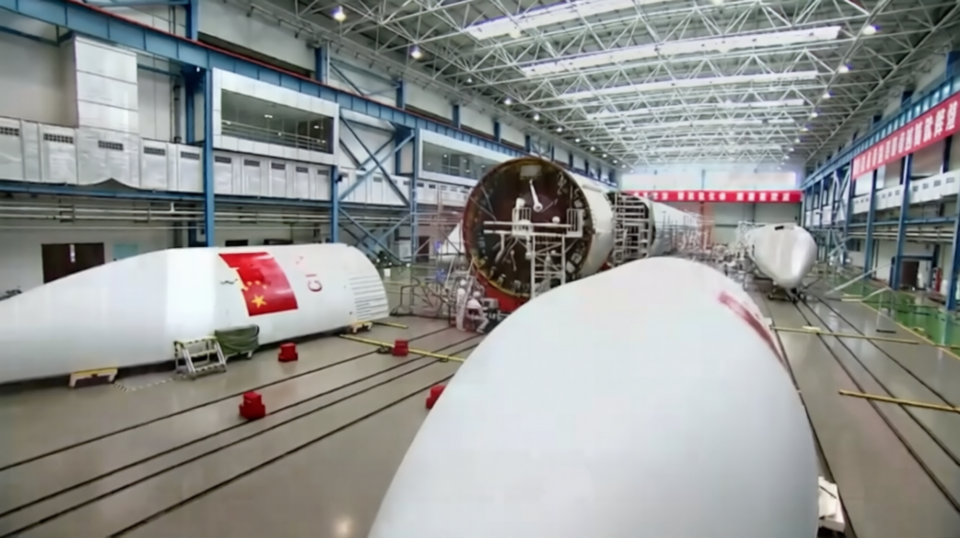
BEIJING, July 10 — The story of China’s race to the moon runs through the life of one man: Li Dong, a senior engineer who has spent nearly three decades perfecting the rockets that could carry Chinese astronauts to the lunar surface. Born in Beijing in 1975, Li graduated from Beihang University in 1998 with a degree in aerospace engineering. The following year, he joined the China Academy of Launch Vehicle Technology (CALT), the state-owned giant behind China’s most ambitious space projects.
Li’s early career was spent on the Long March 5 rocket, a heavy-lift vehicle that first launched in 2016. That program laid the groundwork for what came next.
In 2021, he was appointed chief designer of the Long March 10 series, a next-generation family of rockets designed for crewed missions. At its heart, the Long March 10 program is about reusability — a concept that has transformed the economics of spaceflight. The 10B variant, which Li designed, achieved its first successful recovery on June 23, 2024.
That milestone, Li has stated, positions China for crewed lunar missions by 2030. Li now leads a team of 5,000 engineers at CALT.
He has published over 50 papers on rocket propulsion and reusability, and in 2023 he was elected a member of the Chinese Academy of Engineering, one of the country’s highest scientific honors.
The man behind the rocket
What unfolded over the past five years is a story of rapid technological acceleration. When Li took over the Long March 10 program in 2021, China had not yet recovered a single orbital-class rocket booster. The successful recovery of the 10B in June 2024 changed that, bringing Beijing into a small club of nations — led by the United States — that have mastered reusable rocket technology.
For Li, the stakes are personal and national. China has announced plans to land astronauts on the moon before 2030, and the Long March 10 series is the vehicle designed to get them there.
The rocket’s architecture, with its reusable first stage, is intended to lower the cost of repeated launches to the lunar surface. Li’s background in aerospace engineering from Beihang University gave him the technical foundation. But it was his work on the Long March 5 that taught him how to manage the immense complexity of a national rocket program.
The Long March 5’s first launch in 2016 was a success, but a second launch in 2017 failed, delaying China’s space station plans by years. Those lessons, engineers say, informed the design philosophy of the Long March 10.
A team of thousands
The scale of Li’s responsibility is hard to overstate. He leads 5,000 engineers — a workforce larger than the entire staff of many aerospace companies. His published research, more than 50 papers on propulsion and reusability, has made him one of China’s most cited rocket scientists.
The Long March 10B’s recovery in June 2024 was not just a technical achievement. It was a signal to Washington and Moscow that China’s space program had reached a new level of maturity.
The United States has its own Artemis program aimed at returning Americans to the moon. China’s timeline — crewed lunar missions by 2030 — puts the two countries on a potential collision course for lunar resources and influence. Li, by all accounts, is a methodical engineer, not a politician.
But his work has geopolitical weight. The Long March 10 series is designed to carry astronauts and cargo, and its reusability means China could sustain a permanent lunar outpost — something the U.S. has also proposed.
What comes next
For those involved in China’s space program, the next few years will be decisive. Li’s team must now transition from a single successful recovery to a reliable, operational system. The Long March 10B’s first recovery was a proof of concept; the challenge is to repeat it, launch after launch, without failure.
Li was elected to the Chinese Academy of Engineering in 2023, a recognition that places him among the country’s top scientists. But the real test lies ahead.
If China lands astronauts on the moon by 2030, Li Dong will be remembered as the engineer who built the rocket that got them there. If the program falters, the blame will fall on his shoulders. The story of Li Dong is, at its heart, the story of China’s ambition — and the weight of a nation’s hopes on a single launch pad.




