
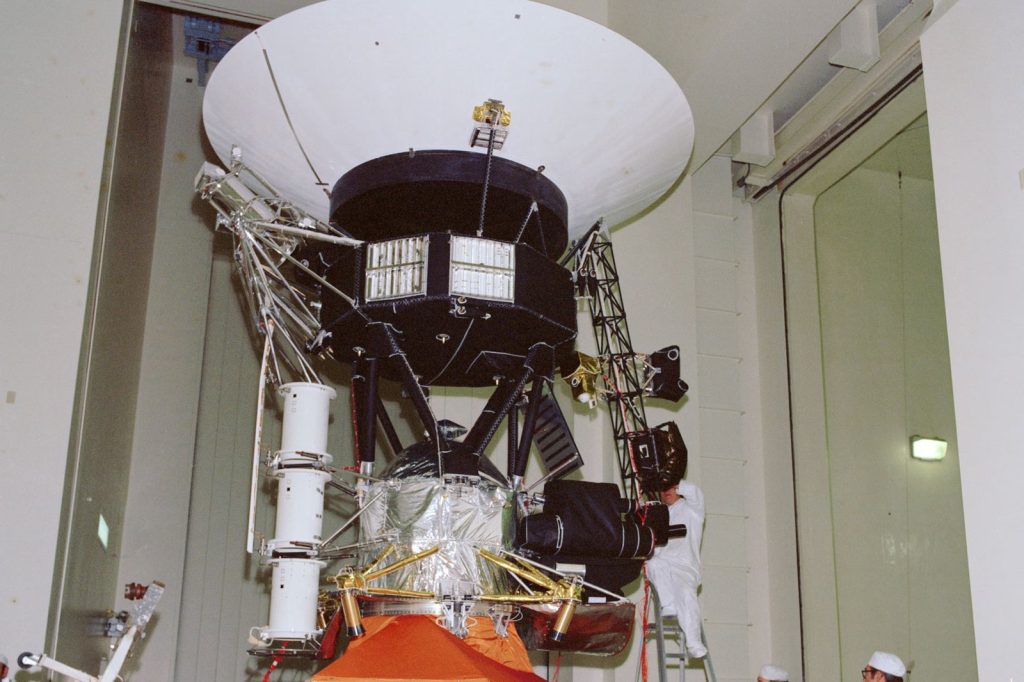
LOS ANGELES, July 9 — The two most distant human-made objects in the universe are about to fall silent. Voyager 1 and Voyager 2, the only spacecraft ever to have entered interstellar space, are running out of power. The technical reality is stark: the mission that has rewritten the textbooks on the outer solar system is entering its final act.
Both probes were launched by NASA in 1977 — Voyager 2 on August 20, Voyager 1 on September 5. The detail that matters is their staggering longevity: nearly half a century of continuous operation.
Voyager 1 crossed the heliopause, the boundary where the Sun’s influence gives way to the interstellar medium, in August 2012 at a distance of about 121 AU from the Sun. Voyager 2 followed in November 2018 at about 119 AU. They are the only human artefacts to have made that crossing.
Each spacecraft carries a Golden Record — a phonograph record containing sounds and images of Earth, intended as a message for any intelligent life that might one day find them. As of 2025, both Voyagers were still transmitting data from interstellar space, a feat that depends on their radioisotope thermoelectric generators converting the heat of decaying plutonium into electricity.
That power is declining. Under the hood, the engineering margin has been shrinking for years. Mission managers at NASA’s Jet Propulsion Laboratory in Pasadena, California, have been systematically shutting down non-essential instruments and heaters to stretch the remaining power.
Voyager 1 is expected to have enough power to operate one instrument until about 2025. Voyager 2 is expected to last until about 2026. The dates are not precise — they depend on how aggressively the teams conserve power — but the direction is not in doubt.
The wry observation is that these two spacecraft, designed for a four-year tour of Jupiter and Saturn, have outlasted every reasonable expectation. Voyager 2 went on to visit Uranus and Neptune, the only spacecraft ever to do so.
Voyager 1’s flyby of Saturn’s moon Titan in 1980 revealed a thick nitrogen atmosphere, a discovery that reshaped planetary science. Both then kept going, their trajectories carrying them out of the ecliptic plane and toward the heliopause. The data they have returned from interstellar space has been transformative.
Measurements of cosmic rays, magnetic fields, and plasma waves have given scientists a direct sample of the medium between the stars. The heliopause itself was found to be thinner and more complex than models had predicted.
As ever, the real universe turned out to be more interesting than the simulations. When the last instrument on each spacecraft stops, the Voyagers will continue to coast outward, carrying their Golden Records. They will not be retrieved.
They will not be heard from again. The silence will mark the end of a mission that began before most of its current engineers were born. What to watch next: the final instrument shutdowns.
Voyager 2’s last science data is expected to trickle in through 2026, after which the spacecraft will become a silent monument — the most distant human artefact in existence, heading for the stars.




