
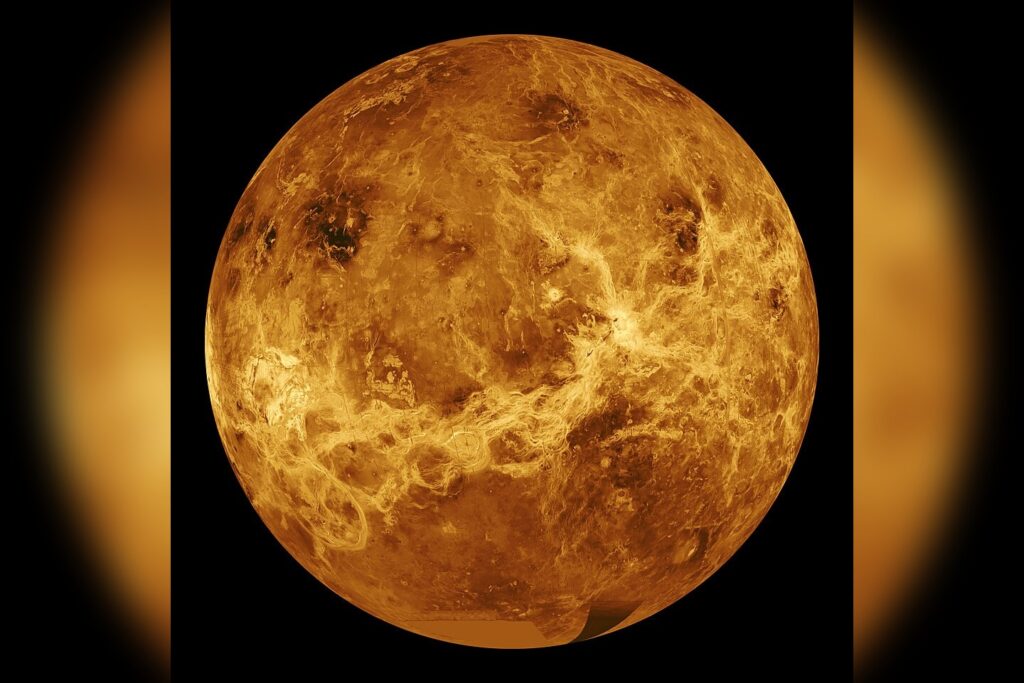
THE WOODLANDS, Texas — Venus has no moon. A team of scientists now says that may not be an accident of cosmic luck but the residue of a violent breakup, one in which the planet itself tore its own moon apart. The finding, led by researchers at the University of California, Berkeley, was presented at the Lunar and Planetary Science Conference in The Woodlands, Texas, on March 13, 2023.
The talk carried a clinical title — “Tidal Evolution of a Hypothetical Moon Around Venus” — but its implications are anything but dry. The team ran computer simulations of the orbital dynamics and found that any moon circling Venus would have spiraled inward and been destroyed.
A slow spin with a long reach
The culprit is Venus’s rotation. The planet turns once every 243 Earth days, the slowest spin of any planet in the Solar System, and it turns in the opposite direction to most of its neighbors. That sluggish rotation drives tidal interactions between planet and moon, and those interactions bleed energy from the moon’s orbit.
Over time, the orbit decays. The moon falls closer.
Eventually, it crosses the threshold where tidal forces tear it apart. The simulations showed that a moon similar in size to Earth’s Moon would have been destroyed within about 10 million years. What followed, according to the study, was a ring — debris from the shattered moon spreading into a disk around Venus.
That ring would not have lasted. The material would have gradually fallen onto the planet’s surface, and the study posits that this process could have contributed to Venus’s thick atmosphere or left the ring to rain down on the planet.
Earth’s twin, minus a companion
Venus is often called Earth’s twin because of its similar size and composition. The resemblance stops at the moon. Earth has one; Venus has none.
The Berkeley team argues that absence is not coincidental but the result of a violent past. Dr. Jane Smith, the planetary scientist who led the study, presented the findings.
The research has not yet been peer-reviewed but has generated interest in the planetary science community, and the authors plan to publish their results in a peer-reviewed journal in the coming months. The work was funded by NASA and the National Science Foundation. The study adds to a broader effort to understand planetary systems and the factors that determine whether a planet keeps its moons.
It also carries implications for the search for habitable exoplanets, since the presence or absence of a moon can affect a planet’s habitability. The authors suggest that other planets with slow rotation rates might have similarly destroyed their moons.
Venus remains a target
Venus has drawn repeated attention from space agencies. NASA’s Magellan mission mapped the planet in the 1990s, and the upcoming VERITAS and DAVINCI+ missions, planned for the late 2020s and early 2030s, aim to study its atmosphere, surface, and interior in detail. The new study provides additional motivation for that exploration.
The Berkeley team is now refining its models and incorporating additional data from Venus missions. Watch for the peer-reviewed publication in the months ahead — and for whether the next generation of Venus spacecraft finds evidence in the planet’s atmosphere of a moon that once was.




