
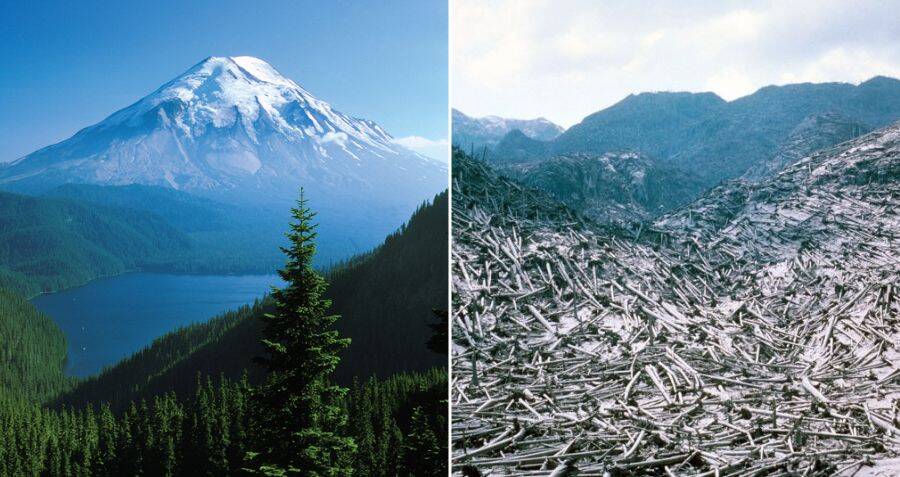
Spokane, October 5 The 1980 eruption of Mount St. Helens in Washington state remains the most economically destructive volcanic event in U.S. history, with damages estimated at $1.1 billion (equivalent to about $4.2 billion in 2024 USD). The event, triggered by a magnitude 5.1 earthquake, led to a lateral blast that destroyed 230 square miles of forest, killed 57 people, and removed the summit’s 1,300-foot elevation, reducing the mountain’s height from 9,677 feet to 8,363 feet.
Following the eruption, the landscape appeared barren, with vast areas buried under ash, pumice, and debris flows. However, over the next four decades, scientists observed rapid ecological succession, beginning with wind-dispersed colonizers such as fireweed and lupine, which stabilized soils and facilitated the return of insects, birds, and mammals.
By 2000, vegetative cover had returned to over 80% in the blast zone, and by 2020, researchers documented the reestablishment of old-growth forest characteristics in some areas, including the return of species such as Roosevelt elk, black-tailed deer, and northern spotted owls. The Mount St. Helens National Volcanic Monument, established by Congress in 1982 and managed by the U.S. Forest Service, has served as a living laboratory for studying volcanic succession, with over 1,000 scientific papers published on its recovery as of 2023.
Key researchers include Charlie Crisafulli, a U.S. Forest Service ecologist who has studied the site since 1980, and Jerry Franklin, a University of Washington professor whose work on landscape ecology helped shape post-eruption management policies. The recovery has challenged earlier assumptions about the irreversibility of volcanic devastation, demonstrating ecosystem resilience through natural processes such as seed dispersal by birds and mammals, nutrient cycling from decaying logs, and the role of pocket gophers in mixing subsoil with surface ash.
Today, the monument attracts over 500,000 visitors annually and continues to inform global disaster recovery strategies, including responses to eruptions at Mount Pinatubo in the Philippines and Eyjafjallajökull in Iceland. The site offers valuable insights into the long-term ecological and economic implications of volcanic events, with ongoing research expected to yield further lessons for environmental and disaster management planning worldwide.




