
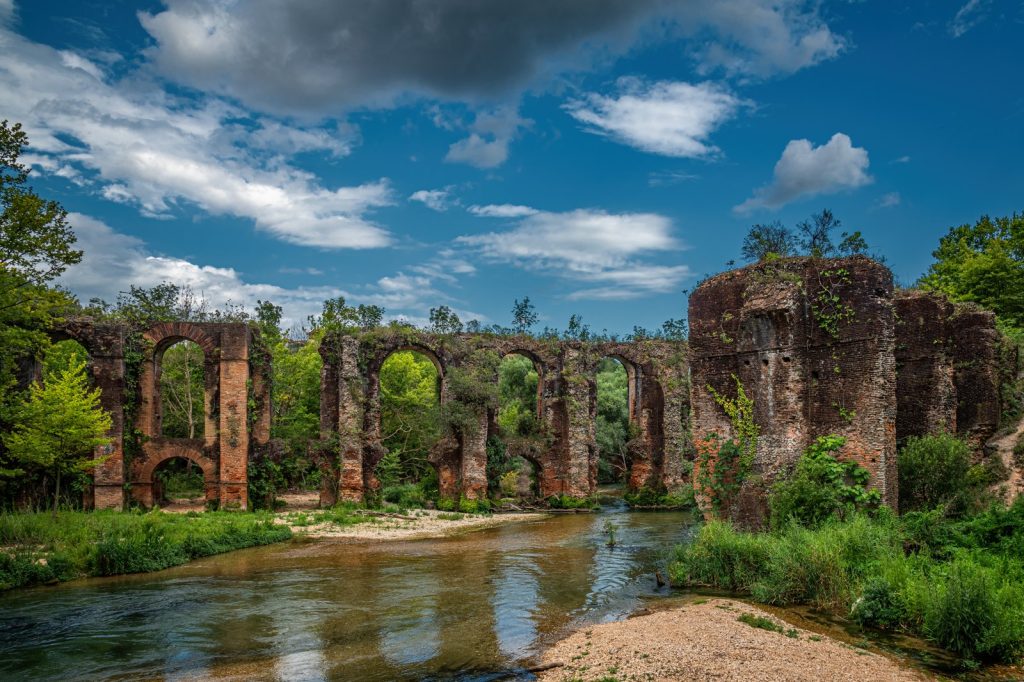
Strip away the marble arches and the Roman aqueduct was an investment project, one of the longest-running in history. Construction ran half a millennium, bookended by the Aqua Appia in 312 B.C. and the Aqua Alexandrina in A.D. 226, financed by both public and private money, with emperors Augustus, Caligula and Trajan all ordering new builds. The return, by one estimate, came to 1.5 million cubic yards a day for the capital, about 200 gallons per person. National Geographic’s account of the system calls it an “enduring symbol of Roman civilization and innovation.” Few public assets have held their value that long.
The asset itself was a network of pipes, tunnels, canals and bridges moving water by gravity alone, from lakes and springs as far as 92 kilometers, or 57 miles, out, into a capital whose population had reached about a million by the first century A.D. Rome itself ran 11 aqueduct systems, and remains survive across France, Spain, Greece, North Africa and Türkiye, with the wider network stretching from Spain to Syria. The category was not a Roman invention: Egypt and India built aqueducts earlier, and on Crete the Minoans collected and filtered rainwater as far back as the mid-third millennium B.C. No earlier system came close to the reach of Rome’s.
The build-out reads like a capital program with a century-by-century horizon. The censor Appius Claudius Caecus opened the account with the Aqua Appia in 312 B.C., a line that ran almost entirely underground. The Aqua Marcia followed in 144 B.C., longest of them all at 56 miles. Augustus’ era added the Aqua Julia in 33 B.C. and the Aqua Virgo in 19 B.C.; Caligula began the Aqua Claudia, which Claudius completed; Trajan’s Aqua Traiana carried water from Lake Bracciano to Trastevere beginning in A.D. 109. The Aqua Alexandrina, about 14 miles long, closed the program in A.D. 226.
The numbers show where the money went. Rome’s channels totaled 315 miles in length; 269 of those miles ran underground, 46 sat above ground, and only some 36 miles, just under 12 percent of the whole, crossed valleys on arches. The arches everyone pictures were the exception, not the rule: the Pont du Gard, built in 19 B.C. to carry water across southern France to Nîmes and now a UNESCO World Heritage Site, is the celebrated case. Underneath sat borrowed technique: shafts known as putei sunk at intervals of around 230 feet on the ancient Persian qanat method, tunnels waterproofed with opus signinum, a mortar of crushed tiles and amphorae, and gradients so gentle that the Aqua Traiana needed 37 miles of channel to cover the 31 miles from its spring to the city as the crow flies.
What the capital received: 11 grand-scale baths, some 900 public baths and nearly 1,400 monumental fountains and private pools, with drinking and irrigation taking their share. Not every city bought in; Pompeii managed on wells and cisterns, and at Miseno, on the Bay of Naples, the Roman navy’s Piscina Mirabilis held close to half a million cubic feet, its vault carried on 48 pillars, while Constantinople answered with the Basilica Cistern. The financing mixed public and private money from the start: emperors from Augustus onward donated regularly to upkeep, and Agrippa, Augustus’ son-in-law, drew on his own mines for the lead pipes of the Aqua Julia and the Aqua Virgo. One of the few records of how the work actually went is a funerary monument in Algeria commemorating an engineer named Nonius Datus, and it recounts the difficulties he ran into.
The longest-lived asset in the portfolio is the Aqua Virgo, the only one of Rome’s aqueducts still functioning today. Restored by popes Adrian I, Nicholas V and Pius V in later centuries, it now serves irrigation and still supplies water to the 18th-century Trevi Fountain. Even the drainage side endured: writing in his encyclopedia the Naturalis historia, Pliny the Elder noted that “700 years from the time of Tarquinius Priscus, the sewers have survived almost completely intact,” a verdict on the Cloaca Maxima. The survival is the system’s closing argument, what its history calls “a remarkable example of how ancient infrastructure can evolve to meet the needs of different ages.” As investments go, a water channel still paying out after two millennia sets a benchmark few modern projects will ever match.




