
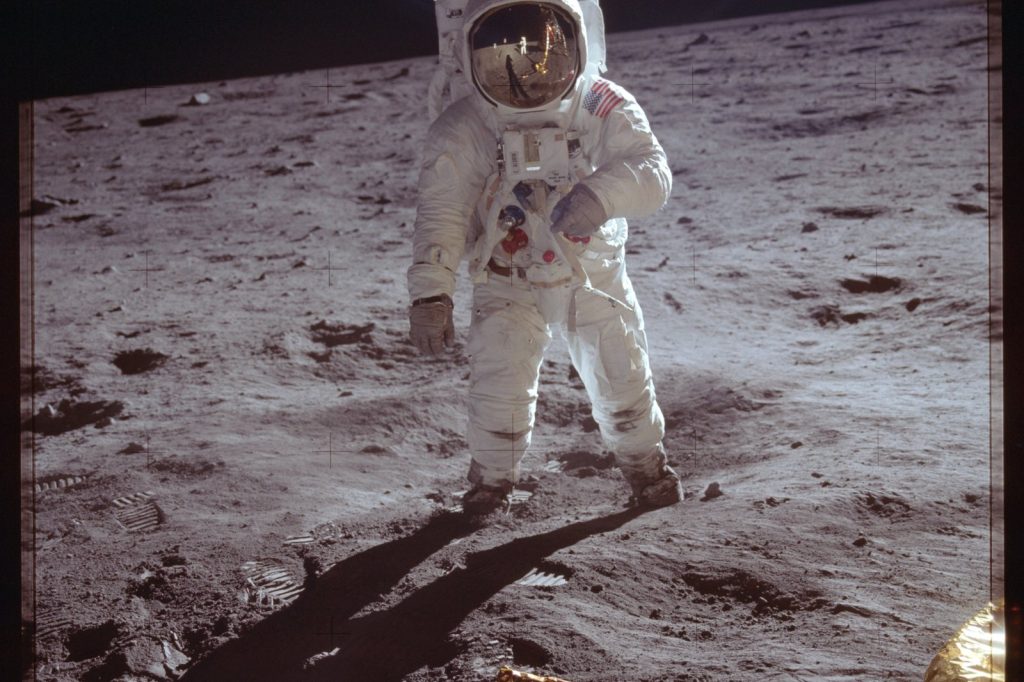
The scene, replayed in every documentary since: on July 20, 1969, millions crowded around their television sets to watch two Americans do what no human had ever done. The week had begun with the ground shaking: at Cape Kennedy, Florida, on the morning of July 16, the huge Saturn Five rose slowly into the sky while someone on the launch crew spoke three words into history: “Good luck. And Godspeed.”
The trip was the finish line of a twelve-year sprint. Russia put the first artificial satellite, Sputnik 1, into space in 1957; on April 12, 1961, Yuri Gagarin became the first person in space, with Alan Shepard following for the United States less than a month later. President John F. Kennedy then tasked NASA with landing a person on the moon within ten years. The crew he never lived to see: Neil Armstrong, calm test pilot, Gemini veteran, in command; Edwin “Buzz” Aldrin piloting the moon lander the crew named Eagle; Michael Collins, popular and always ready with a smile, alone in the command module Columbia. Halfway out they beamed color television home, Earth behind them, the moon swelling ahead.
The landing itself nearly slipped away. Descending toward the Sea of Tranquility, the computer-flown Eagle passed over a field of boulders; one hundred forty meters up, Armstrong took manual control and flew the lander forward to smoother ground, touching down with about 20 seconds of fuel to spare, a fact hidden from the watching world. Armstrong radioed: “Tranquility Base here. The Eagle has landed.” President Richard Nixon had given federal workers the day off; five hundred million watched on television, countless millions more listened by radio.
The moonwalk came ahead of schedule. The plan called for a four-hour rest; Armstrong and Aldrin asked to skip it, spent over three hours squeezing into suits in the cramped cabin, and at fifty-six minutes past two GMT, Armstrong’s boot pressed into the gray dust and the world heard the words that echo still: “one small step for man; one giant leap for mankind.” Out of the Eagle’s cold black shadow he stepped into blinding sunlight, describing ground so fine that “I can kick it loosely with my toes.” Aldrin followed down the ladder. They read a plaque saying they “came in peace for all mankind,” planted the flag, took Nixon’s call, and packed 47 pounds of rock and dust before rejoining Collins, who had orbited throughout with no television receiver, closest to the event and unable to see it.
By July 24, 1969, all three were home. Ten more astronauts would follow their footprints by 1972, when the last mission lifted off from the moon, and the residue still orbits as confidence: carry people to another world and back, NASA reasoned, and anywhere is possible, next stop Mars.
Sources
- The Moon Landing | National Geographic Kids
- 'That's One Small Step for Man': The Apollo 11 Moon Landing




