
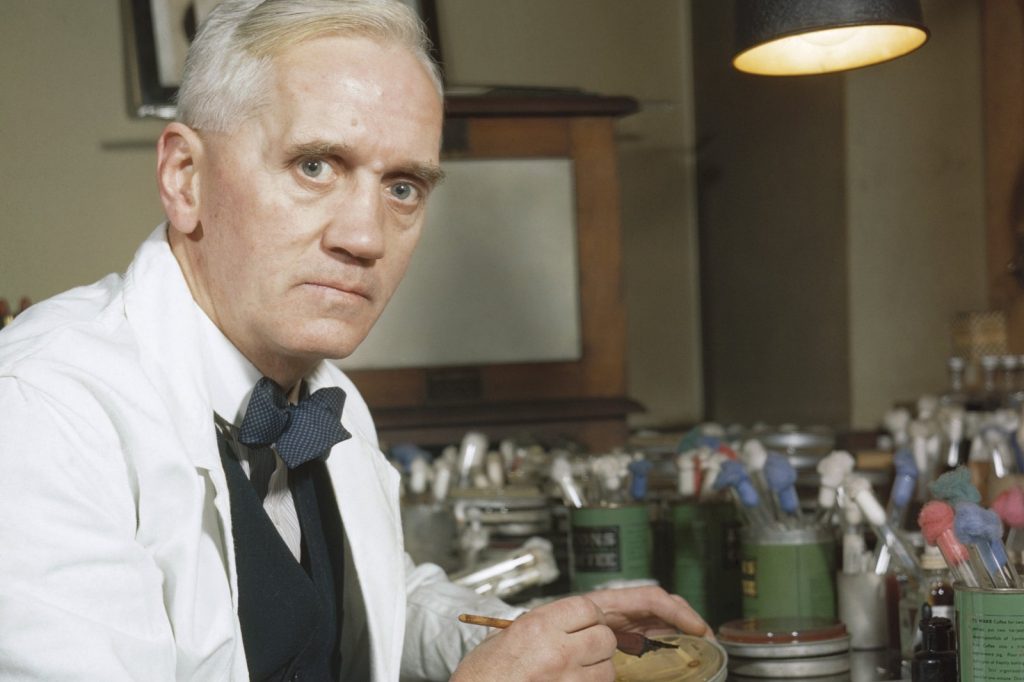
The claim is famous: a messy London laboratory, a forgotten petri dish, and in 1928 the accident that gave the world penicillin. The catch is that almost nothing about the payoff came quickly. Alexander Fleming did not grasp the full significance of what grew on that dish for at least another decade, and the Nobel Prize in Physiology or Medicine, shared with the Oxford team that turned his find into medicine, only arrived in 1945.
The mechanics here were a chain of small failures. Fleming, investigating staphylococcus, a common bacterium that causes boils and, in patients whose immune systems are weakened, disastrous infections, went away on a two-week vacation. One of his culture dishes stayed out on the bench instead of going into the incubator as intended. A spore of Penicillium mold found its way into the dish, perhaps through a window, though more likely it floated up a stairwell from a lab below where molds were being cultured. The mild conditions during his absence let both bacteria and mold grow; had the incubator been in use, only the bacteria would have grown.
On closer reading, even the founding observation is shakier than the legend. Fleming’s laboratory notebooks were sketchy, and his later accounts of the discovery contradicted each other. Sometimes he described lysis, the weakening and destruction of bacteria he had studied in his earlier lysozyme work; at other times he pointed to inhibition, growth checked in the areas affected by the mold “juice,” shown by a clear zone where bacteria had stopped spreading. He probably forgot which came first after months of experiments under varying conditions. He worked out that the antibacterial substance came only from certain strains of the mold, Penicillium notatum. He could not isolate the compound, but he named it “penicillin” and studied its stability at different temperatures and its effect on many microbes.
Then the trail went cold, and the reasons are instructive. Fleming tested the fluid for toxicity in a laboratory mouse and a rabbit but never injected infected animals first, an omission biographers still puzzle over, likely because he believed cures come from within the body rather than from an external agent. He was hunting a topical antiseptic for wounds, not a cure. His paper in the British Journal of Experimental Pathology in June 1929 drew little notice through the 1930s, and the few scientists who sent for samples failed to capitalize on the discovery.
The money question, medically speaking, was scale and proof. It fell to Howard Florey and Ernst Chain at Oxford to demonstrate in 1940 that penicillin could work as a therapeutic agent against a large number of bacterial diseases, the step that converted a laboratory curiosity into the drug that reshaped medicine. Fleming, born in Lochfield, Ayrshire, in 1881, the seventh of eight surviving children on a Scottish farm, had come to St. Mary’s Hospital Medical School on a scholarship in 1901 and stayed there for his entire career; the 1945 Nobel Prize recognized the discovery that had waited since the dish on his bench.
The site is now part of medical history in a literal sense. St. Mary’s Hospital in Paddington houses the Alexander Fleming Laboratory Museum, where visitors can see the laboratory restored to its 1928 condition, and in 1999 it was declared an International Historical Chemical Landmark.
Sources
- Alexander Fleming | Science History Institute
- Fleming museum | What we do | About us | Imperial College Healthcare NHS Trust




