
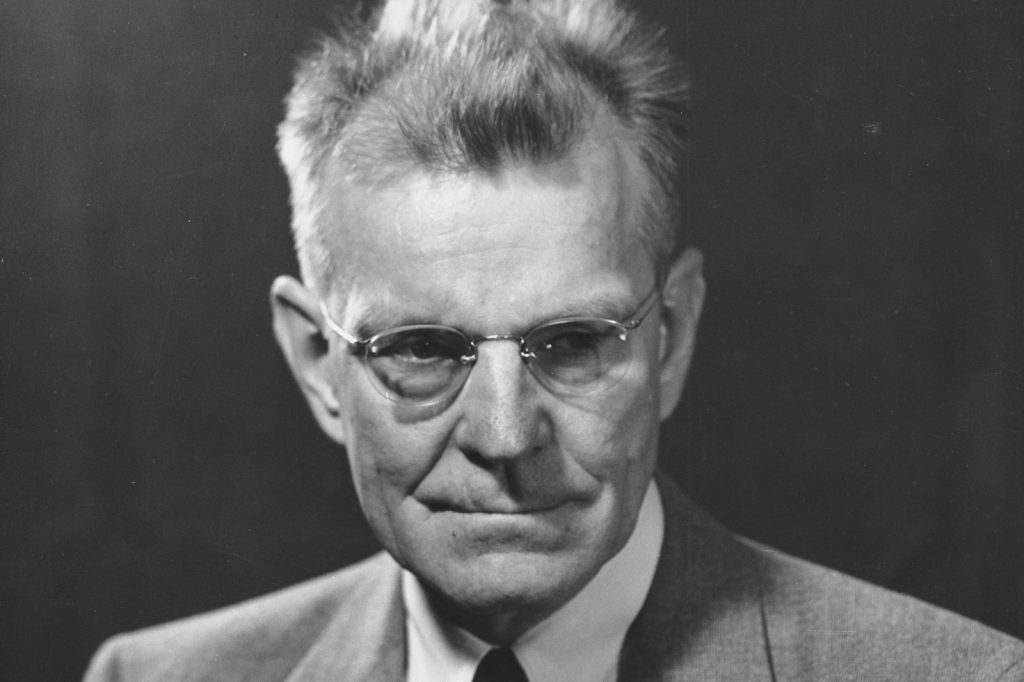
On the ground in Texas hill country, the scene of M. King Hubbert’s beginnings was about as far from a corporate laboratory as it gets: a poor Methodist family, a hardscrabble farm, and a teenager who sold his cow to pay his way into college. What he carried out of those hills was a fierce intellect and, by his own account, an atheism that pushed him toward science; he later put money behind Martin Luther King. He did his breakthroughs with little more than a blackboard.
The Fight He Won
In 1956, working as a geologist for Shell, Hubbert made the call that defined him. Oil production, he argued, traces a bell curve: the rate climbs, crests and then slides into permanent decline long before the last barrel, because deposits are finite and oil needs millions of years to form. For the United States, he put the crest somewhere between 1965 and 1970. The industry fought him for years, until he was proved “excruciatingly right during the oil crisis of 1973” and gained “oracle” status while Jimmy Carter was president.
The American numbers behaved, up to a point. Production topped out in 1970 at 9.6 million barrels per day, then decreased through 2008, just as the curve said. What the curve missed was technology: from 2009, new oil and gas methods began prying loose resources once written off as out of reach, and the Shale Revolution pushed American output back up. One security-focused verdict on the model is blunt: a single bell curve is “too simplistic”, because each time recovery techniques advance, output starts climbing again.
The Bullseye Nobody Awards
Then came the part almost nobody gives him credit for. In the same 1956 work he forecast that world crude output would peak “within about half a century”, and it did: crude production peaked in 2006, at 70 million barrels per day, and bodies from the International Energy Agency to most major oil companies now concede conventional crude has crested. The catch is rich with irony. The peak’s impact was deferred by fracking, a technique Hubbert himself was the first to work out, in 1953, showing that fractures from fluid injected into rock spread vertically, not horizontally, as the industry then believed. Doubters were won over by improvised rigs involving a goldfish bowl, a soda bottle, plus a turkey baster.
The argument outlived him; he died in 1989. Between 2005 and 2009, world output sat flat at 82 to 83 million barrels per day and the price ran to $147 a barrel, and plenty of observers decided the peak had arrived. It had not: by 2014 production hit almost 89 million barrels per day, and the price fell from a seeming new normal around $115 to under $30 by the start of 2016.
Even so, the skeptics’ case has cracks: fracking wells can lose up to 50 per cent of output in their first year, and the IEA expected American shale itself to peak in 2020. On the security side, the Strauss Center argues that decades of peak-oil fear steered defense policy and fed worries about dependence on producers like Saudi Arabia and Libya, and that false scarcity maps can push states toward policies that are unnecessarily aggressive. Whether Hubbert ends up a footnote or a prophet depends on what happens after shale. If nothing replaces it, he may yet be proved broadly right, though as one reviewer of a 2016 biography of the man put it, “the oracle’s forecasts were always ignored or dismissed until it was too late”.




