
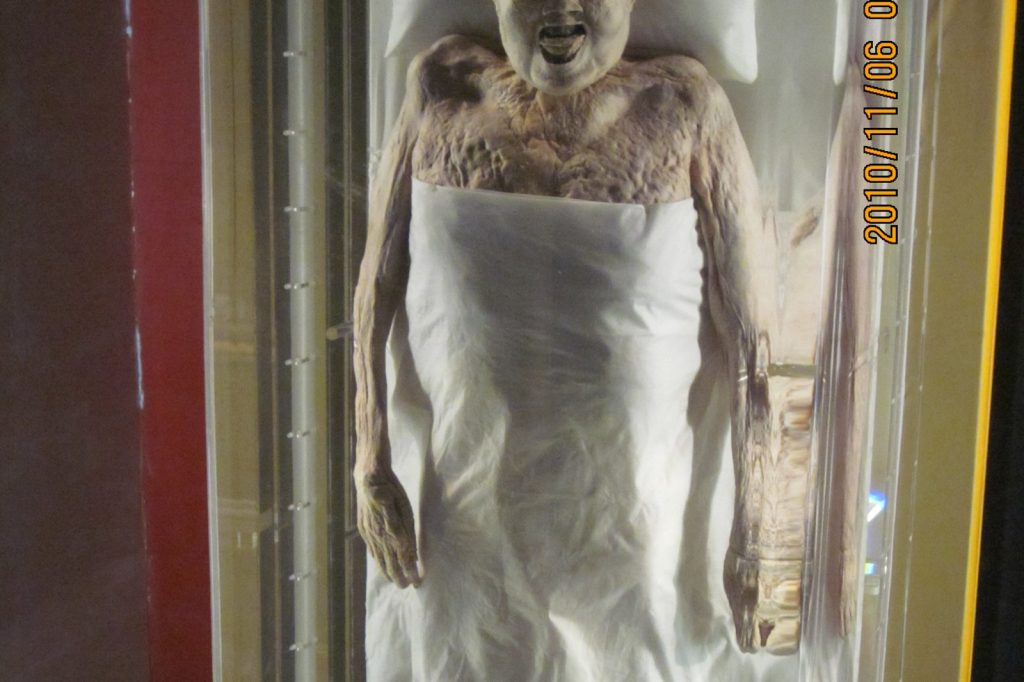
The smallest detail from one of archaeology’s most celebrated finds is also the hardest to shake off: 138 melon seeds, sitting in the digestive system of a woman who died more than two thousand years ago, still recognizable. How does a piece of fruit outlast two millennia? The answer begins with a Chinese noblewoman named Xin Zhui.
Xin Zhui, the Marquise of Dai, belonged to the Western Han dynasty. Her husband, Li Cang, was Marquis of Dai and chancellor of the Changsha kingdom. She was born around 217 BC and died in 168 or 169 BC, aged about 50, after a life of privilege: her own musicians, silk clothing, cosmetics and foods reserved for the royal table.
The tomb was found in 1971, when workers digging an air raid shelter for a hospital broke into a burial chamber beneath Mawangdui hill near Changsha. Formal excavation began in 1972, helped by more than 1,500 local students. Inside lay four coffins nested one inside another, sealed under charcoal and white clay, with the woman herself wrapped in twenty layers of clothing. The finds numbered more than 1,400 items, among them 100 silk garments, 182 lacquerware pieces and 162 carved wooden figures of servants.
What researchers found when the innermost coffin was opened has kept scientists busy ever since. Her skin was soft and moist, her limbs were actually bendable, her organs and blood vessels were intact, and traces of Type A blood remained in her veins. An autopsy in December 1972 recovered 138 melon seeds from her stomach and intestines. The seeds show that she “died within a few hours of eating the fruit”, and that the meal fell in summer, when melons ripen. Her death most likely came from a heart attack, on top of heart disease, high blood pressure, liver trouble and gallstones, with one account adding probable diabetes.
The science behind the survival comes down to three things. Careful preparation of the body slowed the first stage of decay. The airtight nested coffins kept oxygen away. And the chamber, deep underground and packed with charcoal and white clay, shut out water and air while the temperature stayed low. Intriguingly, an acidic fluid of unknown origin sat inside the coffin; many scientists suspect it came from her own body and may have stopped bacteria from growing. Even so, nobody is sure exactly why she stayed preserved while her husband and son, buried nearby, decomposed completely.
Her remains, among “one of the best-preserved ever found”, now rest at the Hunan Museum, and in 2003 a special compound was developed and injected into her blood vessels to sustain the preservation. The melon seeds, meanwhile, remain the plainest proof that decay simply never finished its work: a summer snack, caught mid-digestion, holding its shape across twenty-two centuries.
Sources
- Xin Zhui Facts for Kids
- One of the world’s most preserved mummies, the Lady of Dai, is still soft to the touch, has bendy ligaments, and is 2,100 years old | The Vintage News




