
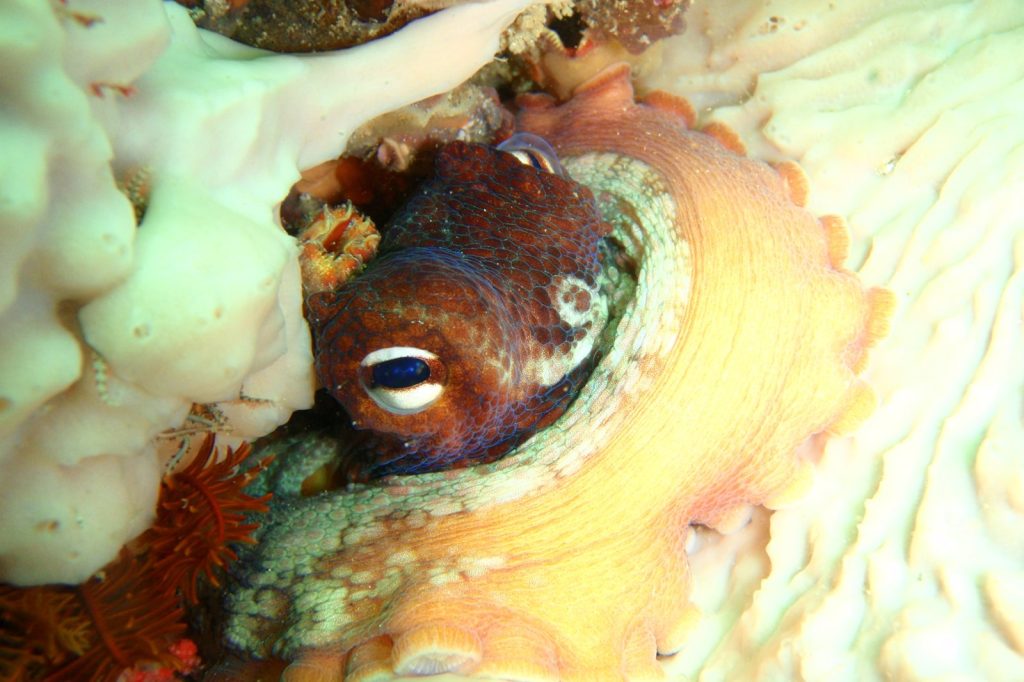
The kraken has a fossil pedigree now. In Science on April 23, 2026, a team led by Shin Ikegami with Yasuhiro Iba and colleagues reclassified 27 mineralised jaws from Late Cretaceous rocks in Hokkaido and on Vancouver Island as two species of Nanaimoteuthis, finned octopuses, material long divided among five named species and previously thought to be vampire squids. Twelve jaws were newly detected; 15 were reanalysed from earlier literature.
The two species bracket two grades of giant. Nanaimoteuthis jeletzkyi ranges across rocks about 100 to 72 million years old and is estimated at 3 to 8 metres, roughly the span of today’s giant Pacific octopus. Its relative N. haggarti appears by about 86 million years ago and persists to about 72; jaw-to-body equations put it at roughly 7 to 19 metres, or 23 to 62 feet, longer than a city bus and big enough to rival most megalodons.
Those figures are modelled, not measured. The team measured 12 living finned octopus species and modelled jaw-to-body scaling, producing a range of 6.6 to 18.6 metres for the largest animal, rounded for public communication to 7 to 19 metres. The estimate assumes the extinct cirrate had proportions like its living relatives; if its arms were unusually short, the top number shrinks.
The new jaws surfaced through what the Hokkaido group calls digital fossil-mining: a destructive tomography rig grinds a rock away in layers, photographing each surface, and a zero-shot detection pipeline then searches the stacked image volumes for objects missing from conventional training sets. Humans still make the biological calls. The same instrument previously pulled 263 tiny jaws across 40 squid species, 39 of them new, from Cretaceous rocks, and in January 2026 flagged Uluciala rotundata in South Dakota as the oldest known sepioid.
The feeding evidence is in the damage. Juvenile jaws came through intact while adults are chipped, scratched and cracked, some having lost nearly 10 percent of jaw length. “This extensive wear suggests dynamic crushing of hard skeletons,” the researchers write, with ammonites, crustaceans and bony fish the plausible menu; claims that it killed mosasaurs remain speculation, since no bite-marked reptile or gut content has been found.
The study’s own framing is bold but bounded: “these octopuses may represent the largest invertebrates thus described, rivaling contemporaneous giant marine reptiles,” with the authors adding that “powerful jaws, and the loss of superficial skeletons, convergently transformed cephalopods and marine vertebrates into huge, intelligent predators.” Not everyone accepts size estimates from beaks alone, and the safest reading, as one careful write-up puts it, is ecological parity: large enough and mechanically equipped to join the upper predator conversation with marine vertebrates, not proven ruler of every sea.
One last wrinkle: left and right jaws wore unevenly, which the authors read as lateralised behaviour, a distant analogue of handedness, and maybe a hint of the sophistication octopus fans expect. That inference, like the rest, hangs on a beak. The monster that survived the Cretaceous is a pair of worn jaws, and it is enough to redraw the size chart for soft-bodied life.
Sources
- The Real Kraken: Giant Octopuses Ruled Ancient Seas | JAPAN.co.jp
- Paleontologists Identify 60-Foot Octopus With Bone-Crushing Jaws




