
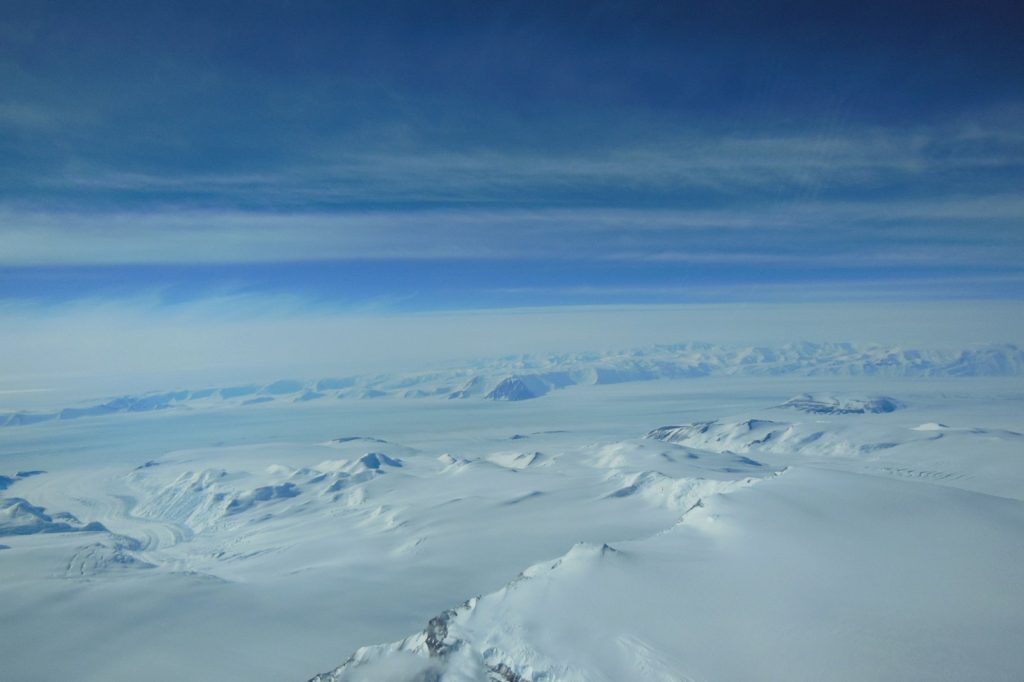
Covering roughly 14.2 million square kilometres (5.5 million square miles), Antarctica ranks as the world’s fifth‑largest continent—about 40 percent larger than Europe. Almost entirely positioned south of the Antarctic Circle, the landmass is encircled by the Southern Ocean and holds the geographic South Pole.
The continent’s surface is dominated by the Antarctic ice sheet, whose average thickness reaches 1.9 km (1.2 mi). This ice stores roughly 70 percent of the planet’s fresh water; a complete melt would elevate global sea levels by nearly 60 metres (200 ft). The massive ice cover also drives Antarctica’s extreme climate, which is, on average, the coldest, driest and windiest of all continents.
Antarctica sits at the highest mean elevation of any continent, contributing further to its inhospitable conditions. Nevertheless, a range of native organisms have adapted to survive. Among the fauna are mites, nematodes, penguins, seals and tardigrades. Vegetation is limited to hardy lichens and mosses that can endure the few pockets of relatively milder weather.
Summer temperatures along the coast can rise above 10 °C (50 °F), offering a brief respite from the perpetual freeze that characterises the interior. Precipitation remains low throughout the continent, with coastal areas receiving just over 200 mm (8 in) of moisture annually and the interior receiving far less, classifying Antarctica as a polar desert.
The continent also holds the record for Earth’s lowest measured temperature: –89.2 °C (–128.6 °F). Such extremes make human habitation difficult, yet they provide a unique laboratory for scientific inquiry. Nations operate research stations across the ice, gathering data on the environment, climate dynamics and the effects of global warming. These outposts contribute essential insights into how Antarctica’s ice sheet responds to temperature changes and how sea‑level rise may unfold.
Because of its pristine and isolated nature, Antarctica is a focal point for climate‑change research. Scientists study ice cores, glacial movement and atmospheric patterns to understand past climate variability and to model future scenarios. The continent’s role in the global climate system ensures that it will remain a priority for international research programs.
Exploration and study of Antarctica demand meticulous planning and robust safety measures, given the harsh weather and remote location. Despite these challenges, continued expeditions are expected as the scientific community seeks to unravel the continent’s many secrets.
Looking ahead, Antarctica’s distinctive geography and climate will keep it at the forefront of environmental research. As the world confronts accelerating climate change, the data derived from this frozen continent will be vital for informing policy and adaptation strategies worldwide.




