
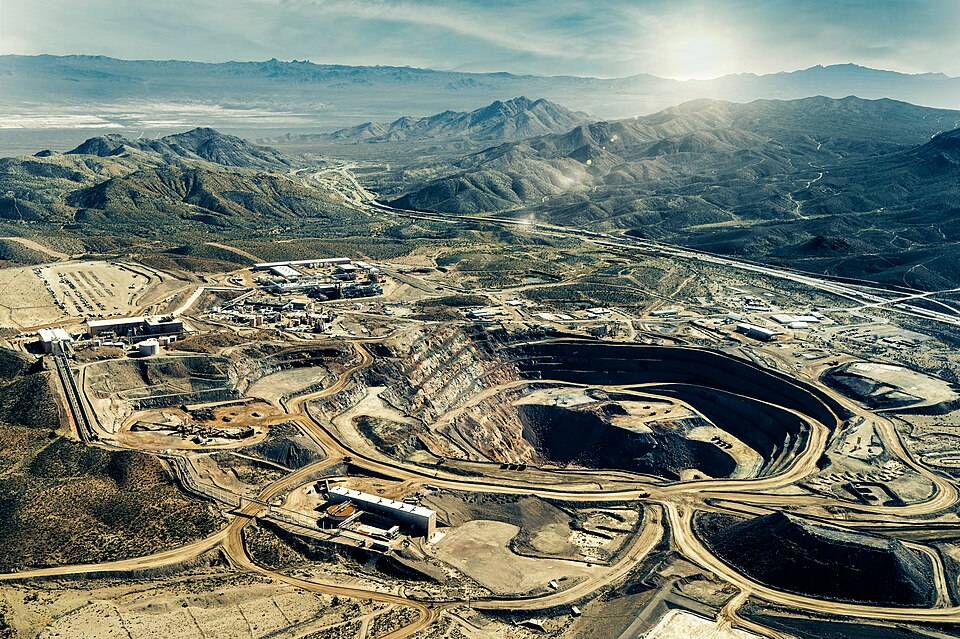
China’s decades-long consolidation of the rare earth supply chain gives Beijing powerful leverage over a class of minerals essential to electric vehicles, wind turbines, and advanced electronics. According to the U.S. Geological Survey, the country controlled about 90 percent of global processing capacity in 2023 and produced 70 percent of the world’s rare earth oxides.
Those oxides totaled 240,000 metric tons last year, drawn from reserves that are the largest of any nation. China’s total rare earth reserves are estimated at 44 million metric tons, with the single largest deposit located at the Bayan Obo mine in Inner Mongolia. That mine holds roughly 48 million metric tons of reserves and is considered the world’s largest rare earth deposit.
Additional deposits are spread across Sichuan, Jiangxi, and Guangdong provinces. The scale of these resources, combined with state-directed industrial policy, has allowed China to build a near-totally integrated supply chain from mining through magnet manufacturing.
State control and consolidation
Beijing sets annual production quotas for rare earths through a system of state-owned enterprises that dominate every stage of production. For 2023, quotas were fixed at 210,000 metric tons.
The key firms include China Northern Rare Earth (Group) High-Tech Co., China Minmetals Rare Earth Co., and Shenghe Resources, each operating within a framework designed to centralize control and prevent market fragmentation. This consolidation did not arise spontaneously. Since the 1990s, the government has used low labor costs, relaxed environmental standards, and direct subsidies to undercut competitors abroad and build what is effectively a monopoly on rare earth processing.
The downstream sector is equally concentrated. China now produces more than 90 percent of the world’s neodymium-iron-boron magnets, according to the U.S. Department of Energy.
NdFeB magnets are critical components in electric vehicle motors and wind turbines, two technologies central to global clean-energy goals. Heavy state investment in magnet manufacturing ensures that even if raw materials were sourced elsewhere, the processing and fabrication steps remain largely within China’s borders.
Trade disputes and environmental costs
China’s dominance has at times been used as an economic weapon. In 2010, an embargo on rare earth exports to Japan caused global prices to spike and set off alarms about supply security among industrialized nations.
The World Trade Organization ruled against China’s export restrictions in 2014, and Beijing formally lifted quotas in 2015. Yet the underlying architecture of state control did not change; the same state-owned enterprises continued to manage production and pricing, leaving overseas buyers reliant on those firms for their supplies. That reliance comes with environmental consequences largely confined to China’s territory.
The Bayan Obo mine produces not only rare earths but also radioactive thorium and uranium as byproducts. Mining and processing have led to soil and water contamination in surrounding areas of Inner Mongolia.
The concentration of refining capacity means these externalities are borne within the country, while global consumers avoid direct exposure. The long-term sustainability of current extraction methods remains an open question.
Geopolitical implications
China’s rare earth position is part of a broader economic structure that gives the state significant leverage over global supply chains. As the world’s largest manufacturer, China supplies a large portion of the industrial goods that underpin modern technology. Other countries depend on Chinese exports for everything from batteries to defense components.
This dependence creates inherent tension, especially when trade disputes arise or when Beijing uses its market position for strategic ends. For the rest of the world, the challenge is to secure supply chains for magnets, electric vehicles, and wind turbines without replicating the environmental problems that have accompanied China’s approach.
No single nation currently possesses the full combination of reserves, processing infrastructure, and manufacturing capacity needed to challenge China’s position quickly. The United States and its allies have invested in domestic mining and processing projects, but scaling these to compete with decades of state-directed development will take years. In the meantime, the rare earth map remains drawn largely from Beijing.




