
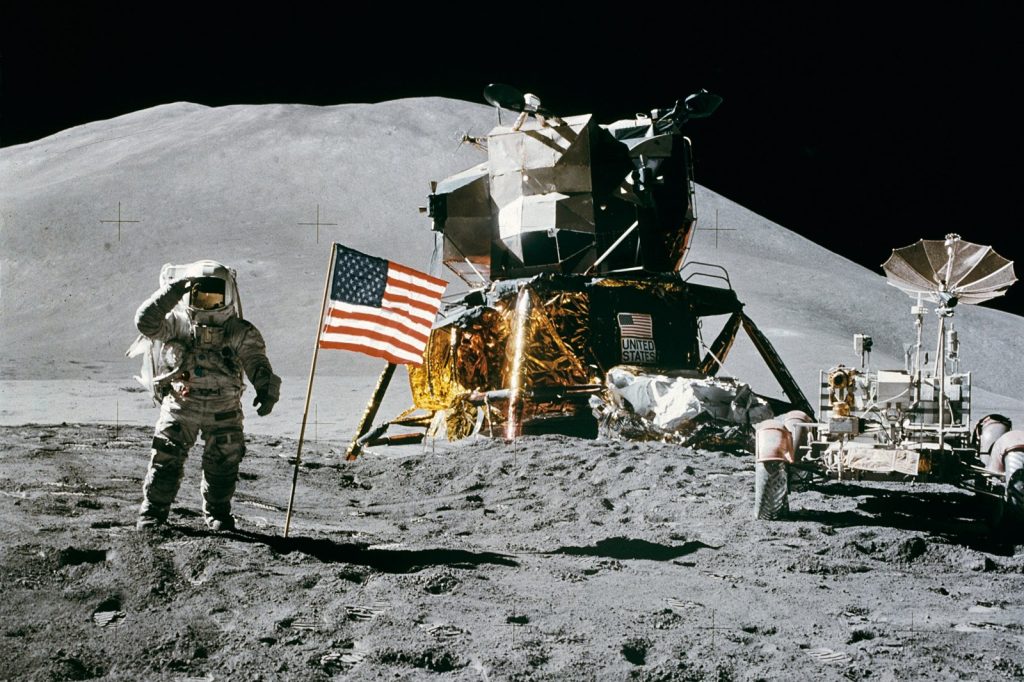
Eugene Cernan and Harrison Schmitt spent three days in the Taurus-Littrow valley in December 1972, and then they went home. Nobody has stood on the Moon since. Twenty-four American astronauts have travelled there, 12 of them walked on the surface, and five of the 24 are still alive. All of it happened under Apollo.
The reason for going was never subtle. America went in the 1960s mainly to beat the Soviet Union and assert its geopolitical and technological dominance. Once that was done, political enthusiasm and public interest drained away, and funding went with them.
Artemis II: the hardware works
The first crewed step back came this year. Artemis II launched from Kennedy Space Center on April 1, 2026, carrying commander Reid Wiseman, pilot Victor Glover, mission specialist Christina Koch and Canadian Space Agency astronaut Jeremy Hansen. No one had flown that far from Earth since 1972.
Over about ten days the Orion capsule looped round the far side of the Moon, passing within 4,000 miles of the surface and reaching 252,756 miles from Earth, farther than any people have gone. It splashed down off San Diego on April 10. The flight tested Orion’s life-support and communication systems and gave engineers their first detailed look at how the heat shield behaves coming back from the Moon. Under the hood, it proved that the Space Launch System and Orion can carry a crew. The twin boosters alone, each stacked from five segments built by Northrop Grumman in Utah, supply more than 75 percent of the rocket’s thrust at launch.
Artemis III: no landing, by design
Here the schedule changes. Artemis III was conceived as the first landing since Apollo 17, but in February 2026 NASA changed course. The SpaceX Starship lander is not ready, and the in-orbit refuelling it relies on has never been demonstrated. So Artemis III, now set for summer 2027, stays in low Earth orbit as a crewed docking rehearsal.
NASA has called it the most complicated mission it has attempted: four astronauts, three launches, three spacecraft and two dockings, over 14 days with room to stretch to 17. Blue Origin’s New Glenn goes first, carrying its Blue Moon prototype lander with nobody aboard. Orion follows on the SLS, and on flight day three the crew docks with Blue Moon and climbs in for two days of systems checks. On day six a Starship upper stage, a prototype lander without life support, is launched. Orion docks with it for a two-hour test, but the crew does not go inside. The way home tests an upgraded heat shield.
The rehearsal clears the way for Artemis IV, currently scheduled for 2028, when astronauts are meant to land on the Moon for the first time in more than half a century.
Sources
- What is Nasa's Artemis III mission? And what comes next? (BBC, via Yahoo News)
- NASA makes big step for next Artemis mission and goal of landing on the moon by 2028 (New York Post)
- What is Nasa's Artemis III mission? And what comes next? (BBC, via Yahoo News), second extract




