
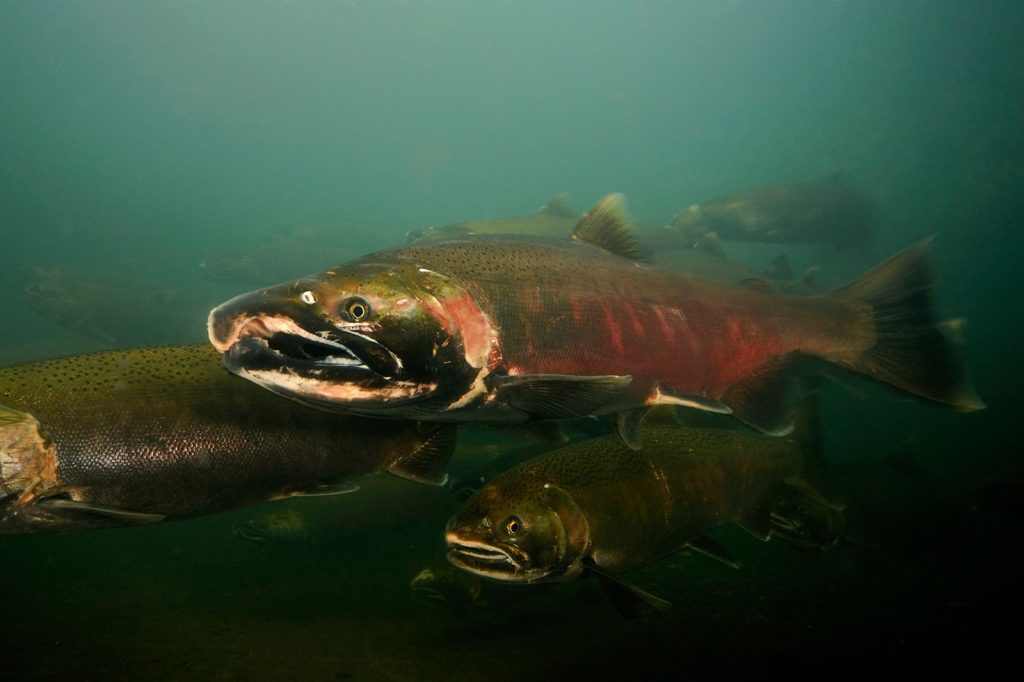
SEATTLE — Every fall, more than half the coho salmon returning to Puget Sound’s urban streams died before they could spawn. In some streams, all of them died. For years, no one knew why.
Then came a paper in Science, published December 3, 2020. A team from the University of Washington Tacoma’s Center for Urban Waters, Washington State University, and half a dozen other institutions had isolated the killer: 6PPD-quinone, a transformation product of a tire preservative used since 1960.
“When large numbers of coho salmon heading upstream to spawn started becoming disoriented, swimming on their sides, gasping, and dying in urban waterways before they could lay their eggs, no one knew why,” the Washington Department of Fish and Wildlife states on its website. Stormwater runoff was the vector. The chemical was lethal at low concentrations.
The calculus changed overnight. 6PPD prevents rubber from cracking. Every tire on the road sheds particles thinner than a human hair. Rain washes them into streams just as coho return. Concentrations after heavy storms exceed toxicity thresholds for coho. Steelhead and Chinook face medium and medium-low risk. Sockeye, low.
The findings drew international attention. The Seattle Times, The New York Times, The Guardian, Der Tagespiegel in Germany.
Detectable levels of 6PPD-q have since turned up in mussels, juvenile Chinook, English sole. The department’s Toxics Biological Observation System team is now partnering with NOAA’s Northwest Fisheries Science Center to develop monitoring methods for indicator species.
Human health impacts from consuming contaminated fish and shellfish at observed concentrations are currently unknown.
The broader stakes extend beyond salmon. 6PPD appears in footwear, artificial turf, synthetic playground surfaces. Manufacturers are investigating alternatives. None exists yet.
Washington’s Department of Ecology, state agencies, federal partners, local and tribal governments are working to reduce 6PPD-q pollution. The chemical had no regulatory standard, no monitoring program, no public profile before 2020.
What this signals: a transformation product hiding in plain sight for sixty years, identified only when the right analytical tools met an urgent ecological crisis. The coho were the sentinel. The human question remains open.
Sources
- 6PPD | Washington Department of Fish & Wildlife
- CUW Research Identifies Salmon Killer | News & Information | University of Washington Tacoma




