
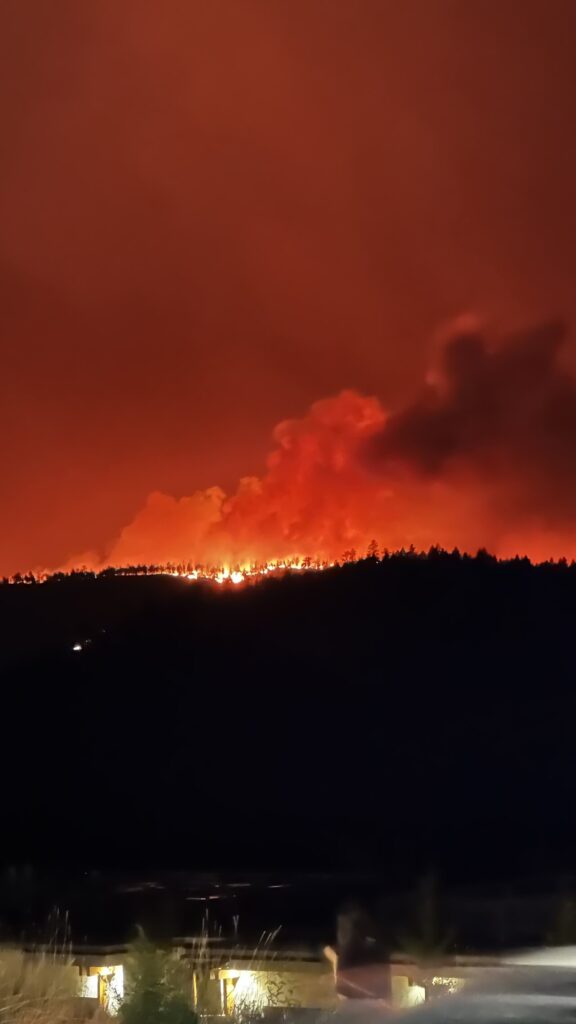
Premier David Eby announced a province-wide state of emergency on Friday, August 18, 2023, in response to the continuing threat posed by wildfires across British Columbia. The declaration gives the provincial government expanded authority to coordinate firefighting operations, mobilize additional resources, and enforce evacuation orders when necessary. According to Eby’s office, the measure was deemed essential to achieve a rapid and unified response to what officials describe as an increasingly volatile fire situation.
The state of emergency follows reports of multiple large blazes burning out of control, which have forced thousands of residents to leave their homes in areas such as the Okanagan and Shuswap regions. Firefighters are contending with extreme conditions, including hot, dry weather and shifting winds that have caused some fires to expand dramatically in size over recent days.
Although the province has already committed significant air support and ground crews, the scale of the fires has stretched available resources thin, prompting the need for the emergency declaration. Under the emergency order, the provincial government can restrict travel to fire‑affected zones, requisition property or equipment, and direct local authorities to prioritize firefighting efforts. This is not the first time British Columbia has invoked such powers during wildfire season; similar declarations were issued in 2017, 2018, and 2021 when large fires overwhelmed local capacity.
The current fires have already destroyed structures and disrupted transportation routes. Officials warn that conditions could deteriorate further if forecasts for sustained heat prove accurate.
For many communities, the blazes have revived memories of past disasters that reshaped local landscapes and economies. British Columbia has invested heavily in fire prevention and suppression infrastructure, including new detection technology and expanded fuel management programs. Environmental groups have long maintained that cleaner air and healthier forests are essential goals in their own right, independent of the broader climate debate.
They argue that preserving natural habitats and reducing the human toll of such disasters provides compelling justification for aggressive fire‑mitigation strategies. Renewable energy development has also emerged as a related priority for the province.
Officials frame it as a matter of energy security and long‑term cost savings, noting that British Columbia’s hydroelectric grid already supplies a substantial share of its power. Expanding solar and wind capacity could reduce reliance on imported energy and help stabilize electricity prices for residents. These renewable projects face challenges, including permitting delays and community opposition, but advocates contend they offer a practical pathway to lessen the risks associated with fossil‑fuel dependence. Looking ahead, the immediate focus remains on containing the fires and ensuring the safety of evacuees.
Emergency shelters have been established in several cities, and the province has urged residents to comply with evacuation orders without delay. Meteorologists anticipate some relief in the form of cooler temperatures early next week, although fire danger is expected to remain high until significant rainfall arrives.
The state of emergency will remain in effect for an initial period of 14 days, with the possibility of extension if conditions do not improve. For now, British Columbia’s fire crews and emergency managers are preparing for what could be a prolonged and exhausting battle against the flames.




