
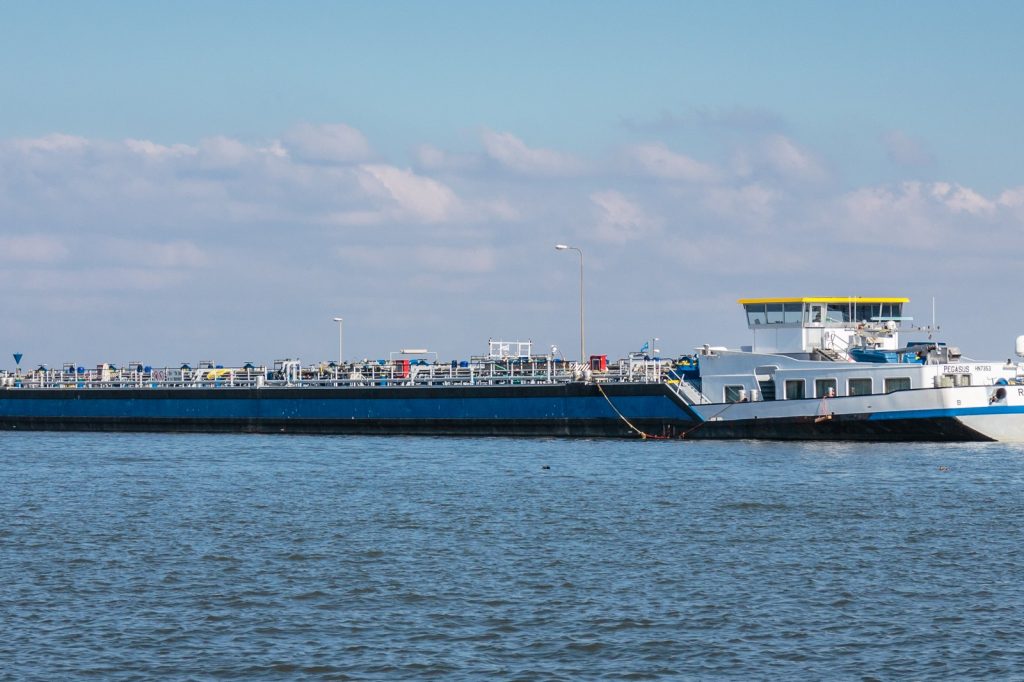
DUBAI, April 22 — The rumble of tanker engines idling in the Strait of Hormuz is the sound of a global economy holding its breath. By nightfall, the price of Brent crude had surged past $95 a barrel, a more than five percent leap that rippled through trading floors from London to Singapore. The trigger was a single announcement from President Trump: a 20 percent toll on all cargo transiting the world’s most vital oil chokepoint.
The previous close had been $90.20. The premium the market is now paying for passage through those narrow waters tells a stark story.
Analysts at Goldman Sachs are already sketching out a darker scenario, estimating that a prolonged disruption could push prices above $120 a barrel. On the ground, the immediate cost is clearer: the toll adds an estimated $5 to $7 per barrel to shipping costs for crude hauled out of the Persian Gulf.
The choke point
The Strait of Hormuz is a slender waterway, but its throughput is staggering. It handles roughly 21 million barrels per day of oil and petroleum products. To put that in perspective, global oil demand last year averaged 102 million barrels per day.
That means one in every five barrels the world burns passes through this strait. The U.S. Energy Information Administration reports that America itself imported about 1.5 million barrels per day from Persian Gulf states in 2023.
The mechanics of the toll are straightforward, but the consequences are not. The levy is not a sanction and not a blockade — it is a tax on transit. Ships that enter the strait must now pay a fifth of their cargo’s value to pass.
The American Automobile Association estimates that this will add between 15 and 25 cents to the price of every gallon of gasoline at U.S. pumps. For American drivers already watching prices climb, that is a direct hit to the household budget.
Market mechanics
Traders on the floor describe a session of raw tension. The jump was not a slow grind — it was a spike, a sudden repricing of risk. Brent crude, the global benchmark, is priced in dollars and traded in London, but its heartbeat is in the Persian Gulf.
Every tanker that loads at Ras Tanura or Kharg Island must eventually thread the needle of Hormuz. The toll now makes that passage the most expensive stretch of ocean on the planet.
The timing is critical. Global oil markets were already tight, with demand running near record levels and spare production capacity concentrated in a handful of OPEC states. The toll injects a new layer of cost and uncertainty into a system with very little margin for error.
Goldman Sachs’ warning of $120 oil is not a prediction — it is a calculation of what happens if the toll stays in place and shipping patterns are forced to adjust.
What to watch next
The immediate question is how tanker operators and their insurers respond. Some vessels may divert, but there is no practical alternative route for the volume of crude that moves through Hormuz. The strait connects the Persian Gulf to the Gulf of Oman and the open Indian Ocean; any detour would mean unloading onto pipelines that lack the capacity to absorb 21 million barrels a day.
That is not a workaround — it is a fantasy. By nightfall in the Gulf, the price was still climbing.
The toll is a lever, and the administration has pulled it. Now the market waits to see who blinks first: the tanker owners who must pay, the refineries that must buy, or the drivers who will ultimately foot the bill at the pump.
Sources
{“@context”: “https://schema.org”, “@type”: “NewsArticle”, “headline”: “Brent Crude Surges After Strait of Hormuz Toll Incident”, “description”: “DUBAI, April 22 — The rumble of tanker engines idling in the Strait of Hormuz is the sound of a global economy holding its breath….”, “datePublished”: “2026-07-13T09:30:00+00:00”, “author”: {“@type”: “Person”, “name”: “Isabella Moore”}, “publisher”: {“@type”: “Organization”, “name”: “InfoPulse Today”, “url”: “https://newsfeed.infopulsetoday.com/”}, “citation”: [{“@type”: “CreativeWork”, “url”: “https://en.wikipedia.org/wiki/Brent_Crude”}]}




