
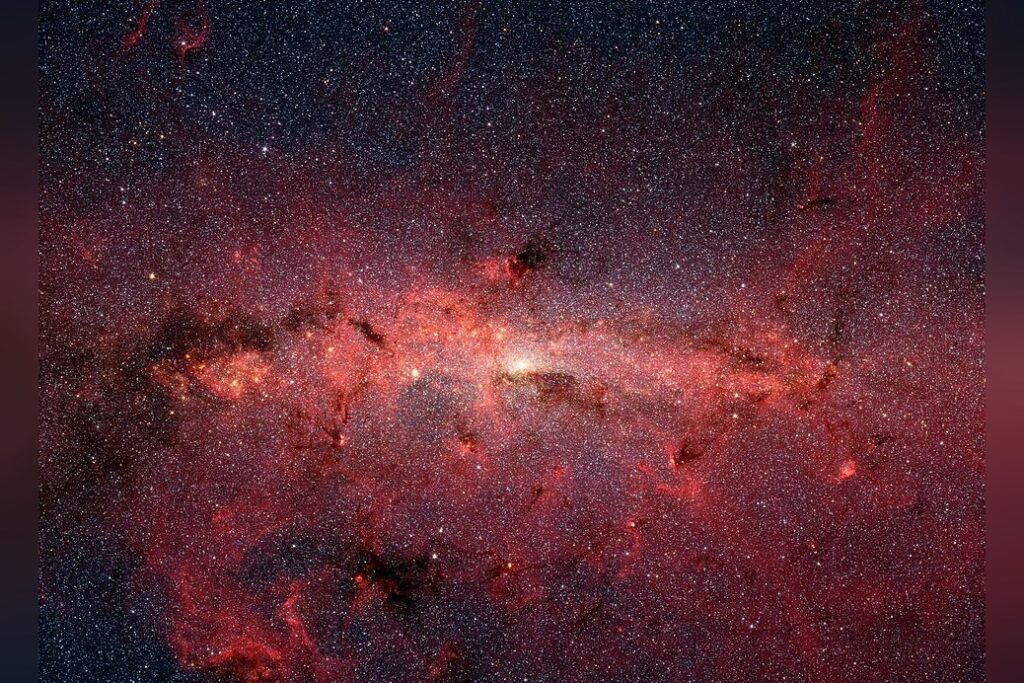
MANILA, July 13 — A vast cosmic laboratory more than 26,000 light-years from Earth is offering scientists a clearer window into the chemistry that might precede life. New observations of Sagittarius B2, a giant molecular cloud of gas and dust near the centre of the Milky Way, have confirmed the presence of glycolaldehyde, a simple sugar, within one of the galaxy’s most prolific star-forming regions. Sagittarius B2 is no ordinary cloud.
Spanning roughly 150 light-years across, it contains about 3 million solar masses of material. It is one of the largest and most active star-forming regions in the entire galaxy, a dense, warm environment where the formation of complex molecules is possible.
The detection of glycolaldehyde was made possible by the high resolution of the Atacama Large Millimeter/submillimeter Array, or ALMA, a powerful radio telescope array in Chile. ALMA’s precision allowed scientists to pinpoint exactly where the molecule sits within the cloud, a critical step in understanding how such compounds form in space.
A rich chemical stew
For communities of astrochemists and researchers across Asia and the world, Sagittarius B2 has long been a prime target. Over 50 different interstellar molecules have been detected there, including alcohols, acids, and complex organic compounds. The cloud’s rich chemistry makes it a natural laboratory for studying the building blocks of life far from Earth.
Glycolaldehyde is of particular interest. It is the simplest form of sugar, and its presence in a star-forming region suggests that the raw ingredients for life could be more common in the universe than previously thought.
For families across the region who follow space science, the finding points to a universe that may be chemically predisposed to the kind of complexity that leads to life. The discovery does not mean life exists in Sagittarius B2. But it does mean that the molecular steps toward life can happen in the cold, harsh environment of interstellar space, not just on planets.
What it means for science
ALMA’s ability to resolve specific molecules within a cloud as distant as Sagittarius B2 is a technological leap. Earlier telescopes could detect the presence of molecules, but not always their precise location. Now, researchers can trace where and how these compounds form, and how they might be delivered to young planetary systems.
For scientists in the Philippines and across Southeast Asia who collaborate in international radio astronomy projects, the work at Sagittarius B2 represents a step toward answering a fundamental question: how common are the chemical precursors to life? The cloud sits near the centre of the Milky Way, in the constellation Sagittarius.
Its sheer scale — 150 light-years across — means it will continue to be a focus for ALMA and other observatories for years to come. As more molecules are identified, the picture of a chemically rich universe will only grow sharper.
Sources
{“@context”: “https://schema.org”, “@type”: “NewsArticle”, “headline”: “Sagittarius B2 Cloud Confirms Simple Sugar 26,000 Light-Years Away”, “description”: “MANILA, July 13 — A vast cosmic laboratory more than 26,000 light-years from Earth is offering scientists a clearer window into the chemistry that might…”, “datePublished”: “2026-07-13T09:30:00+00:00”, “author”: {“@type”: “Person”, “name”: “Merry Gel Sigui”}, “publisher”: {“@type”: “Organization”, “name”: “InfoPulse Today”, “url”: “https://newsfeed.infopulsetoday.com/”}, “citation”: [{“@type”: “CreativeWork”, “url”: “https://en.wikipedia.org/wiki/Sagittarius_B2”}]}




