
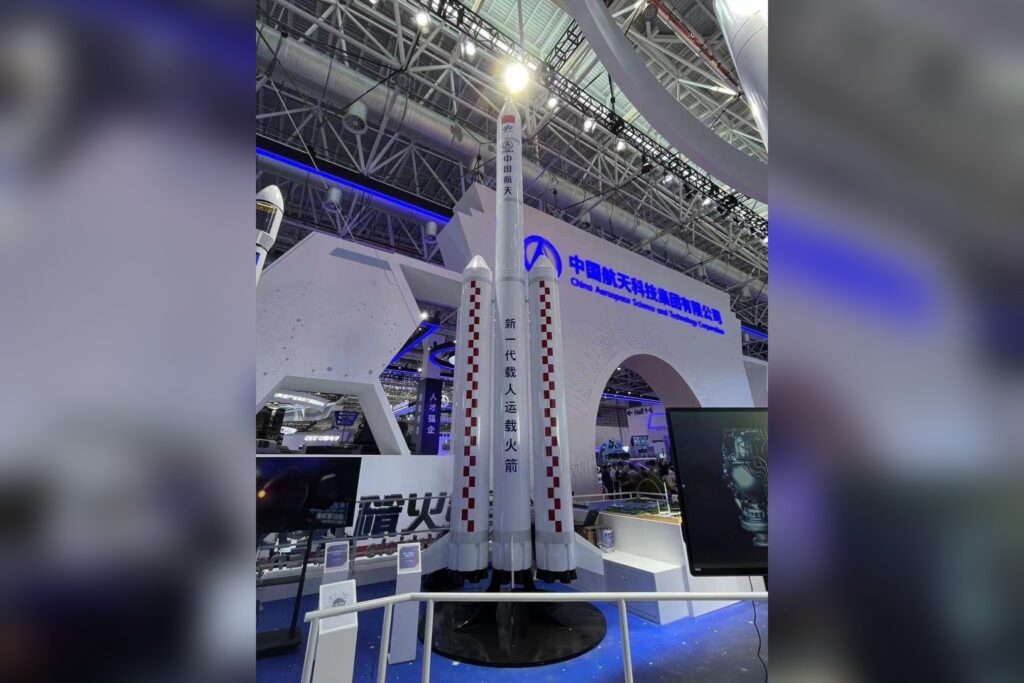
BEIJING, July 10 — Wang Wei, chief designer of the Long March 10 rocket family at the China Academy of Launch Vehicle Technology (CALT), has spent years overseeing the development of a reusable first stage for a vehicle central to Beijing’s lunar ambitions. Appointed to the role in 2020, Wang leads the design of the Long March 10’s first-stage recovery system, including the grid fins and landing legs developed for the Long March 10B variant.
The Long March 10 family is the rocket line China intends to use for its crewed lunar landing, a mission the country has targeted for 2030. Wang’s career in rocketry stretches back to the 1990s.
He contributed to the Long March 2F, the workhorse launcher that has carried the Shenzhou crewed spacecraft on every Chinese human spaceflight mission since 2003. That lineage, from human-rated launch vehicles to the new generation of reusable hardware, places him at the center of China’s push to lower launch costs.
From expendable to reusable
Wang holds a degree in aerospace engineering from Beihang University, formerly the Beijing University of Aeronautics and Astronautics. Over the course of his career, he has published more than 50 papers on rocket propulsion and reusability, according to CALT. His advocacy for cost reduction through reusability is explicit.
Wang has cited SpaceX’s achievements as a benchmark, according to the academy. The Falcon 9’s reusable first stage demonstrated that recovery and refurbishment can dramatically cut per-launch expenses — a lesson Wang has applied to the Long March 10B’s design.
The Long March 10B’s grid fins and landing legs are the most visible elements of that reusability strategy. Grid fins, essentially lattice-like control surfaces, steer the booster during atmospheric descent. The landing legs deploy just before touchdown, allowing the stage to set down vertically.
These components are not new in the industry — SpaceX has used them for a decade — but their integration into a Chinese crew-rated lunar rocket marks a significant technical milestone for CALT.
Lunar mission timeline
China has not yet announced a specific launch date for the first Long March 10 flight, but the 2030 lunar landing target imposes a tight development schedule. The rocket will need to complete a series of uncrewed test flights, including at least one reusability demonstration, before it can be certified for astronaut transport. Wang’s work is critical to that timeline.
The Long March 10 is designed to lift the next-generation crew spacecraft and a lunar landing stack, both of which are also under development. A reusable first stage, if proven reliable, could reduce the number of rockets needed for each mission and lower the overall program cost — a factor Wang has consistently emphasized.
The China Academy of Launch Vehicle Technology, a subsidiary of the state-owned China Aerospace Science and Technology Corporation, is the country’s primary designer of large launch vehicles. CALT also built the Long March 5, which launched the Chang’e-5 lunar sample-return mission in 2020 and the Tianwen-1 Mars orbiter and rover in 2021.
Industry context
Wang’s focus on reusability aligns with a broader shift in the Chinese space industry. Several commercial launch startups, including iSpace and Galactic Energy, are developing reusable stages of their own. State-owned CALT, however, retains the lead in large-scale crew-rated systems.
The Long March 10 family is expected to replace the Long March 2F for crewed missions to China’s Tiangong space station once it enters service. That transition would free up the older rocket for other roles and provide operational experience with reusable hardware before the lunar flights begin.
Wang has published extensively on the technical challenges of reusability, including thermal protection for boosters reentering the atmosphere at high velocity and the fatigue life of landing structures. His more than 50 papers cover propulsion cycles, stage separation dynamics, and landing gear design, according to CALT records.
What to watch next
The next major milestone for the Long March 10 program will be a full-duration static fire test of the first stage, likely at the Wenchang Space Launch Site on Hainan Island. CALT has not disclosed a date for that test, but industry observers expect it within the next 12 to 18 months. Wang’s team is also working on the avionics and guidance software needed to execute a propulsive landing — a task that requires precise throttle control of the YF-100K engines and real-time trajectory corrections.
A successful landing demonstration would be the strongest signal yet that China’s lunar timeline is on track.




