
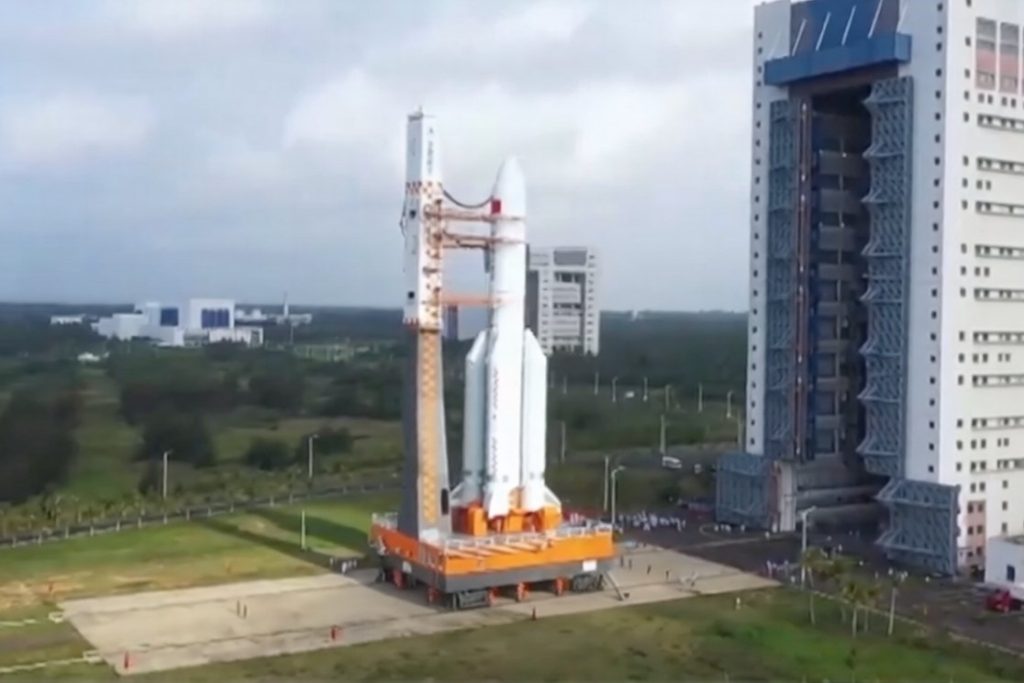
BEIJING, July 10 — China’s push into reusable rocket technology is no longer an experiment. The Long March 10B, the country’s first operational rocket designed for reusability, is now the centerpiece of a strategy that could reshape launch economics across Asia and beyond. For India and other regional space players watching Beijing’s moves, the stakes are clear.
China’s space budget, estimated at $11 billion annually, is the second-largest in the world after the United States. That spending is now being directed at a capability that has already transformed the global launch market: reusability.
The Chinese effort began in earnest around 2015, with early studies by the state-owned China Aerospace Science and Technology Corporation (CASC) and the China Academy of Launch Vehicle Technology (CALT). By 2018, a small-scale vertical takeoff and landing prototype had been tested. In 2020, CASC demonstrated a 10-kilometer altitude hop test with a test vehicle — a key milestone in proving the technology could work at scale.
Analysts note that the Long March 10B program is not an isolated project. It is part of a broader set of Chinese space ambitions that include a crewed lunar landing by 2030 and the development of the super-heavy Long March 9 rocket, which will also feature a reusable first stage.
For markets across Asia, this signals that China is committing to reusability across its entire launch vehicle family, not just in a single demonstrator. The economic logic is familiar to anyone who has watched SpaceX’s Falcon 9, which has flown over 300 successful landings since 2015. According to officials, China’s reusable rocket effort aims to reduce launch costs by up to 80% compared to expendable rockets.
That kind of cost reduction would directly affect the commercial launch market in Asia, where Indian, Japanese, and Chinese providers compete for satellite contracts.
Technology Pathway
The technical path China has taken mirrors elements of the Falcon 9 approach but with distinct Chinese characteristics. The vertical takeoff and vertical landing (VTVL) method tested in the 2018 prototype and the 2020 hop test has now been scaled up to the Long March 10B design. What matters for the region is that China has moved from paper studies to flight-proven hardware in roughly a decade.
The 2015 start date for serious work means the program has moved at a pace comparable to early private-sector efforts in the United States, but under a state-owned framework with different budget constraints and political drivers. For Indian launch providers, both the state-run Indian Space Research Organisation (ISRO) and emerging private players, the Chinese progress puts pressure on their own reusable vehicle programs.
ISRO has been developing its Reusable Launch Vehicle (RLV) technology demonstrator, with glide tests and landing experiments, but has not yet flown a reusable orbital-class rocket.
Market Implications
The cost reduction target of up to 80% is the number that commercial satellite operators across Asia are watching most closely. If China achieves that level of savings, it would undercut current launch prices from all competitors in the region. The Long March 10B is still in development, and officials have not announced a firm first launch date.
But the program is now an operational priority, backed by China’s $11 billion annual space budget and tied directly to the country’s lunar landing timeline. What to watch next: how quickly China moves from testing to regular commercial operations with the Long March 10B, and whether the super-heavy Long March 9, with its own reusable first stage, follows on schedule.
For India and the rest of Asia, the window to match these capabilities is narrowing.
{“@context”: “https://schema.org”, “@type”: “NewsArticle”, “headline”: “China’s Reusable Rocket Program: History and Development Path”, “description”: “BEIJING, July 10 — China’s push into reusable rocket technology is no longer an experiment. The Long March 10B, the country’s first operational rocket designed…”, “datePublished”: “2026-07-10T09:30:00+00:00”, “author”: {“@type”: “Person”, “name”: “Arjun Mehta”}, “publisher”: {“@type”: “Organization”, “name”: “InfoPulse Today”, “url”: “https://newsfeed.infopulsetoday.com/”}}




