
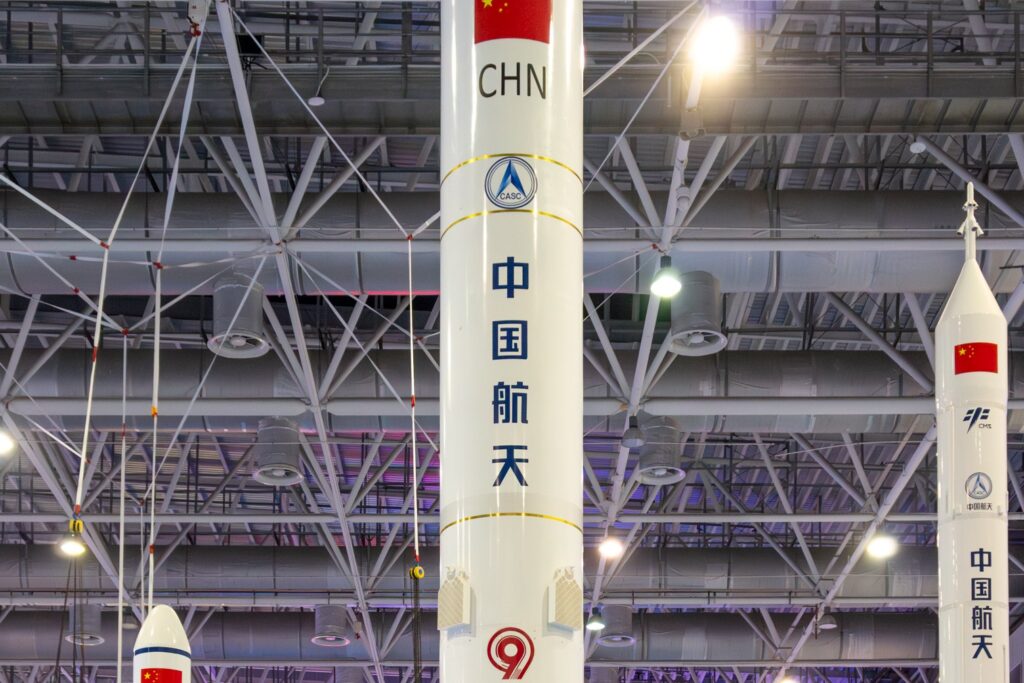
For more than half a century, the Long March rocket family has been the backbone of China’s access to space, evolving from Cold War-era ballistic missile derivatives into a diverse lineup of launch vehicles. Now, that legacy is poised to reshape the global commercial launch industry. China is accelerating its development of reusable rocket technology, a move that could introduce downward pricing pressure in a market long defined by SpaceX’s cost advantages.
The stakes are particularly high for smaller launch providers worldwide, as China’s state-backed push toward reusability threatens to upend the existing competitive order.
A Growing Challenge to Market Dominance
The global commercial launch market was valued at $12.4 billion in 2023, with SpaceX holding a commanding 45% share. Arianespace followed at 12%, United Launch Alliance at 10%, and Russia’s Roscosmos at 8%.
Chinese entities — the state-owned China Aerospace Science and Technology Corporation (CASC) and its commercial spinoffs LandSpace and Galactic Energy — collectively accounted for a combined 6% share that year, relying primarily on expendable rockets. But the key shift lies ahead. According to industry estimates, the reusable Long March 10B could offer launch prices as low as $2,000 per kilogram, undercutting SpaceX’s Falcon 9 price of $2,500 per kilogram.
That $500-per-kilogram differential represents a concrete challenge, especially for smaller providers in the light-to-medium lift segment who lack the pricing flexibility of larger competitors. China has already built a track record of serving international clients.
In 2023, it launched over 200 satellites, including payloads for Argentina’s Satellogic and Ethiopia’s ETRSS-1. These missions demonstrate Beijing’s willingness to serve foreign customers, a factor that could support future bids for commercial contracts as reusable vehicles come online. For Arianespace and United Launch Alliance, a Chinese reusable vehicle offering prices below Falcon 9 rates would add further pressure to Western providers already struggling to match SpaceX’s cost structure.
SpaceX itself, with its established Falcon 9 manifest and internal demand from Starlink, retains more pricing flexibility than newer entrants.
State Backing Fuels Reusable Ambitions
The Chinese government has invested $5 billion in reusable rocket technology since 2018, according to CASC. This level of state backing provides a financial runway that few commercial competitors can match.
The Long March family, operated by CASC, began with the launch of China’s first satellite in the spring of 1970, making the country the fifth nation to independently reach space. Early vehicles derived from Cold War ballistic missiles, but the family expanded over decades into a diverse lineup spanning light to heavy lift, performing hundreds of missions to low Earth orbit, geostationary transfer orbit, the Moon, and Mars. The rockets are named after the Chinese Red Army’s Long March military retreat from the 1930s.
The fleet includes human-rated versions for the Shenzhou crewed spacecraft and the powerful Long March 5 for deep-space probes. Older Long March rockets use hypergolic propellants; newer models burn liquid oxygen with hydrogen or kerosene.
The Long March 10, currently in development, is designed for crewed lunar missions. The commercial side of Long March launches has a complicated history. In the 1990s, China launched U.S.-built communications satellites, but a pair of failures led to controversy and a subsequent ban on such launches under American arms-traffic rules.
Since then, China has focused on launching its own government satellites and, more recently, commercial payloads for international customers. That track record, while modest, has slowly built a base of foreign clients, even as China’s overall share of the global launch market remained small relative to dominant players.
Market Implications and What Comes Next
Analysts at Euroconsult project that the reusable launch market will grow to $35 billion annually by 2030, with China aiming to capture 20% of that market. If achieved, that would represent a significant expansion from the combined 6% share Chinese entities held in the broader launch market in 2023.
The $12.4 billion baseline from 2023 suggests the market could nearly triple in seven years, assuming demand responds to lower prices as expected. Most Long March rockets built to date are expendable — used once and discarded. Reusable rocket technology, which allows a booster to land and fly again, has dramatically lowered launch costs for the leading private company in the field. If China can field a reusable Long March vehicle, it could challenge the pricing structure that has defined the commercial launch industry for years.
What remains to be seen is how quickly China can move from testing to operational reusable launches, and whether Western customers will accept Chinese launch services given geopolitical considerations. For smaller launch providers worldwide, the shift may pose a direct competitive threat.
For now, the numbers suggest a market in transition, with the established order facing its most credible challenge in years.




