
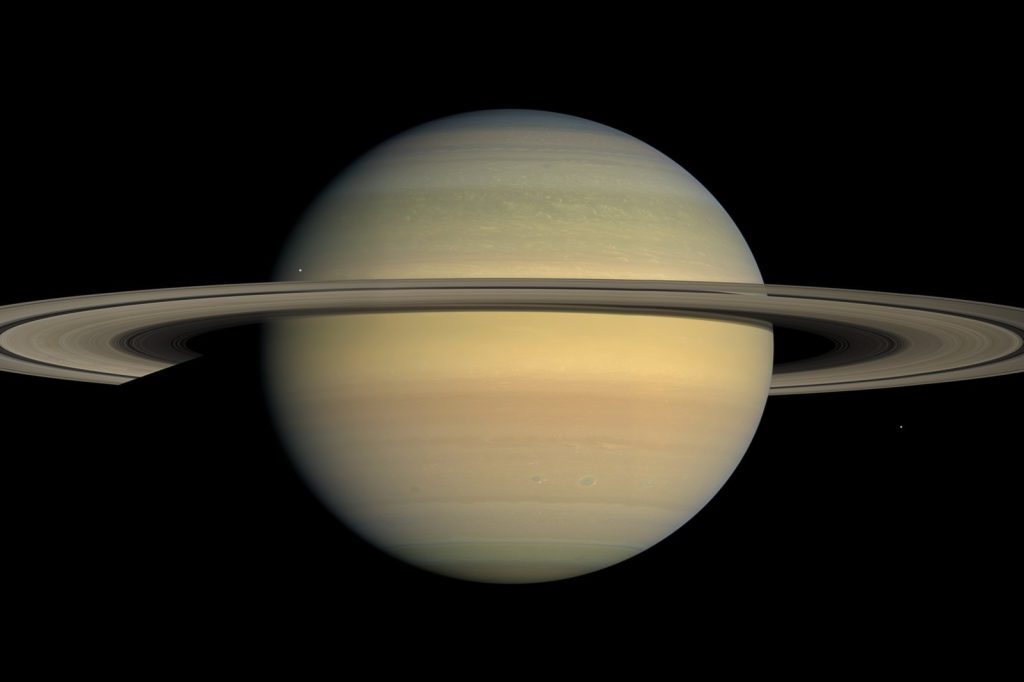
Years after its fiery demise in Saturn’s atmosphere in 2017, the Cassini spacecraft continues to reshape planetary science. The latest analysis of data from its final orbits has upended long-held theories about the nature of Saturn’s winds. Rather than being shallow atmospheric phenomena, the planet’s powerful jet streams extend thousands of kilometers into its interior, according to findings derived from the Cassini-Huygens mission.
The key to this discovery lay in gravity measurements. During its terminal phase, Cassini made extremely close passes to Saturn, allowing its instruments to detect minuscule fluctuations in the planet’s gravitational field.
These variations revealed mass movements deep beneath the visible cloud layers. The winds themselves, scientists determined, are shifting mass on a planetary scale, creating a detectable gravitational wobble that betrayed their depth. The data shows that equatorial winds on Saturn may plunge approximately 10,000 kilometers downward—a distance comparable to the span between New York and Tokyo.
While high-latitude winds are shallower, they still extend to immense depths. In some regions below the visible cloud tops, wind speeds actually increase compared to those at the observable surface.
Saturn lacks a solid surface; its dense interior, combined with intense internal heat and rapid rotation, creates a planet-wide engine of continuous motion. This finding has implications far beyond Saturn. Jupiter exhibits similar banded patterns, and many distant exoplanets classified as gas giants likely operate under the same physical principles. If weather on these worlds is not a thin surface layer but a deep, integral component of the planet itself, then current models of planetary atmospheres require fundamental revision.
The weather is not merely skin-deep—it is a core structural feature. The Cassini-Huygens mission, a collaboration between NASA, the European Space Agency, and the Italian Space Agency, launched in 1997 and reached Saturn in 2004.
Over more than a decade in orbit, it dropped a probe to Titan, flew through Enceladus’s geysers, and ultimately executed final dives so close to Saturn that the spacecraft’s antenna served as a drag brake. These terminal orbits were specifically designed for gravity science, and the gamble has paid off handsomely. The discovery opens new research pathways.
Scientists now aim to understand the complex dynamics at work on Saturn and how they compare with other gas giants in the solar system. The same gravity-mapping technique could be applied to Jupiter, where the Juno spacecraft is already gathering data.
For now, the conclusion is clear: Saturn’s winds are not a weather event. They are a structural feature. The planet’s atmosphere and interior are not separate systems—they are a single machine, operating at depths of thousands of kilometers.




