
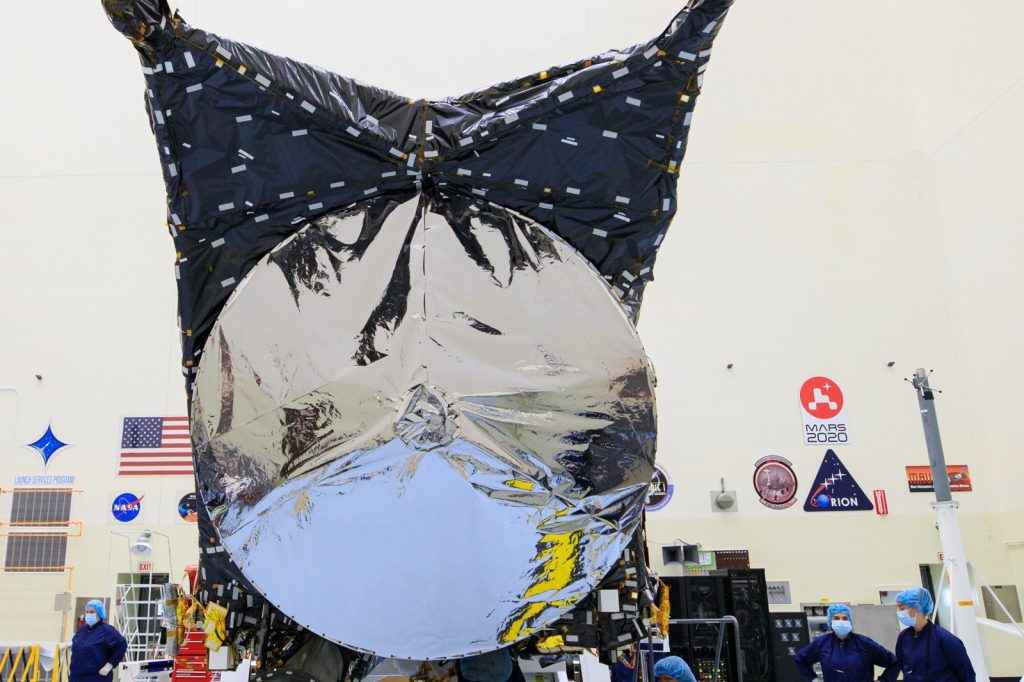
NASA’s Psyche spacecraft has successfully completed a high-stakes “dress rehearsal” after passing within 4,609 kilometers of Mars on May 15. While the probe’s ultimate destination is the metal-rich asteroid 16 Psyche, this encounter with the red planet served as a vital engineering test to ensure the mission’s success before it reaches its target in 2029.
The flyby allowed the mission team to stress-test and calibrate the onboard science instruments. Because 16 Psyche is located 3.6 billion kilometers from Earth, there is no opportunity to repair hardware once the probe arrives. The successful operation of the cameras and the steady flow of data confirmed that the instruments are healthy and capable of handling the light conditions they will encounter at the asteroid.
As a bonus, the probe captured a crescent view of Mars, showing sunlight scattering through high-altitude dust. Beyond instrument calibration, the maneuver demonstrated the spacecraft’s ability to execute a precision flyby without human intervention.
The mission required extreme accuracy; a deviation of just a few kilometers could have ruined the trajectory. Despite the proximity to the planet, which brought the risk of atmospheric drag, the spacecraft navigated the path successfully. This gravitational slingshot provided a speed boost of approximately 1,600 kilometers per hour without the consumption of fuel, nudging the probe onto a more direct course toward the main asteroid belt. The scientific stakes for the mission are significant.
Researchers believe 16 Psyche is the exposed metallic core of a failed early planet. Because Earth’s own iron core is unreachable—buried under thousands of kilometers of crust and mantle—the asteroid serves as a proxy for studying the interior of our own planet.
If the spacecraft’s instruments had failed, this unique opportunity to study an exposed core would have vanished. The risk of failure would have meant a decade of travel and billions of dollars spent for a mission that delivered a non-functioning probe to its destination. Since there is no backup spacecraft or replacement parts, the Mars flyby was the only chance to verify that the navigation can steer and the instruments can measure before the final arrival.
With the most difficult part of the journey—threading a needle at interplanetary speeds—now complete, the mission team has confirmed the probe’s health. The spacecraft has proven it can handle the rigorous demands of deep space.
While years of travel remain, the flyby has verified that the cameras can see and the navigation is precise. The probe is now on its way to the asteroid, leaving the team to wait for its arrival in 2029.




