
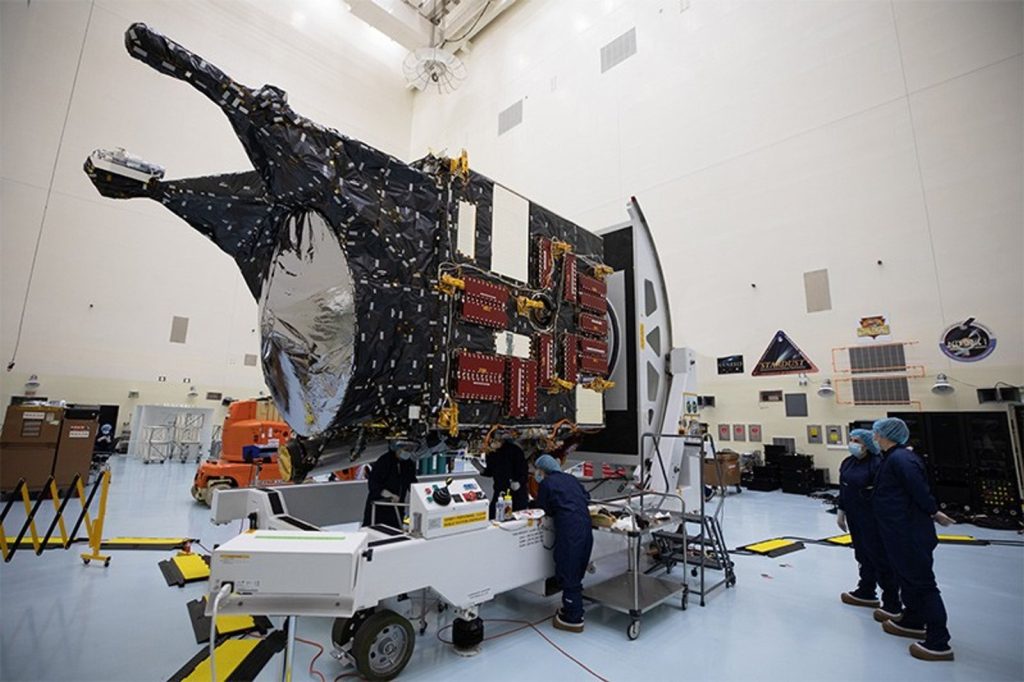
On 15 May, the Psyche probe, launched by NASA in 2023, passed within roughly 4,609 km of Mars. The close encounter added about 1,600 km per hour to the spacecraft’s speed without the use of additional propellant, relying solely on the planet’s gravity.
This increase is essential for the probe to stay on course for its primary target, the metal‑rich asteroid 16 Psyche, where it is slated to arrive in 2029. The mission’s timeline leaves little margin for error. A mis‑aligned flyby would have required a trajectory correction that would consume valuable fuel reserved for later phases, including orbital insertion around the asteroid and the execution of scientific operations. Because the Mars assist was the final planetary gravity assist on Psyche’s itinerary, the spacecraft now follows a largely uninterrupted trajectory through the main asteroid belt.
Beyond the navigation benefit, the Mars pass served as a comprehensive systems check. All of Psyche’s scientific payloads were powered on, and the cameras captured calibration images.
Engineers used the real‑space environment to verify that each instrument functions as expected, a step that cannot be fully replicated in laboratory simulations. The data gathered from this rehearsal will be used to fine‑tune observations of 16 Psyche, ensuring that every pixel returned from the asteroid is accurately interpreted. Among the images returned, Mars appeared as a slender crescent, illuminated by sunlight scattering off high‑altitude dust in its thin atmosphere.
While visually striking, these frames also provide valuable calibration references for the probe’s imaging system. The scientific payoff of reaching 16 Psyche is significant.
Researchers believe the asteroid is the exposed iron core of a protoplanet that never fully formed, offering a rare opportunity to study planetary core material directly. Unlike Earth’s core, which lies thousands of kilometres beneath the surface and is inaccessible to drilling, the metallic heart of Psyche can be examined up close, potentially shedding light on the early processes of planetary formation. Despite the successful flyby, the mission still faces challenges over the next four years of travel.
The spacecraft must endure prolonged exposure to radiation, micrometeoroid impacts, and the gradual wear of its components. Continued performance of the instruments and propulsion system is critical to maintain the planned arrival window and to carry out the planned science campaign around the asteroid.
NASA’s mission team now has confidence that Psyche can meet its objectives, having demonstrated both the required velocity boost and the operational readiness of its scientific suite. The probe’s trajectory is on target, the fuel budget remains intact, and the instruments have passed their deep‑space rehearsal. As the spacecraft coasts toward the asteroid belt, the agency’s engineers and scientists will continue monitoring system health, ready to address any anomalies that may arise.
The ultimate test—arriving at 16 Psyche and conducting detailed investigations of its metallic composition—remains four years away, but the successful Mars flyby marks a pivotal milestone on the path to that historic encounter.




