
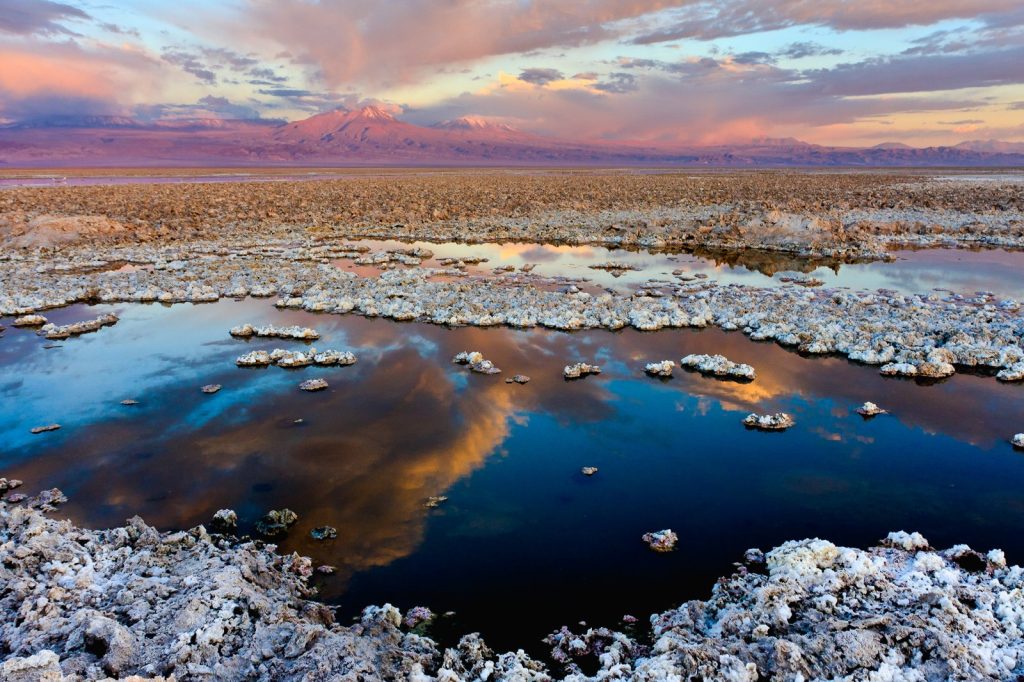
Chile sits on the biggest known lithium deposits on Earth. It is the second-largest producer of the metal. But that position is slipping.
By 2030, analysts say, Chile will be overtaken by Argentina and China. Its share of global production could fall to roughly eight percent.
The country that once led the lithium rush is watching its lead evaporate — much like the briny water in its own extraction ponds. The math is stark. Chile’s lithium comes almost entirely from one place: the Salar de Atacama, a vast salt flat in the Atacama Desert.
It is a unique geography. Unlike Australia, which crushes hard rock to get lithium, Chile pumps brine from beneath the salt crust and lets the sun do the work.
Water evaporates over months. Lithium concentrates. The process is cheap — some of the cheapest in the world.
But it is slow. It is tied to a single, fragile ecosystem. And it is not scaling fast enough.
Industry analyst Gustavo Lagos has laid out the trajectory. By 2030, Chile’s slice of the global lithium pie shrinks to eight percent.
That is a dramatic fall for a country that, until 2012, was the world’s top producer. Australia overtook it that year. Now Argentina and China are poised to do the same.
The question is not whether Chile will lose ground. It is how much ground, and what that means for a mining industry that has long been a pillar of the national economy.
The stakes are concrete. Lithium is the backbone of the global battery boom. Electric vehicles, grid storage, consumer electronics — all of it runs on lithium.
Demand is soaring. Prices have been volatile, but the long-term trend is up. Countries that lock in production capacity now will be the ones supplying the energy transition for decades.
Chile, with its cheap brine and massive reserves, should be a natural winner. But the numbers suggest otherwise.
The bottleneck is not geology. Chile has two major lithium-bearing salt flats: Salar de Atacama and Salar de Maricunga. Only the first is in production.
The second sits idle. That is a strategic choice, or a failure of policy — depending on who you ask.
New projects require permits, water rights, community agreements, environmental reviews. The process is slow. Meanwhile, Argentina is opening new brine operations.
China is expanding its hard-rock mines and its own brine projects. They are moving faster. Chile’s method has advantages.
Evaporation is energy-efficient. It produces low-cost lithium.
But it is also inflexible. A brine pond takes years to yield product. You cannot ramp up quickly when prices spike.
And the Salar de Atacama sits in one of the driest places on Earth. Water use is a flashpoint.
Indigenous communities have protested. Environmental groups have raised alarms. The industry cannot simply expand without consequence.
The risk is that Chile gets stuck. It has the resource. It has the know-how.
But if it cannot bring new capacity online — if Salar de Maricunga remains undeveloped, if permitting stays slow, if community opposition hardens — then the world will buy its lithium elsewhere. Argentina is already courting investors.
China is building refineries. The market does not wait. Eight percent by 2030.
That is the projection. It is not a forecast of failure.
It is a warning. Chile could still adapt. It could streamline approvals.
It could invest in direct extraction technologies that use less water and produce faster. It could negotiate new deals with Indigenous groups. But none of that is guaranteed.
What is guaranteed is that the lithium will be mined somewhere. The question is whether Chile will be the one mining it.




