
“We will spare no effort to strive for the goal of achieving the first Chinese landing on the moon by 2030.” Zhang Jingbo, spokesman for the China Manned Space Agency, said that on May 23 at the Jiuquan Satellite Launch Center, before the Shenzhou-23 crew left for the Tiangong space station.
He used the same event to announce a reshuffle. China is creating a single Lunar Exploration Program that folds its robotic Chang’e probes together with its human spaceflight effort. The two sides, Zhang said, will be integrated across “missions, resources, and teams.”
Two rockets, one landing
The plan splits the landing across two Long March 10 flights. One carries Mengzhou with the crew. The second carries the Lanyue lander. Both head for lunar orbit and dock there. Two astronauts move into Lanyue and go down to the surface, and the ascent stage brings them back to Mengzhou for the trip home. A three-member crew is planned, according to Ji Qiming, a spokesperson for the crewed program.
The profile resembles Apollo, with one difference that matters. Apollo sent its command module and lunar module up together on a single Saturn V. China launches them separately, which lowers the rocket requirement to 27 metric tons toward the Moon but gives the mission more things that must work. Two launches mean two chances for a failure to end it. And the docking happens 380,000 kilometers from Earth, where a problem cannot be talked through in real time.
What has flown so far
The hardware is far from finished. According to Orbital Intel, the Long March 10 has completed only a low-altitude test and has yet to reach orbit. Zhang pointed to those low-altitude demonstrations, and to maximum-dynamic-pressure escape and abort tests of the Mengzhou crew spacecraft. In his telling, they are paving the way for a reusable crewed transportation system.
Still to come, he said, are technical verification flights of the Long March-10 and the maiden flights of Mengzhou and Lanyue. Orbital Intel’s list of what stands between now and a crewed landing includes an uncrewed orbital flight of the rocket, an uncrewed Mengzhou flight to lunar orbit and back, and almost certainly an uncrewed landing rehearsal of Lanyue.
The space station is part of the preparation. “Our space station has been operating steadily in orbit for nearly four years now,” Zhang said, “and it has deployed and verified a number of key technologies needed for crewed lunar landing.” The Long March-10A rocket and the Mengzhou spacecraft that fly station missions share design and engineering with the lunar vehicles. Zhang said verification across several station flights over the next two years will raise “technical maturity and task reliability.”
Astronauts who have worked on the station are likely to supply the lunar crews, Ji said, though the detailed plan is still being developed.
The ground and the robots
Chinese officials have said all five pieces of hardware the crewed effort needs finished the main work of their prototype stage. The focus of 2026 moved to ground infrastructure at Wenchang: pads, tracking and telemetry, communications and a landing site. Orbital Intel noted that the date is a stated goal, not a schedule with public milestones, and officials have kept saying “before 2030.”
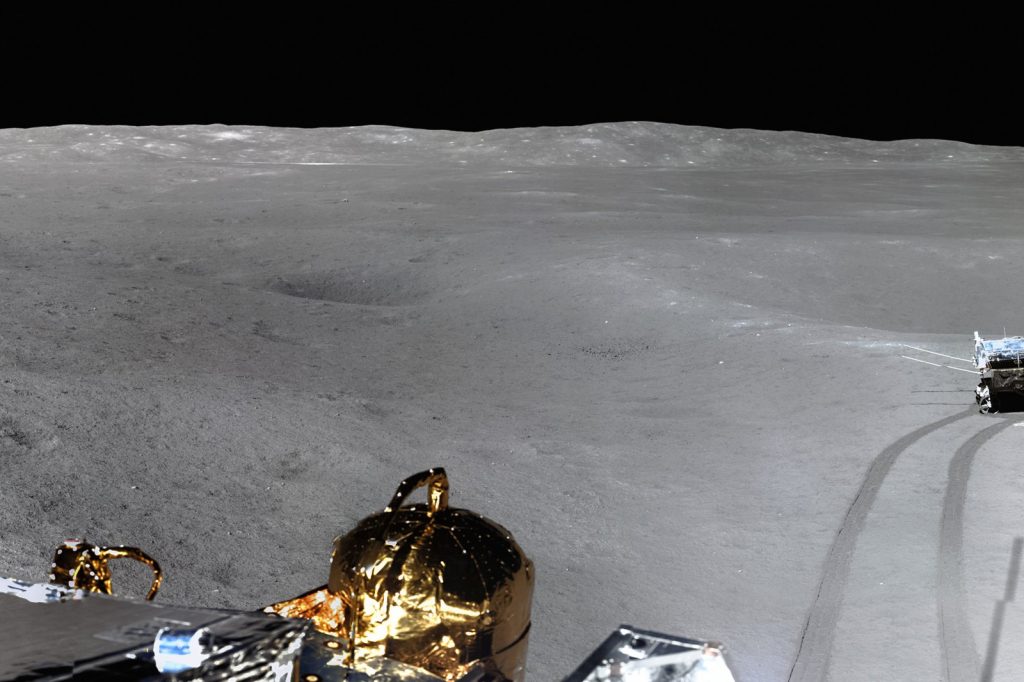
The robotic side keeps moving. The Chang’e-7 probe was shipped to Wenchang in April and is slated to launch in the second half of the year, reportedly in August. Zhang said it will orbit, land, rove and deploy a lunar hopper to study the environment and resources of the south pole, the region China has chosen for its landing.
Ice in permanently shadowed craters there can be split into breathable oxygen and rocket propellant. NASA’s Artemis program wants the same water, which leaves both countries aiming at the same few viable sites.
Sources
- China's Moon Landing: The 2030 Crewed Plan Explained
- China shakes up its space programs to land astronauts on the moon by 2030: 'We will spare no effort'




