
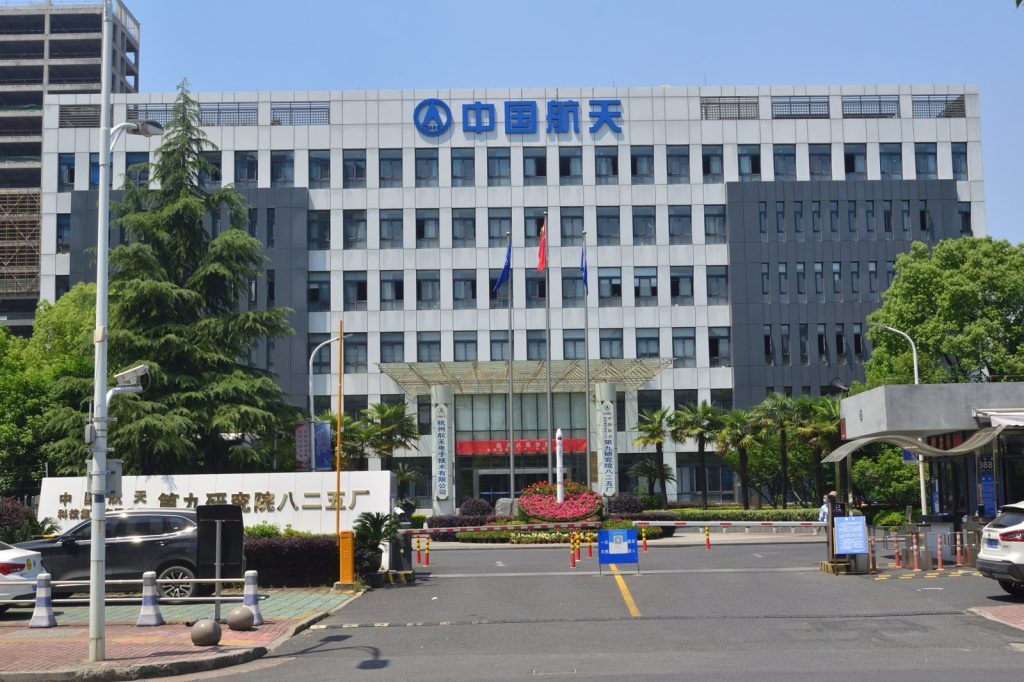
China’s primary state-owned space contractor, the China Aerospace Science and Technology Corporation (CASC), is pursuing reusable rocket technology as it faces mounting competition from both domestic private startups and established international launch providers. The giant enterprise, which builds the Long March rocket family, Shenzhou crewed spacecraft, Tiangong space station modules, and Chang’e lunar probes, has set a goal of conducting 50 launches per year by 2025, with reusable vehicles central to that ambition.
The State-Owned Giant
CASC was founded in 1999 as a state-owned enterprise after the Chinese government split the former China Aerospace Corporation into separate entities. It now employs more than 170,000 people and reported revenues of approximately 300 billion yuan, or about $42 billion, in 2023. The corporation operates under the supervision of the State-owned Assets Supervision and Administration Commission of the State Council.
Its rocket expertise resides largely with the First Academy, also known as the China Academy of Launch Vehicle Technology (CALT), based in Beijing. CALT has designed every rocket in the Long March family since the Long March 1 first flew in 1970.
For decades, CASC held a monopoly on China’s orbital launches, building the boosters that sent the Shenzhou spacecraft and Tiangong station modules into orbit. For international customers, CASC markets its launch services through a commercial arm, the China Great Wall Industry Corporation (CGWIC).
Reusable Ambitions and the Long March 10B
The Long March 10 family of launch vehicles is being developed for crewed lunar missions, flights to the Tiangong space station, and commercial launches. The standard version is a super heavy-lift rocket with a core stage and two boosters.
Medium-lift variants, designated Long March 10A and 10B, omit the boosters and are designed with a first stage that can be recovered and reused by landing vertically on a floating platform. The rocket family was first publicly revealed at an air show in 2018. The Long March 10B, a commercial variant, represents CASC’s attempt to adapt a design originally conceived for the country’s crewed lunar program into a vehicle that can capture a larger share of the global launch market.
The newer Long March 10B, which comes from CALT’s drawing boards, is designed for crewed lunar missions. While the Long March 10B’s design hints at a reusable architecture, the corporation has not yet publicly demonstrated a landing or recovery of a booster stage.
This shift from expendable to reusable hardware could reshape how China accesses orbit for years to come.
Race for Market Share
CASC’s pursuit of reusable launch capability positions it to compete not only with international providers such as SpaceX and United Launch Alliance, but also with a growing field of private Chinese launch companies. Domestic rivals like LandSpace and Galactic Energy have been developing their own rockets, chipping away at CASC’s traditional monopoly on Chinese orbital access.
Reusable launchers can lower the cost of each flight and increase launch frequency, making them attractive for commercial customers. The push toward reusable rockets matters now because it lets CASC compete with these emerging competitors as well as international providers. With private competitors moving fast and international players already flying reusable vehicles, the pressure is on China’s state champion to prove it can match the pace of innovation in the commercial sector. The question now is how quickly CASC can move from its current expendable rocket fleet to a reusable architecture capable of meeting its ambitious launch targets.




