
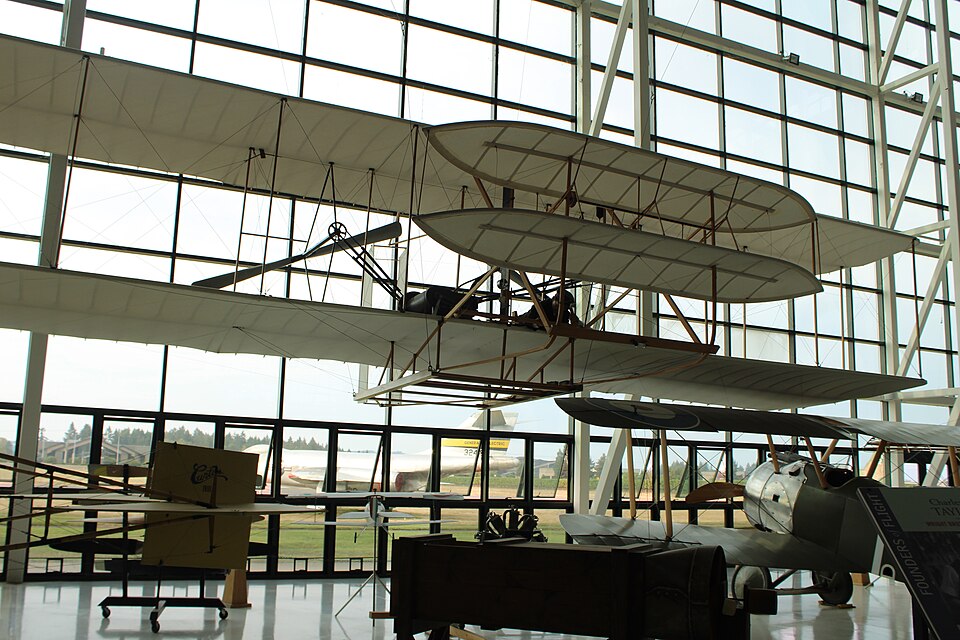
Closer to home, every airliner that lifts a family across Asia each morning began as 120 feet over North Carolina sand. On December 17, 1903, at 10:35 a.m., Orville Wright lay prone on the lower wing of a spindly powered machine, hips in a cradle that worked the wing-warping controls, while Wilbur ran alongside holding the right wing upright. Twelve seconds later the first powered, controlled, sustained flight in history was done. The photograph that recorded it exists because Orville had preset the camera and asked John T. Daniels to squeeze the rubber bulb.
The wish itself was old and shared by every culture that watched birds. Practical steps began with balloons: the Montgolfier brothers’ paper-and-fabric craft in 1783, hydrogen versions soon after, animals sent up before any human dared, a pattern that would repeat with space flight, and, by 1785, a balloon crossing of the English Channel. Winged flight lagged behind. Toy helicopters of the 1870s could climb many feet and stay aloft for nearly thirty seconds, teasing a generation of tinkerers toward machines that might carry a person. Among them were two Ohioans who had mastered printing presses and, later, the building and repair of bicycles.
By 1901, working in fields near Dayton and on the windier dunes of Kitty Hawk, the brothers had named the three problems precisely: wings that lift, an engine that drives the machine forward, and a steering system that controls it. Gliders flown in 1901 and 1902 let them perfect a rudder, and by late 1903 they bolted on a specially designed engine. The solution was a union of borrowed parts, glider wings and automobile-style power, joined by a wing design that captured the wind and a temperamental rudder steered by hand.
What it means for people was won in details Orville logged in his diary that morning. He opened with readings from the anemometer, wind being the key to the wings’ pull upward, and noted when “a strong gust from the left” pushed the machine off course. The first flight was also a wrestling match with the front rudder: the aircraft “would rise suddenly . . . and then as suddenly, on turning the rudder, dart for the ground.” A drop from exactly that problem ended the inaugural flight, though the machine “left the ways successfully at every trial,” avoiding even the tail damage the brothers had braced for.
The day closed with the machine’s death. While the Wrights and their observers talked over what they had achieved, a gust caught the parked aircraft, rolled it over repeatedly, heavily damaged it and nearly killed one of the men present. No matter: the proof was made. By 1908 the brothers were selling the airplane to commercial buyers and the US military alike, and defending their patents in court with equal vigor. Orville, born in 1871, kept a hand in aviation until his death in 1948.
For communities the distance since Kitty Hawk is measured in ordinary miracles: 120 feet has become routine routes that carry families across the region, mail, medicine and trade over oceans that once took weeks. The 12 seconds over the dunes were the first sentence of that story, photographed by a man who had never handled a camera before, for two brothers who fixed bicycles for a living. Every boarding call is its echo.
Sources
- [First flight, 120 feet in 12 seconds, 10:35 a.m.; Kitty Hawk, North Carolina] | Library of Congress
- Analysis: The Wright Brothers’ First Powered Flight | History | Research Starters | EBSCOhost




