
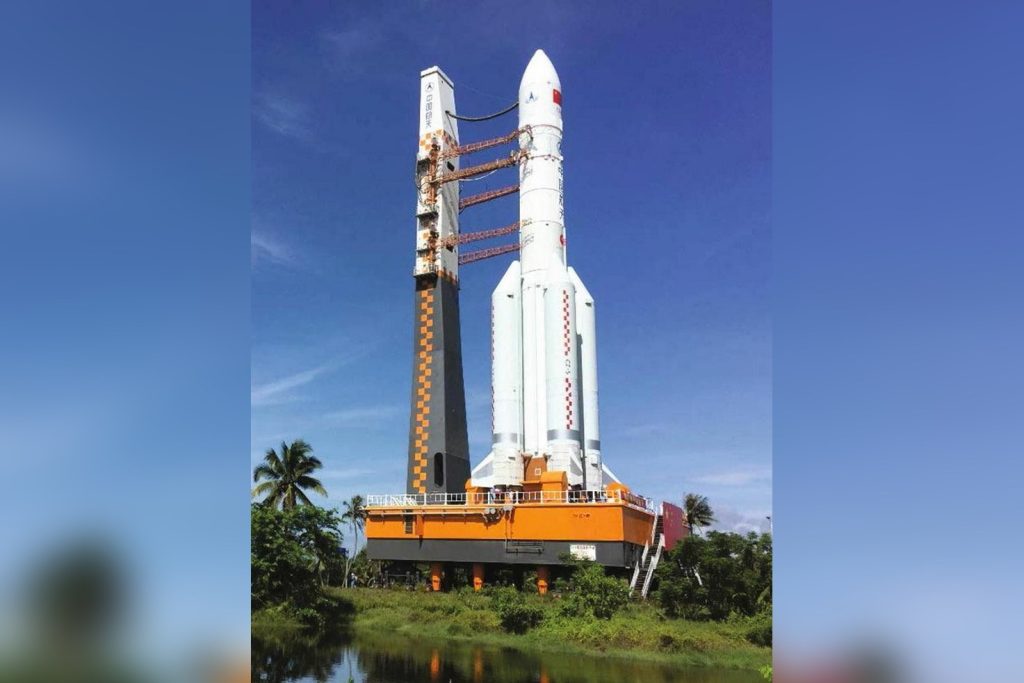
Eleven minutes after liftoff on July 10, 2026, a rocket stage dropped through the haze over the South China Sea, restarted its engines and settled onto a web of tensioned cables strung across the deck of a ship. The Long March 10B had lifted off at 04:15 UTC from Launch Complex 2 at the Hainan Commercial Space Launch Site. It was the first orbital-class booster ever caught in a net, and it made China the second country to bring one back under control.
The cargo hardly mattered. A ten-tonne test spacecraft, Chuangxin-26, went into an orbit near 810 kilometers at 50 degrees inclination. The rocket was the point.
A moon rocket in training
The 10B is the first stage of China’s crewed lunar launcher in single-core form, with seven YF-100K engines. On May 29, 2023, the China Manned Space Agency committed to landing two astronauts on the Moon before 2030, and named the Long March 10 as the vehicle for the job. The plan needs two launches. One rocket sends the Lanyue lander to low lunar orbit, a second sends the Mengzhou crew spacecraft to meet it, and after roughly six hours of work on the surface the ascent stage carries the crew back to Mengzhou.
The full Long March 10 stands 92.5 meters tall and weighs 2,189 tonnes, with 21 YF-100K engines across its core and two strap-on boosters. It has never flown in that form. Its debut is planned for 2027.
That is why the single-core flights matter. Each one tests the engines, the avionics and the ground crews that the lunar mission will rely on. The 10B also pairs its core with a methane-fueled second stage to offer 16 tonnes to low Earth orbit on the commercial market.
Fewer stages falling on villages
For half a century, the question after a Long March launch was where the spent stage would land. The older CZ-2, 3 and 4 rockets fly from inland sites at Xichang, Taiyuan and Jiuquan, and their stages come down on districts that receive evacuation notices beforehand. Videos of villagers filming toxic orange plumes from a fallen booster have become a familiar genre of Chinese spaceflight coverage.
A launch over water, with a controlled return and a catch at sea, changes that. A rocket rated to carry astronauts cannot rain stages on Guizhou, the space-tracking site KeepTrack argues, and a country planning more than 150 launches a year cannot keep emptying villages under every flight path.
Claims still to be proven
CASC says the net approach saves structural mass, supports up to ten flights per stage and allows turnarounds as short as ten days. The ten-day figure is a projection, and no recovered Long March stage has flown again. CASC says the stage caught on July 10 will refly before the end of 2026.
On a February 11 test, the core stage restarted twice and rehearsed the recovery hover. “This places extremely high demands on engine reliability, propellant management, and ignition timing control,” CASC’s Zhu Pingping said of the restarts.
One schedule slip has already appeared. With pad outfitting unfinished at the new Launch Complex 301 at Wenchang, the uncrewed Mengzhou-1 flight on the 10A has drifted from late 2026 toward early 2027. SpaceX, by comparison, needed five and a half years and 20 flights to recover its first Falcon 9 stage. China’s team caught theirs on the first launch.




