
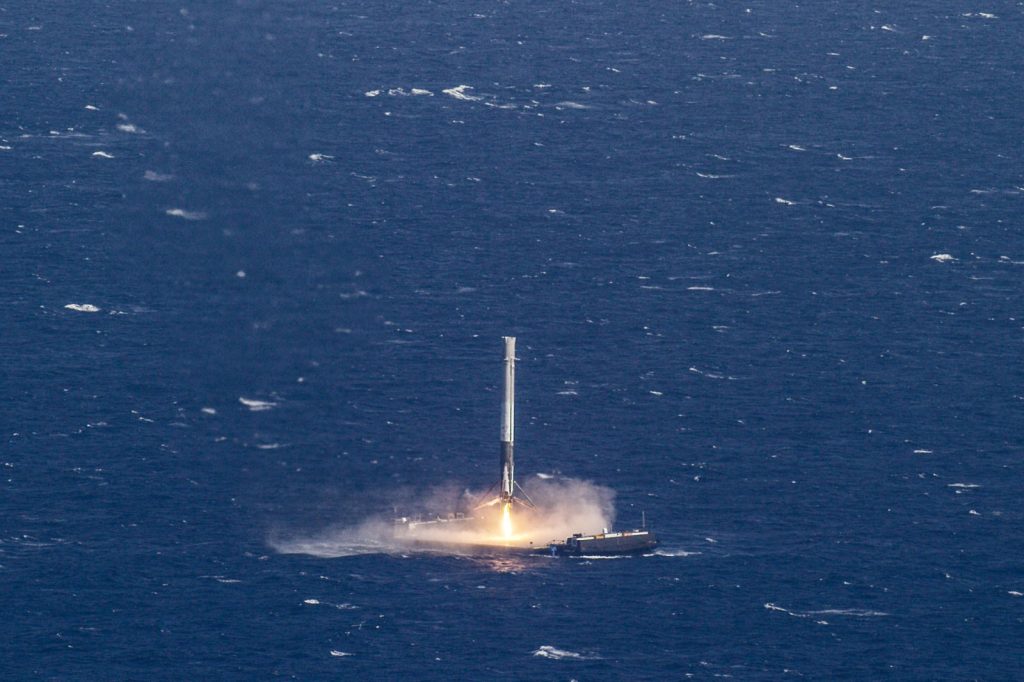
Picture a 63-metre rocket stage falling back toward the sea, one engine still burning, and a steel gantry on a ship waiting to catch it like a fielder under a high ball. That is what Chinese state television showed on Friday 10 July 2026, and it is why a comparison with SpaceX’s Falcon 9 is now unavoidable.
The Long March 10B flew for the first time that day from Hainan island. It left the Hainan Commercial Space Launch Site at 12:15pm Beijing time, which was 5:15am in the UK. Its upper stage took an undisclosed satellite to what state media called a “predetermined orbit”. Then came the part everyone remembers. About six minutes after the stages parted, the first stage came back down under power, righted itself and settled into a net of tensioned cables aboard a ship waiting in the South China Sea. Footage showed smoke streaming from the top of the stage as the net took its weight.
The China Aerospace Science and Technology Corporation (CASC), which builds the Long March family, called it “a historic breakthrough in the field of reusable rocket technology”. It described the method as “the world’s first network-based recovery of a launch vehicle”.
How it differs from Falcon 9
A Falcon 9 booster comes home on four fold-out legs, onto a pad or a drone ship. The Long March 10B has no legs at all. Near the top of the stage sit landing hooks instead, and the ship, called Linghang Zhe (“Navigator”), carries an open steel gantry strung with cables high above its deck. The booster makes the same kind of powered vertical descent, then lowers itself into the net until the hooks catch.
The reasoning is about weight. Legs are heavy, and each kilogram of them takes a kilogram off the payload the rocket could carry. Put the catching gear on the ship and the rocket gets lighter. SpaceX made a similar trade with its much larger Starship booster, which is caught by arms on the launch tower.
The rocket has two stages. The first burns kerosene and liquid oxygen; the second runs on methane and liquid oxygen. In its reusable configuration it can lift about 16 tonnes to low Earth orbit, roughly the Falcon 9 class with a recoverable booster.
Keeping it in proportion
The numbers on the American side are far larger. SpaceX has landed orbital boosters more than 600 times, and last week one of its Falcon 9 boosters flew for a record 36th time. Blue Origin landed its first booster in November 2025 and reflew a New Glenn booster in April. China has landed one rocket, once.
Still, nobody else managed it on a first flight. SpaceX crashed boosters into the ocean for years before its first landing in 2015, and Blue Origin lost its first New Glenn booster on the way down. China’s Long March 12A and Landspace’s Zhuque-3 both reached orbit last December, but both failed their landings.
The test that matters next
Catching a stage proves recovery. Reuse is the part that saves money, since the booster is the most expensive piece of any rocket. CASC says this stage will fly again before the end of 2026. If it does, China will have gone from no landings to a reflown booster in under six months. SpaceX took about fifteen months to do that, and Blue Origin about five.




