
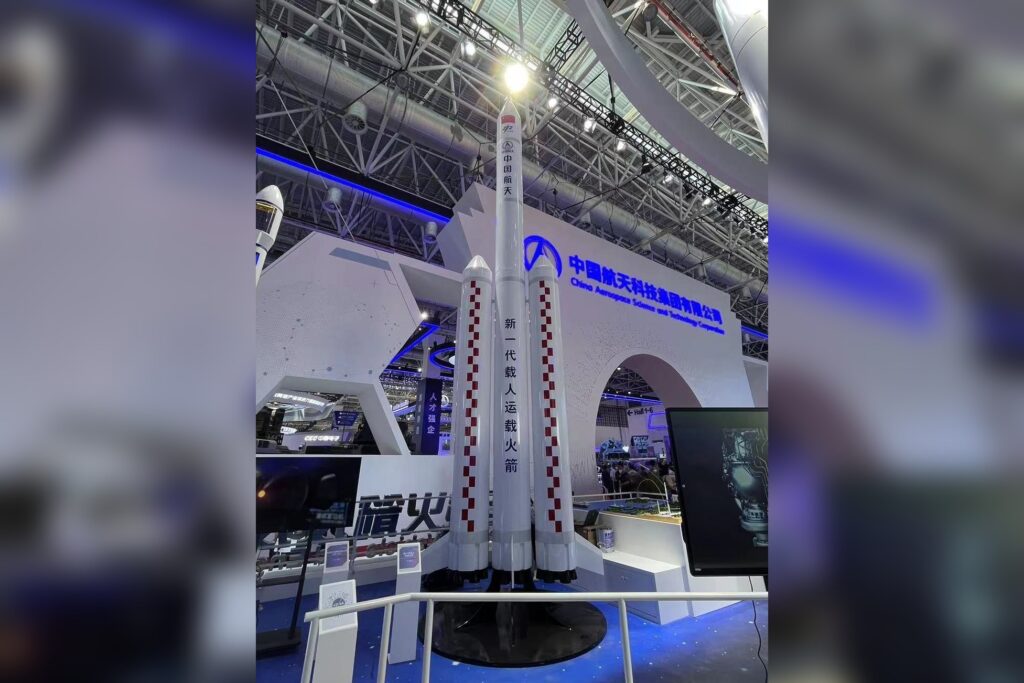
At 12:15 pm on Friday, seven engines lit under the Long March 10B and the 63.6-meter-tall rocket left a service tower at the Hainan International Commercial Aerospace Launch Center in Wenchang. Roughly six minutes after its two stages separated, the first stage dropped into a net of cables strung across a ship at sea. China Daily reported that it was the first time China had recovered the main body of a carrier rocket.
It was also the debut flight of the rocket. The report calls the catch the world’s first recovery of an orbital-class rocket using a wire arrestment system, a net made of pretensioned cables. The Long March 10B is now the nation’s first, and the world’s third, rocket to complete all the key steps of a full recovery profile: controlled return flight, vertical terminal descent and intact retrieval.
How the recovery worked
About two-and-a-half minutes after liftoff the vehicle reached the separation point, several kilometers above the Karman Line. A single liquid oxygen-methane engine on the second stage then pushed the payload toward orbit, and the upper stage later put a satellite into its preset orbit hundreds of kilometers above Earth.
The first stage kept climbing by inertia for a short time. Its grid fins unfolded and the reaction control system adjusted attitude before it began a controlled descent. Select engines reignited twice, and between those burns the booster relied on a calculated falling position to let air resistance bleed off speed.
A recovery ship named Linghangzhe waited hundreds of kilometers southeast of Wenchang, adjusting its position to line up with the incoming stage. At the center of the ship, rail-mounted sliders positioned the pretensioned cables automatically. In the final seconds all engines shut off and metal hooks on the stage engaged the cables. Auxiliary cables then deployed around the booster, and an automatic clamping platform moved underneath to lock and support it.
In the mission control room at the Wenchang commercial spaceport, designers, engineers and ground controllers cheered when cameras on support vessels picked up the booster. When the net held it, the report says, “they erupted into ecstasy.”
Specifications
The rocket was designed and built by the China Academy of Launch Vehicle Technology, a Beijing-based subsidiary of China Aerospace Science and Technology Corp. Fully fueled it weighs about 760 metric tons, has a diameter of 5 meters and produces a liftoff thrust of more than 890 tons. That makes it the second-most powerful launch vehicle in China, behind the Long March 5 at around 870 tons of liftoff weight and nearly 1,100 tons of thrust.
It can carry 16 tons to a typical low-Earth orbit at an altitude of 200 kilometers, or 11 tons to a 50-degree inclined orbit at 900 km.
Two other Chinese rockets, LandSpace’s ZQ 3 and the Shanghai Academy of Spaceflight Technology’s Long March 12A, had tried the same feat before and failed at the last moment. In February the Long March 10A flew its maiden flight from the Wenchang Space Launch Site, and its first stage returned for a controlled splashdown in the South China Sea as a deliberate technical trial.
What engineers and officials said
Chen Muye, a structural designer of the rocket, said this vehicle was built in Tianjin and shipped to Wenchang in February. The net, he said, “removed the need for complex landing legs, which helped reduce the rocket’s structural weight and, in turn, boosted its payload capacity and cost-effectiveness.” He added that the cable system tolerates deviations in landing position and can serve rockets of different sizes.
Wang Wei, a project manager of the Long March 10 series, said the flight verified core technologies including methane self-pressurization. The rocket will mainly deploy low-Earth orbit satellite constellations, and he said the recovered booster is expected to fly again before the end of this year. Wang Yanan, chief editor of Aerospace Knowledge magazine, said reusable rockets are seen as strategic assets, and that “it is virtually impossible for companies to use conventional expendable rockets to compete with those that have reusable products.”




