
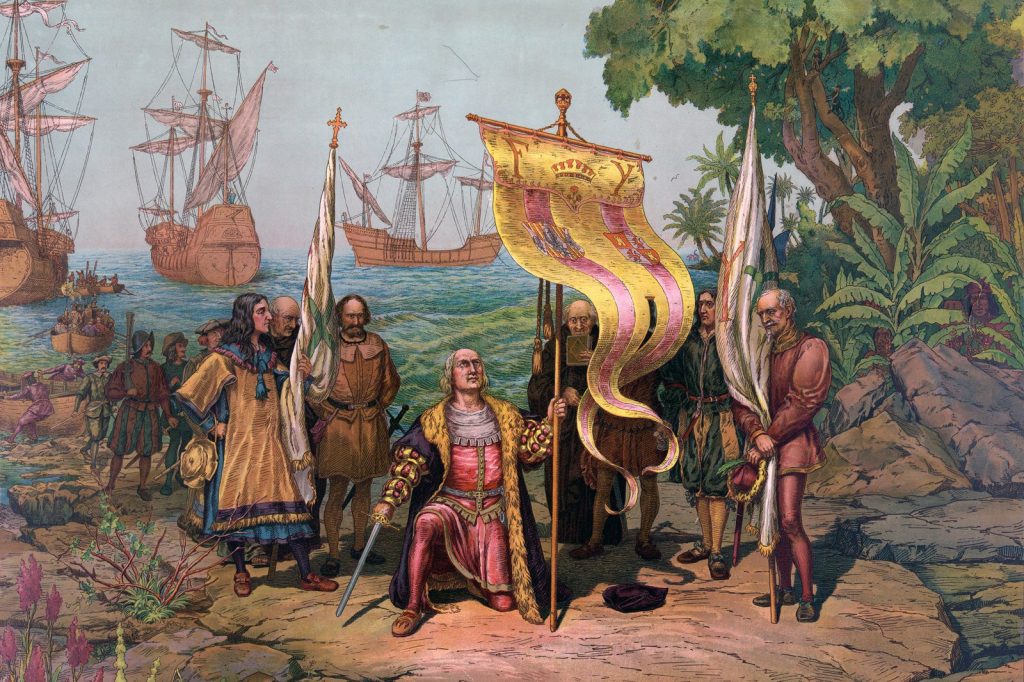
GENOA, July 13 — Against this backdrop of a city that once launched the man who changed the world, the legacy of Christopher Columbus remains as contested as it is consequential. The Italian explorer from Genoa, who sailed under the Spanish crown, completed four voyages across the Atlantic between 1492 and 1504, setting in motion events that would reshape two hemispheres. Columbus’s first voyage began on August 3, 1492, from Palos de la Frontera.
He commanded three ships — the Niña, the Pinta, and the Santa María — with a crew of about 90 men. On October 12, 1492, he reached the Bahamas, landing on an island he named San Salvador, likely in what is now the Bahamas.
From there, he explored Cuba and Hispaniola. The Santa María was wrecked off the coast of Hispaniola. Columbus left 39 men at a settlement he called La Navidad.
By the time he returned, all of them had been killed. He arrived back in Spain in March 1493.
His second voyage, from 1493 to 1496, established the first Spanish colony in the Americas at La Isabela, in what is today the Dominican Republic. The third voyage, from 1498 to 1500, took him to the coast of South America. His fourth and final expedition, from 1502 to 1504, explored the coast of Central America.
The man and his world
Columbus died in 1506, still convinced he had reached Asia. He never knew he had stumbled upon continents unknown to Europe. His voyages initiated widespread European exploration and colonization of the Americas, leading to what historians call the Columbian Exchange — the transatlantic transfer of plants, animals, culture, human populations, technology, and diseases.
What is at stake in the wider picture is the balance between acknowledging Columbus’s role as a pathfinder and confronting the consequences of his arrival. The source material notes that his voyages led to the exploitation and enslavement of indigenous peoples.
In the corridors of modern diplomacy and historical debate, Columbus Day remains observed in the United States on the second Monday of October. The date is a federal holiday, though in recent years some communities have chosen to honour Indigenous Peoples’ Day instead.
A Genoese son, a Spanish admiral
Born around 1451 in Genoa, Columbus was an Italian explorer who sought and won the backing of King Ferdinand and Queen Isabella of Spain. His four voyages across the Atlantic opened the door to European settlement in the Americas, for better and for worse. The source material provides no further details on his early life, his negotiations with the Spanish court, or the specific fates of the men left at La Navidad beyond their deaths.
What is clear is that Columbus’s journeys marked the beginning of a new era in world history — one that continues to provoke reflection and debate, especially here in Europe, where his story began.




