
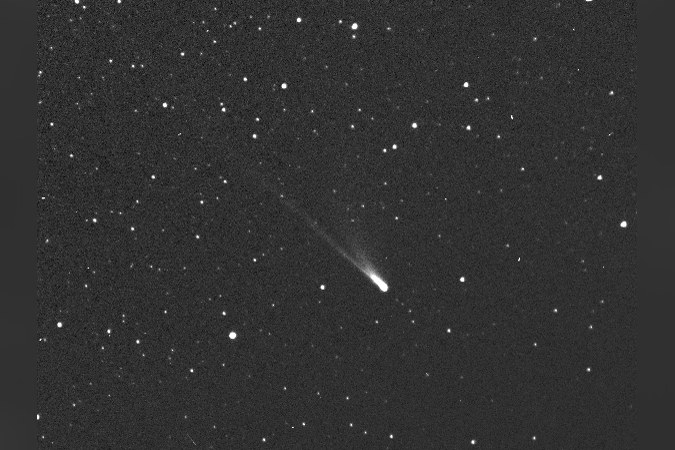
LONDON, July 21 — A comet that barely scrapes the Sun and may have arrived from another star system is heading back toward the inner Solar System, with a close brush with Earth set for 2028. 96P/Machholz, known as Machholz 1, is the sort of object that keeps orbital dynamicists interested. Discovered on 12 May 1986 by amateur astronomer Donald Machholz from Loma Prieta peak in central California, using 130 mm binoculars, the comet at first looked like one more periodic wanderer.
Its debut passage brought it 0.404 AU from Earth on 6 June 1986. The technical reality is that 96P/Machholz is anything but ordinary.
It is the only known short-period comet with both high orbital inclination and high eccentricity, and its current perihelion distance of 0.116 AU (at the 2028 passage) is the smallest known among numbered short-period comets, bringing it closer to the Sun than Mercury. Under the hood, the orbit is a mess: a period of 5.29 years, a Tisserand parameter with respect to Jupiter of 1.94 — a figure that classifies it outside the Jupiter family, where the threshold is 2.
Orbital integrations show that about 2,500 years ago the Tisserand parameter was above 2, meaning the comet has migrated inward. It now sits in a 9:4 orbital resonance with Jupiter, a precarious dance that may eventually see it ejected from the Solar System altogether.
A Sunskirting Wanderer
The comet is the parent body of both the Kracht and Marsden sungrazer families — groups of small fragments that dive close to the Sun and are often picked up by the Solar and Heliospheric Observatory (SOHO). SOHO’s LASCO C2 and C3 coronagraphs have spotted 96P/Machholz during its returns in 1996, 2002, 2007, 2012, and 2017. During the 2001/2002 passage it brightened to magnitude −2.
In 2007 it appeared between April 2 and 6, peaking at magnitude +2. A fragment believed to have broken off during that 2007 passage, SOHO 2333, was discovered in August 2012 by Indian amateur astronomer Prafull Sharma.
Two more small fragments were detected during the 2012 perihelion. The last perihelion — on 31 January 2023 — passed without major drama, but the comet’s estimated diameter of about 6.4 km makes it a substantial chunk of rock and ice for a sunskirter.
Chemical Anomaly
In 2007, spectroscopy revealed that 96P/Machholz is severely depleted in carbon and cyanogen. That chemical composition is nearly unique among comets, and it has prompted the leading hypothesis that the object may be an interstellar interloper — a comet that formed in another star system and was later captured by the Sun’s gravity. No one has proved it yet, but the evidence is suggestive.
As ever, the detail that matters is that no other short-period comet shows such a stark carbon-and-cyanogen signature, making 96P/Machholz a prime target for chemical forensics on the next close pass. Perihelion distances are gradually dropping.
Between 1897 and 2102, the minimum distance to the Sun will fall from 0.17 AU to 0.09 AU. The first time it goes below 0.1 AU will be in 2081. That is still half a century off, but for an object that might not be a local, every orbit counts.
The 2028 close approach to Earth — at 0.3197 AU, or about 47.83 million km — will offer astronomers their best shot in decades to study its strange chemistry up close. SOHO will be watching, as will every ground-based telescope that can get a bead on it.
One observation: Machholz 1 is a comet that breaks every rule of its class — high inclination, high eccentricity, depleted chemistry, a Tisserand parameter that defies neat classification — and yet it keeps coming back every 5.29 years. The question is how many more returns it has left before Jupiter’s gravity finally flings it out into the dark. That answer, as with most things in cometary science, lies in the next apparition.




