
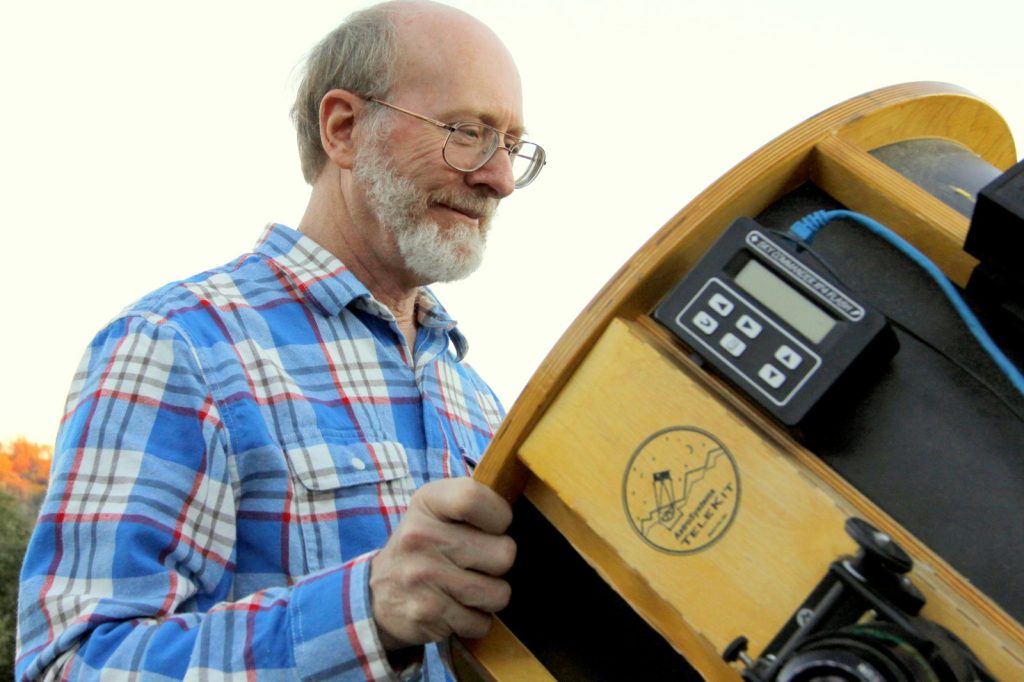
LOMA PRIETA, Calif., July 21, 2026 — On a clear May morning in 1986, amateur astronomer Donald Machholz stood on Loma Prieta peak in central California, peering through 130 mm binoculars. He spotted a faint smudge of light that would become known as 96P/Machholz – a periodic sunskirting comet discovered on 12 May 1986. The comet’s orbit is extreme.
It swings within 0.116 astronomical units of the Sun – closer than Mercury – at a speed of 122 km/s. That’s the smallest perihelion distance of any numbered short-period comet.
Its 5.29-year orbit is also highly eccentric and steeply inclined, a combination found nowhere else among regular comets. What sets 96P/Machholz apart is its chemistry. In 2007, it was found to be carbon-depleted and cyanogen-depleted, a composition nearly unique among comets.
The leading hypothesis points to an extrasolar origin: this comet may have been captured from another star system. It is the parent body of two sungrazer families, the Kracht and Marsden groups, and its orbit also aligns with the Arietid meteor stream.
The comet has become a regular target for the Solar and Heliospheric Observatory, which first caught it in its LASCO C2 and C3 coronagraphs in 1996. During the 2001–2002 passage, 96P/Machholz brightened to magnitude -2. In April 2007, it peaked at magnitude +2, appearing far brighter due to forward scattering.
That same passage apparently fractured the nucleus. During the 2012 perihelion, LASCO C2 images revealed two small, faint fragments of the comet drifting five hours ahead of the main body. One fragment, designated SOHO 2333, was discovered by an amateur astronomer in August 2012 while analyzing archived SOHO/LASCO data.
The comet’s dynamics are shifting. Its Tisserand parameter with respect to Jupiter currently sits at 1.94 – below the 2.0 threshold that typically defines Jupiter-family comets.
Orbital integrations indicate that threshold was crossed about 2,500 years ago. Today, 96P/Machholz is locked in a 9:4 orbital resonance with Jupiter. Over the long haul, its perihelion distance is slowly dropping: between 1897 and 2102, it falls from 0.17 AU to 0.09 AU.
The year 2081 will mark the first perihelion below 0.1 AU. Eventually, the comet may be ejected from the solar system altogether.
On the immediate horizon, the comet will not make another close approach to Earth until 2028, passing at a distance of 0.3197 AU. That next swing past the Sun, peaking at perihelion, should offer another dramatic view. For now, 96P/Machholz remains a ghost in the dark, already on its long loop back toward the Sun – a visitor from somewhere beyond our neighborhood, carrying chemical fingerprints of a star system far from home.




