
A four-carbon sugar called erythrulose, found in raspberries and self-tanners, has been detected in interstellar space for the first time. The findings appeared in Nature Astronomy on July 13.
“This is the very first sugar to be detected in interstellar space, and it is important because it tells us that these sugars are more common than we previously thought,” said Izaskun Jiménez-Serra, a study co-author and astrochemist at the Center for Astrobiology in Spain. “It opens the possibility for life to develop on other worlds in a similar way as it did on Earth.”
Her team pointed two radio telescopes in Spain at G+0.693-0.027, a molecular cloud of cold gas and dust about 27,000 light-years from Earth. Substances in the cloud emit and absorb different wavelengths of light, and the patterns gave away erythrulose. The researchers found no sign of simpler sugars with three carbon atoms.
That surprised outsiders. “It defies expectations, in some ways, based on the chemistry we understand,” said Brett McGuire, an astrochemist at MIT who was not involved in the work. Astrochemists have generally assumed molecules grow one carbon atom at a time. Jiménez-Serra says the data point elsewhere: erythrulose may have formed when two-carbon compounds, glycolaldehyde and ethylene glycol, combined.
Why glycolaldehyde did not count
Glycolaldehyde has a long history in this search. A team using the NRAO 12-meter telescope at Kitt Peak reported it in 2000 toward Sagittarius B2(N), a cloud near the Galactic center about 26,000 light-years away. Headlines at the time called it sugar in space. McGuire says it is “not formally a sugar,” because a true sugar needs at least three carbon atoms.
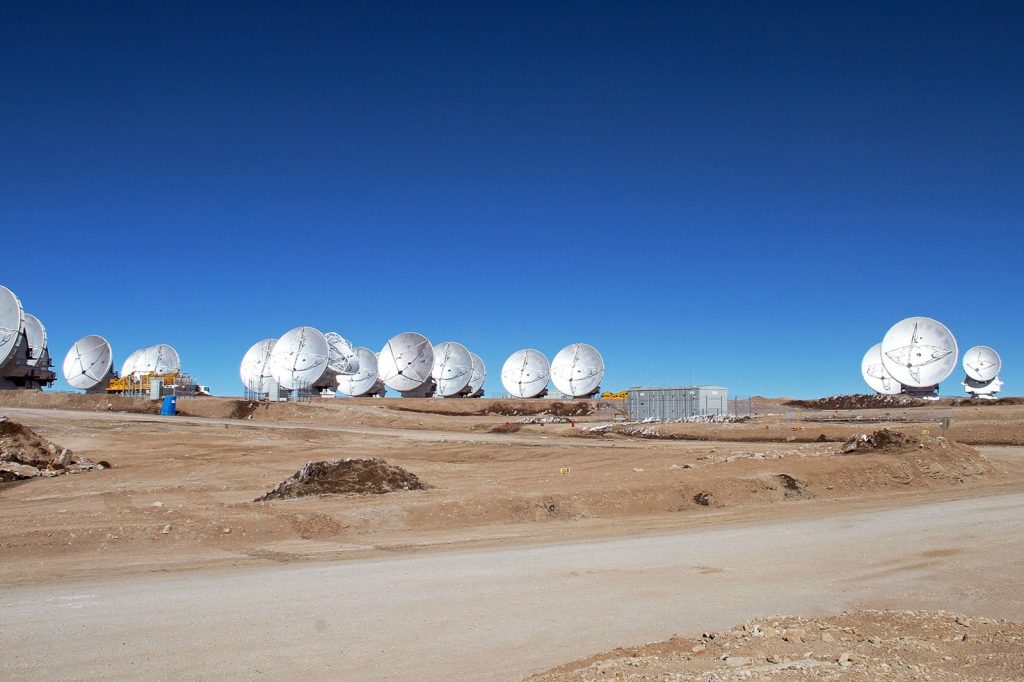
The molecule kept turning up anyway. In 2012, ALMA detected it around IRAS 16293-2422, a young solar-type protostar binary about 120 parsecs away. Warm glycolaldehyde gas appeared to be falling toward the planet-forming zone within 25 astronomical units of the young star. In 2015, observations of the comet Lovejoy made the first cometary detection, at 0.016% relative to water. The Rosetta mission later confirmed glycolaldehyde in comet 67P/Churyumov-Gerasimenko.
Chemists care about it for another reason. It plays a central role in the formose reaction, a route by which formaldehyde builds into larger sugars, including the five-carbon ribose that RNA needs.
What it could mean for early Earth
True sugars have already turned up in asteroid and meteorite samples, which suggested they existed in interstellar space, but nobody had found them there. In March, researchers reported that the asteroid Ryugu holds all five nucleobases of DNA and RNA. Bennu has them too.
Molecular clouds are where stars, planets, comets and asteroids are born, and one of them produced our solar system. So interstellar erythrulose could have been an ingredient for Earth’s first nucleic acids. “That’s why the detection of erythrulose is so relevant for the origins of life,” Jiménez-Serra told Nature.
She and her colleagues calculated that between about 551,000 and 55.1 million U.S. tons of the sugar could have reached Earth roughly four billion years ago, carried by space rocks that kept hitting the young planet.
Yoshihiro Furukawa, an astrochemist at Tohoku University in Japan who was not part of the study, called it “a very exciting finding.” He told New Scientist it “points to an additional source of sugar distribution beyond asteroids. We have been waiting for an actual detection like this.”
Sources
- Sugar in the Stars: Finding the Building Blocks of Life in Deep Space | CRV Science News
- In a First, Astronomers Find Sugar in the Space Between Stars, Providing New Clues About the Origins of Life on Earth
Sources
- Sugar in the Stars: Finding the Building Blocks of Life in Deep Space
- In a First, Astronomers Find Sugar in the Space Between Stars…




