
CADARACHE, July 9 — Against the backdrop of the Provencal countryside, the world’s most ambitious energy experiment is entering a critical phase. Dr. Pietro Barabaschi, the Italian physicist who leads the ITER Organization, is the man steering this immense international fusion project toward its next milestones. He took the helm in October 2022, succeeding Dr. Bernard Bigot, who died that same year.
Barabaschi is not new to the corridors of ITER; he served as Deputy Director-General from 2014 to 2022, overseeing engineering and construction of the machine that is meant to replicate the power of the Sun on Earth. Barabaschi brings more than three decades of fusion research to the role.
He holds a degree in nuclear engineering from the University of Bologna, and his career has spanned some of the field’s most significant projects. He worked on the design of the JT-60SA tokamak in Japan and the JET project in the United Kingdom. He is known for his expertise in superconducting magnet systems — the very technology that confines the superheated plasma inside ITER’s massive tokamak.
What is at stake is clear. ITER is a collaboration of 35 countries, with a total estimated cost that has been publicly reported at over $20 billion.
The project aims to achieve first plasma in 2025 and full fusion power by 2035. Barabaschi has stated that ITER’s success is critical for demonstrating the feasibility of fusion as a commercial energy source. The site itself is a study in scale.
The tokamak building in Cadarache, France, is one of the largest construction projects in the world. Barabaschi inherited a program that had already weathered years of technical challenges, budget revisions, and the logistical nightmare of coordinating components from dozens of nations. His background in engineering and his intimate knowledge of the project’s design history have been seen as assets in keeping the timeline on track.
For Italian science, Barabaschi’s leadership carries a particular resonance. Italy has long been a significant player in fusion research.
Having an Italian physicist — one trained at Bologna, a university with deep roots in nuclear engineering — as Director-General of ITER is a point of quiet pride in the corridors of Italian research institutes. The project remains a bet on the future. Fusion, the process that powers the stars, has been decades away for decades.
But ITER is the machine designed to prove that it can work at an industrial scale. Barabaschi’s task is to shepherd that proof through the final years of construction and into the operational phase.
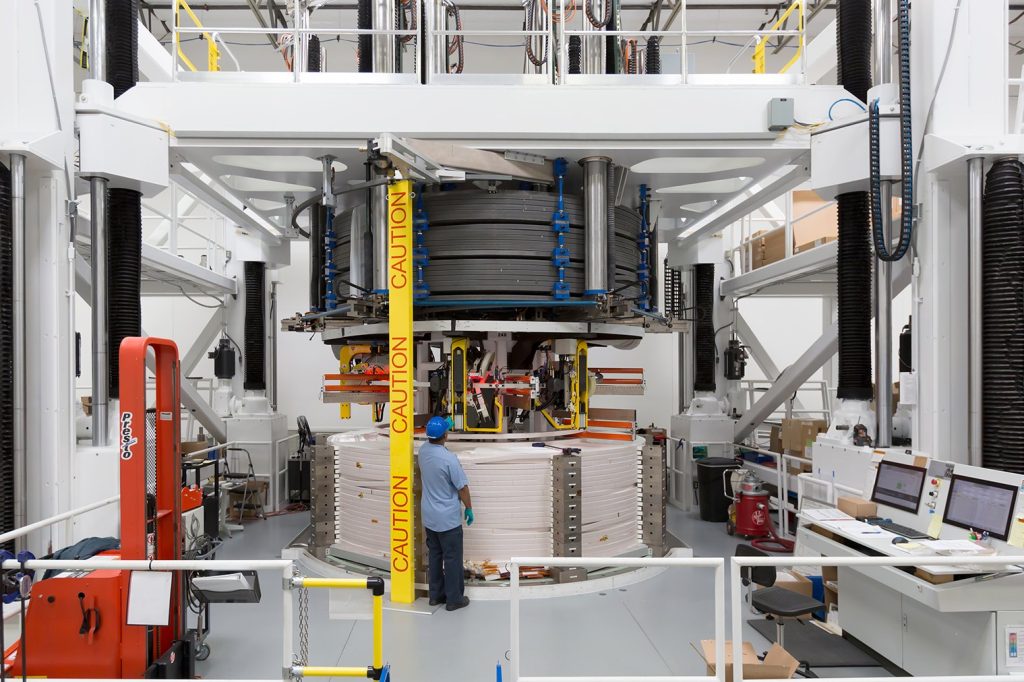
The coming months will be telling. With first plasma targeted for next year, the pressure is on to complete the assembly of the tokamak’s central solenoid, the massive superconducting magnet that will drive the plasma current. Barabaschi’s expertise in these systems is directly relevant to the challenge.
In the wider picture, ITER is not just a scientific project; it is a diplomatic one. The 35-nation collaboration includes the European Union, the United States, China, Russia, India, Japan, and South Korea — a coalition that must coordinate on everything from budget contributions to the delivery of custom-built components. Barabaschi’s leadership is as much about managing this political geometry as it is about plasma physics.
For now, the eyes of the fusion world are on Cadarache. The machine is being assembled.
The magnets are being tested. And Pietro Barabaschi, the engineer from Bologna, is the man in charge of making the Sun’s fire burn on Earth.




