
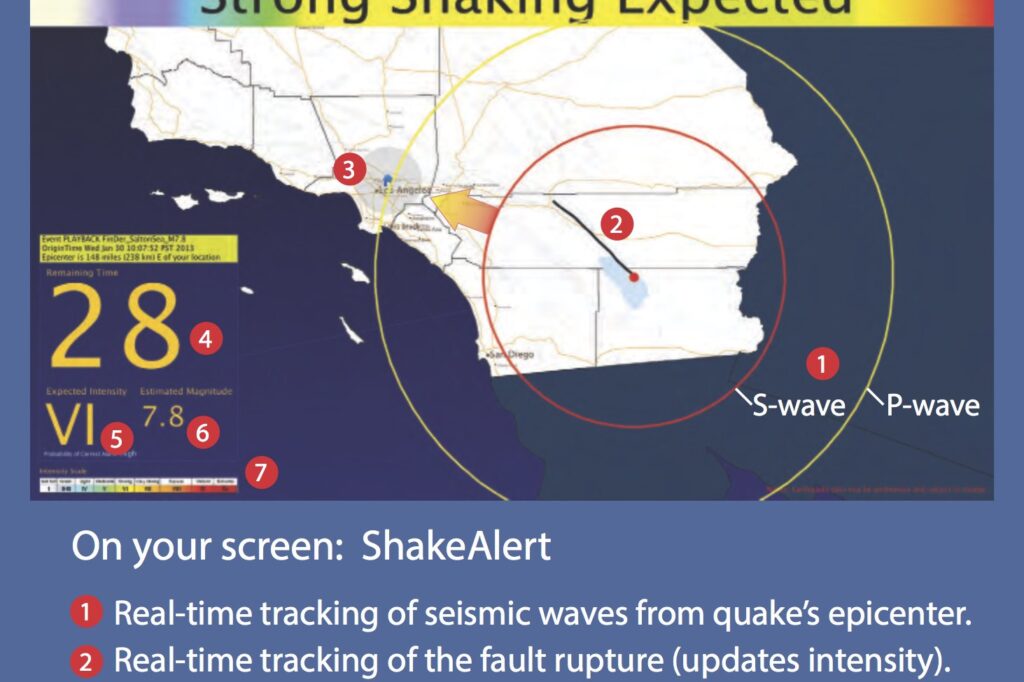
Earthquake early warning systems alert people of impending seismic activity, saving lives
Introduction to Earthquake Early Warning Systems
An earthquake early warning system is a network of accelerometers, seismometers, communication, computers, and alarms that rapidly notify adjoining regions of a substantial earthquake once one begins. This is not the same as earthquake prediction, which is currently not capable of producing decisive event warnings. The pressure waves from an earthquake are always smaller in amplitude than the damaging shear waves.
How the Systems Work
When an earthquake starts, pressure waves travel faster than shear waves and are detected first by sensors near the epicentre. The system estimates the quake’s magnitude and location, then sends alerts to areas where stronger shaking is expected but has not yet arrived. This gives people seconds to tens of seconds to take protective actions like dropping, covering, and holding on. The MyShake app, powered by the U.S. Geological Survey’s ShakeAlert system, sends alerts to phones in affected areas when a quake is estimated to be magnitude 4.5 or greater, giving users anywhere from a few seconds to half a minute to react.
Countries with Comprehensive Nationwide Systems
As of January 2026, China, Japan, Taiwan, South Korea, Israel and Transnistria have comprehensive, nationwide earthquake early warning systems that notify people via cell broadcast, TV alerts, radio announcements or public address systems. Japan’s system was tested beginning in 2004 and became fully operational on October 1st, 2007, making it the first nationwide system to enter service. Mexico, the United States, Canada, and India have regional systems. In the U.S., ShakeAlert covers California, Oregon, and Washington, and extends into British Columbia, Ontario and Quebec in Canada. India’s system covers only Uttarakhand state.
Regional and Opt-in Systems
Countries such as Guatemala, El Salvador, Nicaragua and Costa Rica have deployed systems that alert only specific users through applications that must be installed individually on smart devices. Indonesia and Turkey are currently publicly testing similar opt-in systems. In Indonesia, scientists are testing a pilot scheme to use mosque loudspeakers as warning klaxons for earthquakes. The pilot scheme has already hooked up several mosques to its seismic sensor network. The ultimate goal of the project is to alert people so that they can respond as early as possible. The MyShake test alert audio will say “Earthquake drill. Earthquake drill. When you hear this message, practice: Drop, cover and hold on.”
Effectiveness and Limitations
The effectiveness of early warning systems depends on the distance from the epicentre and local soil conditions. A village 50km from the epicentre could have only five to 10 seconds to respond, as noted in Indonesia’s testing. While systems can provide critical seconds for protective actions, they cannot predict earthquakes before they start. Warnings are issued only after an earthquake begins and faster-moving pressure waves are detected. The systems rely on functioning sensor networks and communication infrastructure, which can be disrupted by strong shaking. Officials noted that maintenance remains a big challenge for disaster infrastructure, though existing systems like mosque loudspeakers in Indonesia offer advantages because they are already well maintained by local communities. Data shows that even a few seconds of warning can reduce injuries and deaths by allowing people to take cover before strong shaking arrives.
Regional Systems in the United States and Other Countries
In the United States, the ShakeAlert system operates as a regional earthquake early warning network covering California, Oregon, and Washington, with extensions into British Columbia, Ontario, and Quebec in Canada. This system relies on data from the U.S. Geological Survey’s seismic sensor array to detect initial pressure waves and issue alerts for earthquakes estimated at magnitude 4.5 or greater, providing users with seconds to tens of seconds of warning before stronger shaking arrives.
Mexico’s Seismic Alert System serves as another regional model, focusing on central and southern Mexico, including densely populated areas like Mexico City and Oaxaca. It uses similar technologies to ShakeAlert, issuing alerts through public sirens, radio, and television broadcasts to give residents critical time to take protective actions before destructive shear waves reach urban centers.
India’s earthquake early warning efforts remain limited in scope, with the only operational system covering Uttarakhand state in the Himalayan region. Unlike the nationwide systems in Japan or Taiwan, India’s approach is geographically constrained, reflecting ongoing challenges in expanding sensor coverage across its vast and seismically varied territory.
Indonesia’s Mosque-Based Earthquake Warning Pilot
Scientists in Indonesia are testing a pilot scheme that uses mosque loudspeakers as earthquake warning klaxons, leveraging the country’s widespread network of mosques to reach remote communities. The initiative, led by Dr. Inoue Hiroshi of Kyoto University’s Disaster Prevention Research Institute, aims to adapt Japan’s early warning model to Indonesia’s geographic challenges. The project began nearly two decades ago after Inoue researched the deadly 2009 Sumatra quake that killed at least 1,000 people.
The Indonesian disaster agency is assessing whether mosques can serve as reliable alarm points, noting that their loudspeakers are already regularly maintained by local communities—a critical advantage over systems dependent on fragile communication infrastructure. As of October 2026, several mosques have been connected to the seismic sensor network, though the system remains a prototype and does not yet issue public warnings. The five-year trial, scheduled to run until 2030, also explores integrating school loudspeakers and broadcast media into the warning network.
Senior researcher Andi Eka Sakya of Indonesia’s National Research and Innovation Agency emphasizes that while tsunami warnings allow minutes of lead time, earthquake waves travel so fast that a village 50km from the epicentre may have only five to ten seconds to respond. The project’s ultimate goal is to provide even brief alerts so people can take protective actions like dropping, covering, and holding on before destructive shaking arrives.
Sources
- Earthquake early warning system
- Why Your Phone Might Get an Earthquake Test Alert Thursday (and What to Do) | KQED
- Indonesia looks to mosque loudspeakers to double as earthquake warning systems
Photo: Erin R. Burkett, Douglas D. Given, and Lucile M. Jones (Public domain)




