
Elon Musk told SpaceX employees in Texas that he gave the company “less than a 10% chance of succeeding at all.” He said it just before ringing the opening bell on its first day of public trading, in a listing Fortune reported valued the company above $2.1 trillion.
The road there began with a college friend’s doubt. Musk, who had just been pushed out of PayPal, talked with his old roommate Adeo Ressi about whether a person could reach space without government backing. Ressi was sceptical. Musk looked at the cost of metal and fuel and thought it might work.
Three explosions and an empty bank account
His first plan was not to build a rocket company at all. He wanted to send a small greenhouse to Mars as a stunt that would push governments to fund missions. Buying a rocket in Russia went badly, and he walked away from an offer of two old Dnepr rockets at $18 million each. On the flight home he sketched out a spreadsheet of what it would cost to build one himself.
He moved to Los Angeles, hired Tom Mueller as the first employee and put $100 million of his own money in. The first rocket was the Falcon 1, with engines named Merlin and Kestrel. At one point about 70% of its parts were built in-house, to save money.
The launches went wrong in a row. The first, in 2006, exploded seconds after liftoff. A second a year later never reached orbit. In 2008 the third rocket blew up when its first and second stages collided during separation. Musk had budgeted for just three attempts, and cash from members of the PayPal Mafia, the same people who had forced him out as chief executive years earlier, kept the company going.
In September 2008 the fourth attempt worked. Falcon 1 became the first privately developed liquid-fueled rocket to reach Earth orbit. Months later NASA placed an order worth $1.6 billion for a dozen Dragon cargo flights to the space station. Ars Technica notes that both Musk and his partner Gwynne Shotwell have said this award probably saved SpaceX from bankruptcy, as the company struggled to meet payroll. An earlier award, $278 million in 2006, had helped as well.
Landing the first stage
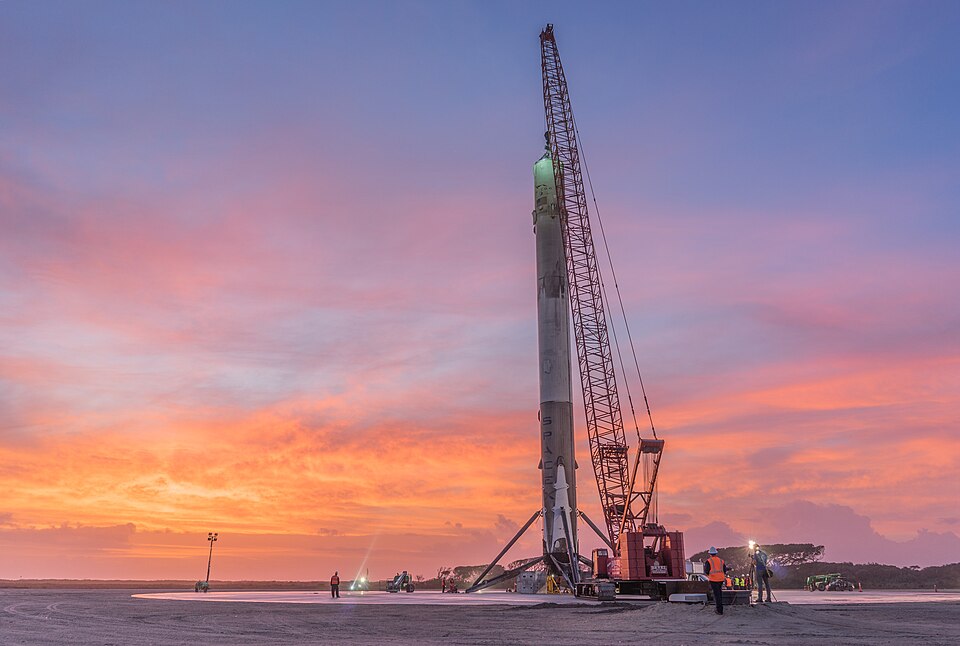
The nine-engine Falcon 9 first flew successfully in 2010. In 2015 SpaceX landed one of its first stages on Earth so it could be flown again. Boosters have since been landed and reflown hundreds of times, while many rivals are still building rockets that are thrown away after one flight.
In May 2020, a Dragon capsule carried NASA astronauts to the space station, the first crewed launch from American soil in nearly a decade. NASA had paid Russia for rides since 2011. Doug Hurley and Bob Behnken’s 64-day mission ended that.
By Fortune’s count SpaceX flew just over half of all rocket launches in 2025 and accounts for 83% of the mass sent to orbit. Its Starlink network has more than 10,000 satellites. The next-generation Starship V3 stands 408 feet tall and can carry 100 metric tons, up from 35 metric tons for the previous model.
Now the customer matters less
NASA has awarded SpaceX contracts worth approximately $20 billion over two decades, including a $2.89 billion proposal to turn Starship into a lunar lander, the only bid that fit the agency’s budget. Yet Ars Technica reports the relationship is shifting. SpaceX has told NASA it will stop flying Crew Dragon by or before 2030, and it has stopped selling commercial Falcon 9 launches for missions after 2028. Lori Garver, a former deputy NASA administrator, said she is “still in denial that there is a divorce pending.” SpaceX is still fulfilling its existing government contracts.
Sources
- SpaceX no longer needs NASA, and that's a problem for America's space agency – Ars Technica
- Before the biggest IPO ever, SpaceX dealt with multiple rocket explosions and near bankruptcy | Fortune




