
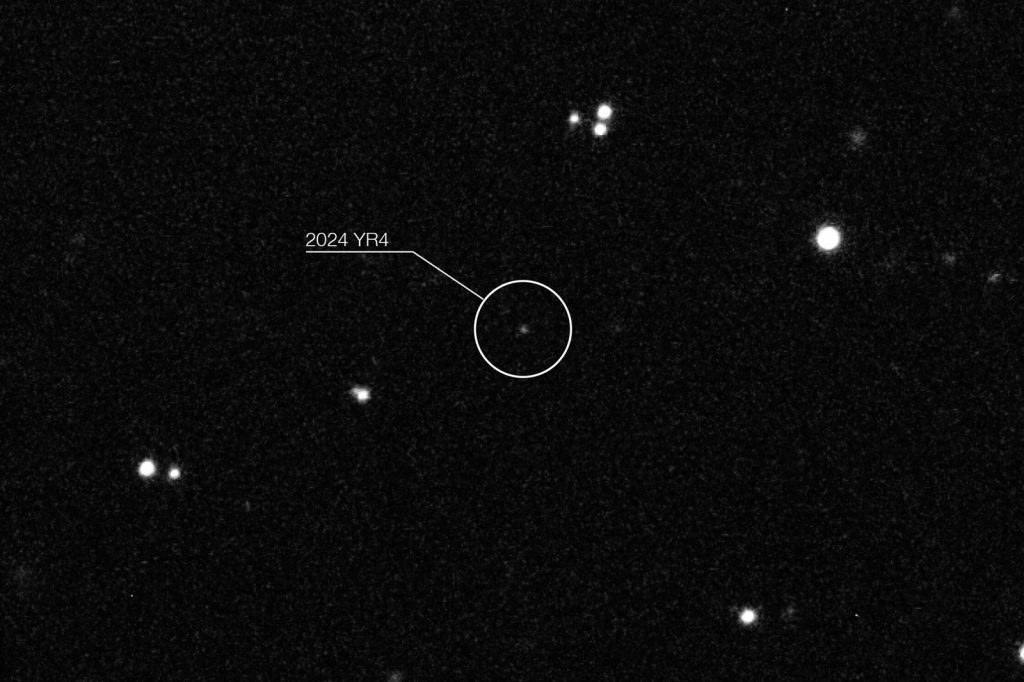
European Space Agency Adjusts Risk of Asteroid 2024 YR4 Impact to 1.5 Percent
The latest assessment of the impact probability for asteroid 2024 YR4 has been revised to 1.5 percent, equating to a one-in-67 chance of colliding with Earth in 2032. This new figure was released by the European Space Agency (ESA) from their headquarters in Paris. The updated estimation is a decrease from previous estimates, and the ESA anticipates it to further decrease, potentially even falling below one percent.
The decrease in the impact probability is significant as asteroid 2024 YR4 had previously caused concern. The ESA, along with astronomers worldwide, continuously monitor near-Earth objects as a part of their regular duties. This diligent monitoring has paid off in this instance, yielding more favorable odds.
The lowered probability is not merely a fluke, but rather the result of extended observation time, improved data, and refined orbital calculations. Asteroid 2024 YR4 remains in its celestial orbit, passing close again in 2032, with the question being how close.
The ESA maintains approximately 3,000 employees globally and was established in 1975. Their annual budget for 2026 is around €8.3 billion, allocated to various endeavors. Space exploration is a substantial part of this budget, with the ESA constructing the European Service Module for NASA’s Orion spacecraft, a critical component of the Artemis program aimed at returning humans to the Moon. The ESA also contributes to the International Space Station, which requires long-term commitment and public trust.
An asteroid scare, even one of relatively minor magnitude, puts this trust to the test. The decrease in the impact probability provides practical consequences, including a reprieve from the need for an immediate deflection mission. The agencies can continue observing and refining the asteroid’s orbit further. If the probability drops below one percent, the public’s anxiety subsides, and the political pressure on funding for planetary defense eases, although it does not vanish entirely.
The lowered probability serves as a reminder that asteroids pose a threat, crossing Earth’s path occasionally. One will inevitably strike at some point. The ESA’s work on asteroid 2024 YR4 is part of a larger international collaboration aimed at identifying and monitoring such celestial bodies. The agency shares data and coordinates observations with its partners, demonstrating the effectiveness of the monitoring network and the limitations of early predictions.
The initial estimates were higher, leading to headlines and anxiety. Now, the numbers have decreased, providing the public with a lesson in how science corrects itself. The ESA expects the probability to continue falling, following the typical pattern of more data reducing uncertainty and the impact chance often decreasing to zero. However, there are instances where this is not the case, keeping astronomers vigilant.
Asteroid 2024 YR4 is not the only such object. The ESA’s dedication and resources are focused on discovering others. The lowered probability for this particular asteroid does not signal the end of the job, but rather one less immediate threat. The space community can breathe a collective sigh of relief, but asteroid 2024 YR4 remains a noteworthy concern within the broader context of their ongoing missions.
Metadata
{“@context”: “https://schema.org”, “@type”: “NewsArticle”, “headline”: “European Space Agency Adjusts Risk of Asteroid 2024 YR4 Impact to 1.5 Percent”, “description”: “The latest assessment of the impact probability for asteroid 2024 YR4 has been revised to 1.5 percent, equating to a one-in-67 chance of colliding with Earth in 20




