
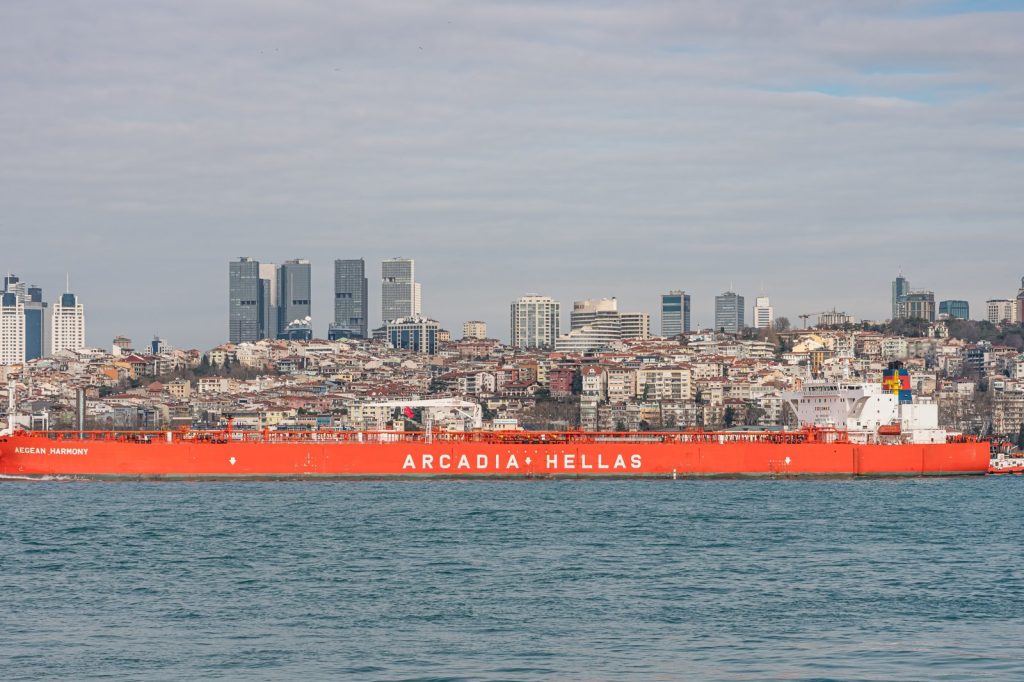
Turkish authorities launched rescue operations in the Bosporus Strait on November 28 following explosions that struck two tankers, leaving one vessel ablaze. The damaged ships belong to what is known as Russia’s shadow fleet—vessels operating under sanctions that continue transporting oil and gas through critical global waterways. The blasts transformed a standard transit into an emergency, compelling Ankara to evacuate crews from the burning ships before flames could escalate.
The Bosporus, a narrow 19-mile strait dividing Istanbul, serves as the sole maritime passage from the Black Sea to the Mediterranean Sea. Daily, tankers carrying crude oil, chemicals, and liquefied gas navigate past Ottoman-era landmarks and residential areas.
A fire aboard such a vessel poses not only a maritime hazard but a direct danger to a metropolis of 16 million residents. That was the situation Turkish officials confronted when the initial explosion occurred. These tankers are engineered for bulk liquid transport, including oil, chemical, and gas carriers, each designed to contain volatile materials in sealed compartments.
According to reports, tanker design traces back to the late 19th century, when iron hulls and steam pumps replaced wooden barrels secured on decks. Modern tankers function as floating steel tanks equipped with advanced piping systems.
However, no level of engineering can fully eliminate risks when an explosion happens in a confined waterway. Sanctions have given rise to the shadow fleet. Following Russia’s invasion of Ukraine, the country lost access to Western insurance and port services, prompting it to acquire older tankers and operate them through opaque ownership structures.
These vessels transport Russian crude to buyers in Asia and the Middle East. Often poorly maintained and underinsured, they are crewed by sailors from developing nations who accept the work due to limited alternatives.
The Bosporus, a natural bottleneck for this trade, sees regular shadow fleet transits. Now, two of those tankers are damaged. Rescue operations continue. The report does not specify whether all crew members were evacuated or if casualties occurred.
It also does not identify the ships, their flags, or their cargo. What is certain is that the Bosporus, already among the world’s most hazardous straits to navigate, has become even more perilous.
The environmental stakes are high. A tanker fire can persist for days. If the hull is breached, oil or chemicals could spill into currents flowing through the Sea of Marmara and into the Aegean Sea.
Turkey has experienced oil spills before—the 1999 collision of the Volganeft-248 and the M/V Independenta in the same waterway resulted in 43 deaths and 20,000 tons of crude released into the sea. That cleanup took years.
A similar incident today, in a strait lined with tank farms and refinery terminals, would be devastating. The incident also raises concerns about governmental control over these ships. Sanctioned tankers lack the public tracking of legitimate vessels.
Their insurance is unclear, crews often face delayed pay, and identifying responsible parties during emergencies is difficult. Turkey, a NATO member, maintains a complex relationship with Russia.
It has not joined Western sanctions on Russian energy but must manage the physical consequences—ships rejected by Western ports, sailing through Turkish waters, carrying cargo still purchased globally. Currently, the priority is rescue. Firefighting tugs are likely applying water and foam to the burning tanker.
Other vessels have probably been directed to clear the strait. Shipping traffic through the Bosporus may be suspended for days, causing delays for Ukrainian grain ships, Kazakh oil tankers, and container vessels heading to the Mediterranean.
The strait is a global supply chain nerve; disruptions affect prices. The report concludes by urging stronger safety standards and cooperation among shipowners, governments, and international organizations. Such statements often follow disasters, but whether change occurs remains uncertain.
The shadow fleet will persist as long as sanctions exist. The Bosporus will not widen.
And tankers, despite engineering advances, remain susceptible to explosions and fires—a ship full of fuel in a narrow strait is essentially a bomb awaiting ignition.




