
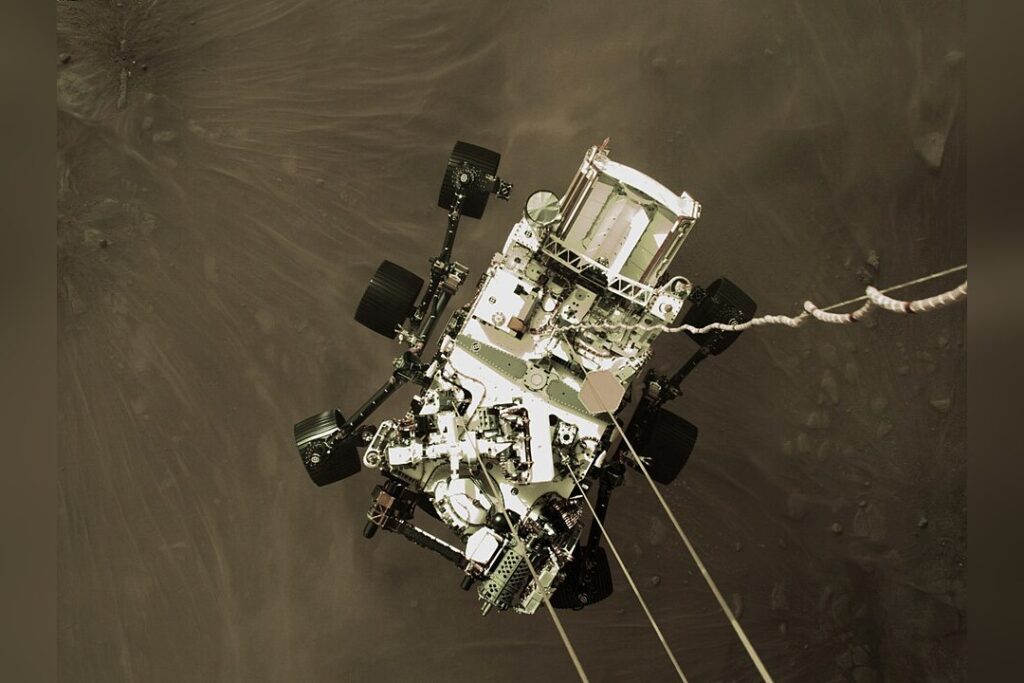
Fit a microphone to a Mars rover and sooner or later it records something nobody scheduled. Perseverance has now captured the snap of electrical sparks, and the miniature sonic booms that follow them, inside Martian dust devils. NASA said the findings appeared Nov. 26 in the journal Nature.
The recordings came from SuperCam. Its microphone exists mainly to pick up the sound of the instrument’s laser zapping rocks, though the team had also logged wind and the first audio of a dust devil. They knew it could register static and the sound of discharges in the air. What they could not know was whether such events happened often enough, or whether the rover would ever sit close enough, to catch one. Searching the archived data settled the question without much delay.
The tally stands at 55 distinct electrical events, the first on the mission’s 215th Martian day, or sol, in 2021. Sixteen came while a dust devil passed directly over the rover. Another 35 lined up with convective fronts during regional dust storms, where intense turbulence favors the build-up and separation of charge.
“We got some good ones where you can clearly hear the ‘snap’ sound of the spark,” said coauthor Ralph Lorenz, a Perseverance scientist at the Johns Hopkins Applied Physics Lab in Laurel, Maryland. “In the Sol 215 dust devil recording, you can hear not only the electrical sound, but also the wall of the dust devil moving over the rover.”
Static, on a planetary scale
The mechanism is the triboelectric effect, the same one that zaps you when you shuffle across carpet in socks and reach for a metal doorknob. NASA says a Martian dust devil likely produces about that level of discharge. Scientists had suspected for decades that dust grains rubbing together inside these whirling columns could build enough charge to arc.
Baptiste Chide, a Perseverance science team member and planetary scientist at L’Institut de Recherche en Astrophysique et Planétologie in France, said the process is rare on Earth. “On Mars, the thin atmosphere makes the phenomenon far more likely, as the amount of charge required to generate sparks is much lower than what is required in Earth’s near-surface atmosphere,” he said.
One result cuts against the obvious guess. Discharges did not climb in the seasons when dust storms, which raise dust levels globally, are more common. The researchers read that as a sign that charge depends more on local, turbulent lifting of sand and dust than on how thick the dust is.
What it could change
The team says sparks of this kind can charge the atmosphere enough to drive chemical reactions that produce chlorates and perchlorates. Those strongly oxidizing compounds can destroy organic molecules on the surface and break down many atmospheric compounds. NASA adds that the finding might explain why Martian methane vanishes so fast, and that electric charge likely affects how dust moves, a process central to Mars’s climate that remains poorly understood.
There is a practical side too. Electrostatic discharge is a potential risk for the electronics on robotic missions, and for future astronauts. No harmful effects have been reported in several decades of surface operations, which NASA suggests may reflect careful grounding of the spacecraft.




