
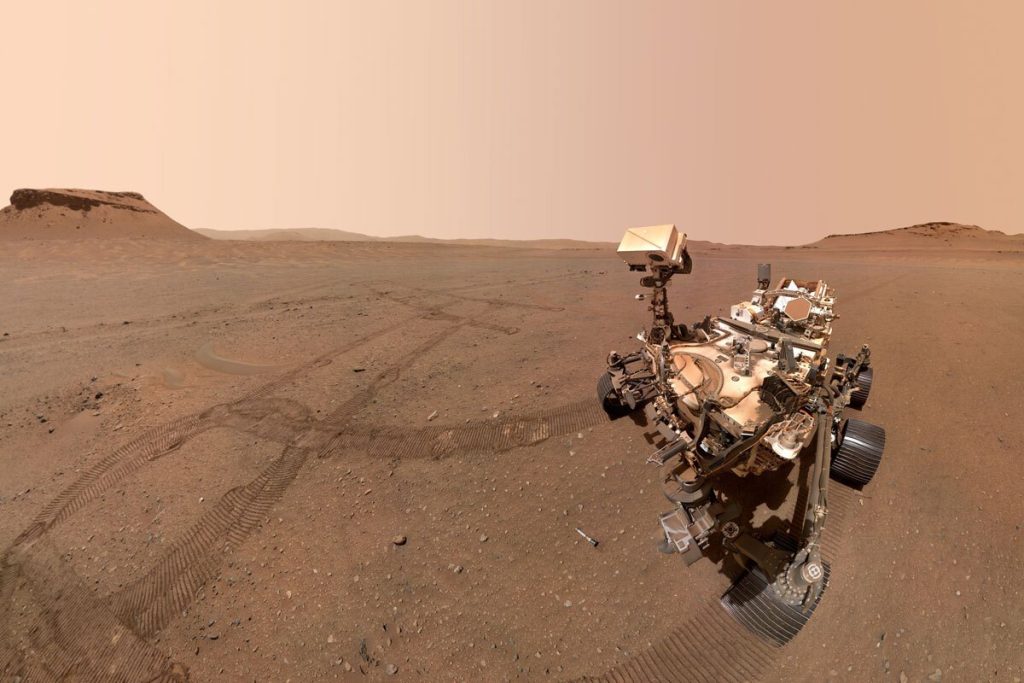
Five years into its drive across Mars, NASA’s Perseverance rover has sent back its sixth selfie, framed against a region scientists call Lac de Charmes. The image was assembled from 61 separate photographs taken on March 11, during the rover’s farthest push west beyond the rim of Jezero Crater.
The selfie shows Perseverance pointing its mast at a rocky outcrop after carving a circular abrasion patch into it, a routine in which the rover grinds away part of a rock’s surface so researchers can study what lies underneath. The composite was built with the WATSON camera at the end of the rover’s arm, which made 62 precise movements over about an hour to assemble the shot.
Katie Stack Morgan, Perseverance’s project scientist at NASA’s Jet Propulsion Laboratory, described the spot as “the farthest west we have been since we landed at Jezero a little over five years ago.” The team had just abraded and analysed the Arethusa outcrop, which turned out to be largely igneous minerals dating back even further than the crater itself.
Alongside the portrait, Perseverance used its Mastcam-Z camera to capture a mosaic of the Arbot area on April 5, Sol 1882 of the mission. Made from 46 images, the panorama shows a windswept landscape of varied rock textures and what scientists believe are megabreccia, rock fragments as large as skyscrapers thrown out by a meteorite strike roughly 3.9 billion years ago.
Ken Farley, Perseverance’s deputy project scientist at Caltech, called the view “excellent exposure of likely the oldest rocks we are going to investigate during this mission.” NASA says the terrain holds some of the most scientifically important rock the rover has examined so far, and Stack Morgan has said the ancient crust could offer clues about whether Mars once had a magma ocean and how it became a habitable planet.
Sources
- NASA’s Perseverance Rover Sends Stunning Selfie From Mars’ Lac de Charmes Region | PetaPixel
- Mars rover snaps a selfie near skyscraper-sized boulders | Popular Science




