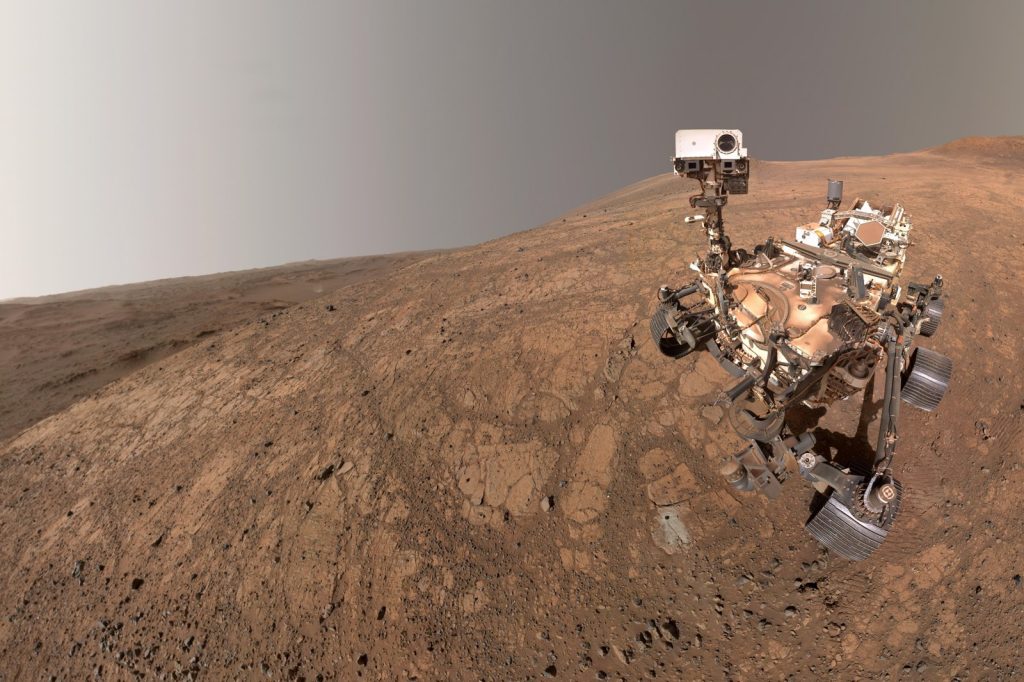
Think of it like a group photo where the camera is also the subject. Perseverance stretched its robotic arm out, pointed a camera back at itself, and made 62 precision movements over about an hour. The result, stitched from 61 individual images, is a rover selfie taken in what NASA’s science team calls the “Wild West” of Mars.
The picture was taken on March 11, the 1,797th Martian day, or sol, of the mission. It shows the rover’s mast aimed at a rocky outcrop where it had just ground a circular patch into the surface. Behind it, the western rim of Jezero Crater runs off into the distance. The spot is a location the team calls “Lac de Charmes.”
“We took this image when the rover was in the ‘Wild West’ beyond the Jezero Crater rim, the farthest west we have been since we landed at Jezero a little over five years ago,” said Katie Stack Morgan, Perseverance’s project scientist at NASA’s Jet Propulsion Laboratory in Southern California. “We had just abraded and analyzed the ‘Arathusa’ outcrop, and the rover was sitting in a spot that provided a great view of both the Jezero Rim and the local terrain outside of the crater.”
What the grinding revealed
Abrading means grinding away part of a rock’s surface so scientists can analyze what lies inside. On Arathusa, that showed igneous minerals that likely predate Jezero Crater itself. Igneous rocks with large crystals form underground, as molten rock cools and hardens.
The selfie came from the WATSON camera on the end of the rover’s arm. It is Perseverance’s sixth since landing in 2021, and the rover is now in its fifth science campaign, the Northern Rim Campaign.
A mosaic of the oldest rocks
Perseverance also used its mast-mounted Mastcam-Z to shoot a 46-image mosaic of an area called “Arbot” on April 5, Sol 1882. NASA calls it one of the richest geological views of the mission. Some of the scattered fragments look like megabreccia, with chunks as big as skyscrapers thrown out by a massive meteorite impact on the plain called Isidis Planitia about 3.9 billion years ago.
“What I see in this image is excellent exposure of likely the oldest rocks we are going to investigate during this mission,” said Ken Farley, deputy project scientist at Caltech in Pasadena. He pointed to a sharp, jagged ridgeline that contrasts with the rounded boulders in front of it, and to a feature that may be a volcanic dike, a vertical intrusion of magma left standing as softer material eroded away.
Texture tells the team more than color here. Some of these rocks appear to be extrusive igneous rocks or impactites, believed to have formed about 4 billion years ago, before the crater. Unlike the sedimentary rock of Jezero’s river delta, they offer a view of the planet’s deep early crust. “The rover’s study of these really ancient rocks is a whole new ballgame,” Stack Morgan said. If the rocks come from deep in the crust, she added, they could show whether Mars once had a magma ocean.
Where the rover goes next
From Arathusa, the rover drove northwest to Arbot to study more outcrops. Next it will head south to “Gardevarri,” a site with a notably clear exposure of olivine-bearing rocks, then southeast toward a region the team calls “Singing Canyon.”
The odometer is closing in on a famous number. After more than five years of surface operations, Perseverance has abraded 62 rocks and filled 27 sample tubes with rock cores, 25 of them sealed and 2 unsealed. It has traveled almost 26 miles (42 kilometers), just shy of a marathon at 26.2 miles.
“We’ve almost reached marathon distance,” said acting project manager Steve Lee at JPL. “Our selfie may show that the rover is a bit dusty, but its beauty is more than skin deep.”