
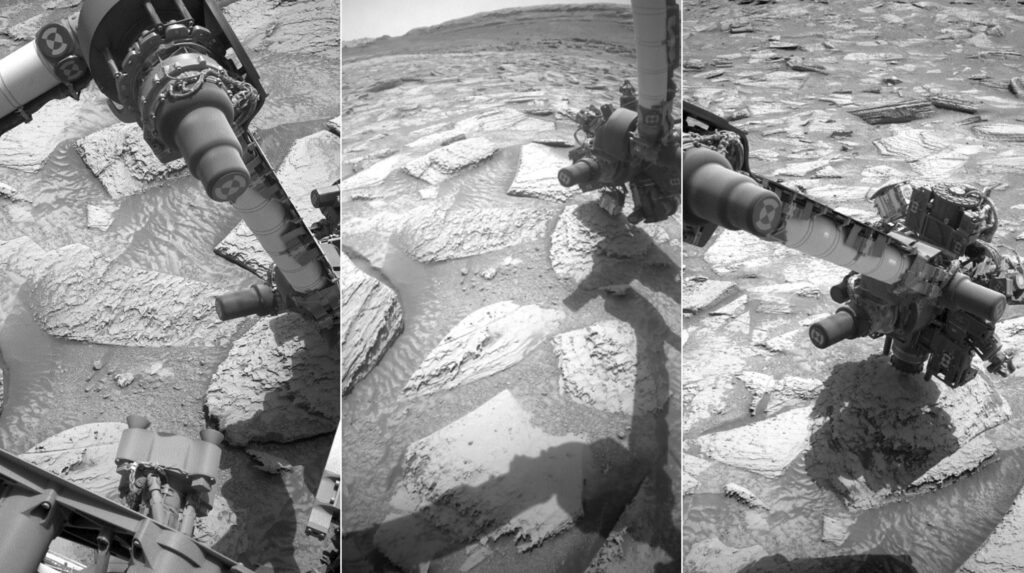
After 14 years traversing the Red Planet, NASA’s Curiosity rover faced a mechanical predicament unlike any in its extended mission. While boring into a sandstone formation nicknamed Atacama, the robotic drill unexpectedly hoisted the entire 13-kilogram slab, leaving it suspended from the turret at the end of the rover’s seven-foot arm. The rock’s mass and instability created a scenario the engineering team had never encountered since the rover’s 2012 landing in Gale Crater.
Initial recovery attempts proved futile. Engineers at the Jet Propulsion Laboratory commanded the arm to vibrate and reposition repeatedly over several weeks, but the slab remained firmly caught in the drill’s grip. The situation threatened to stall the rover’s science operations indefinitely, as the arm could not safely maneuver with the unpredictable load.
Persistence paid off on April 29 when a coordinated sequence finally succeeded. By simultaneously rotating the drill bit, activating the vibration mechanism, articulating the turret, and tilting the arm, the team generated enough combined force to release the rock. The slab shattered upon impact with the Martian surface, resolving the month-long standoff.
Despite this anomaly, the rover’s percussion drill — designed to pulverize rock into analyzable powder — has successfully collected 42 samples throughout its journey. The instrument has endured considerable wear, yet continues to function as a primary tool for the mission’s geochemical investigations.
Curiosity’s longevity far exceeds its original two-year design life. Since arriving at Gale Crater, the rover has uncovered compelling evidence that the region once hosted persistent lakes and possessed the chemical ingredients necessary for microbial life. These findings have fundamentally reshaped scientific understanding of Mars’ habitable past.
Mission managers confirmed the episode caused no permanent damage to the arm, drill, or sampling systems. Science operations resumed promptly after the rock’s release, demonstrating the robustness built into the rover’s hardware and the ingenuity of the ground team. The ability to diagnose and resolve unforeseen mechanical challenges from millions of kilometers away remains a hallmark of the mission’s success.
As Curiosity continues its ascent through the layered foothills of Mount Sharp, each new stratum offers a window into a different epoch of Martian environmental history. The rover’s proven resilience suggests it will continue returning valuable data for years to come, further illuminating the planet’s transition from a potentially life-supporting world to the cold, arid desert observed today.




