
Perseverance’s Selfie Serves Science and Survival
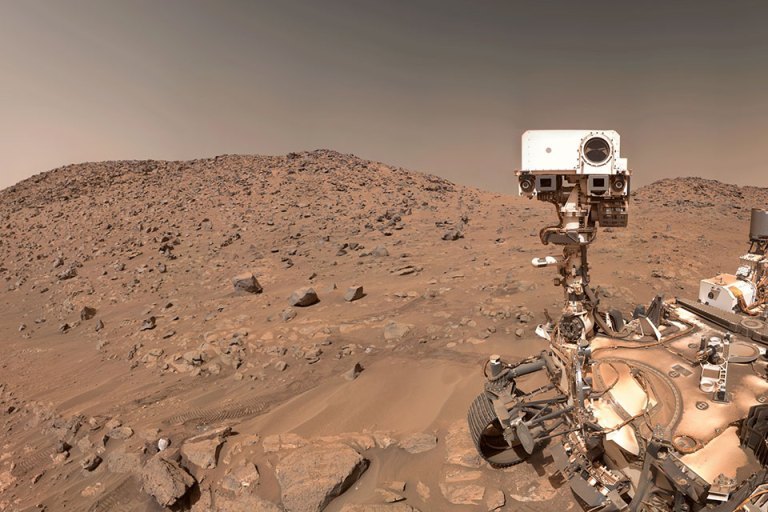
Sixty‑one individual frames, each a thin slice of the Martian landscape, were combined by the Perseverance rover into one high‑resolution self‑portrait. The final image shows the robot posed picture places the vehicle against a rocky feature named Arethusa, an outcrop that is far more than a scenic backdrop.
Before the picture was taken the rover used its abrasion tool to grind away the outer layer of the rock, exposing fresh material for spectroscopic study; the resulting scars are visible in the panorama. Self‑portraits are not new on Mars. Both the Curiosity rover and the InSight lander have taken similar pictures, but Perseverance’s image has a dual role that leans more toward engineering than public relations.
The WATSON camera, fixed to the end of the rover’s robotic arm, can zoom in on the wheels, the drill bit and the sample‑handling hardware. Engineers on Earth will examine those details for signs of wear, dust buildup, wheel abrasion and mechanical fatigue—issues that are real concerns three years after the rover’s landing in 2021, especially after it has already logged many miles across the floor of Jezero Crater.
The picture therefore works as a diagnostic tool masquerading as a postcard. The choice of Arethusa as the subject is deliberate. The outcrop lies inside Jezero Crater, a basin that once held a lake where water flowed.
Perseverance’s chief goal is to search for evidence of ancient microbial life, which means locating rocks that formed in wet environments and could have preserved organic compounds. By stripping away the weathered surface the rover reveals pristine material that has not been altered by radiation or wind, allowing its spectrometer to read the chemical makeup.
If any molecular fossils of long‑dead Martian microbes exist, they are most likely to be found inside such freshly exposed rocks. The selfie records exactly where the rover stood and what it touched, giving future scientists a precise geological reference for the abrasion site. It also serves as a rehearsal for a larger objective: the collection and caching of Martian samples.
Perseverance is sealing small tubes of rock and soil on the surface; NASA and the European Space Agency plan to retrieve those tubes in the 2030s, delivering the first ever material returned from another planet. With the selfie’s exact location data, each tube becomes more than an anonymous sample—it turns into a piece of a larger narrative about a lake that dried up, a climate that shifted and a world that may once have been habitable.
Creating the 61‑image mosaic was a technical feat. The rover had to position its arm with great care, capturing each frame from a slightly different angle. Software on Earth then aligned and blended the shots into a seamless panorama; any slip in the arm’s motion or any hiccup in the stitching algorithm would have produced gaps or distortions.
The process succeeded, yielding a clean, detailed portrait of a solitary machine on a cold, barren world. Looking ahead, the rover will face tougher terrain as it climbs out of Jezero Crater onto the surrounding highlands, where the ground is rougher and the rocks older.
Perseverance will continue to abrade, scan and photograph, and each subsequent selfie will keep serving the same two‑fold purpose: monitoring the health of the vehicle and documenting the geology it explores. The mission has no set end date; it will run until a critical component fails or the nuclear power source dwindles. Until that moment the robot keeps working, the images keep arriving and the analysis keeps deepening.




