
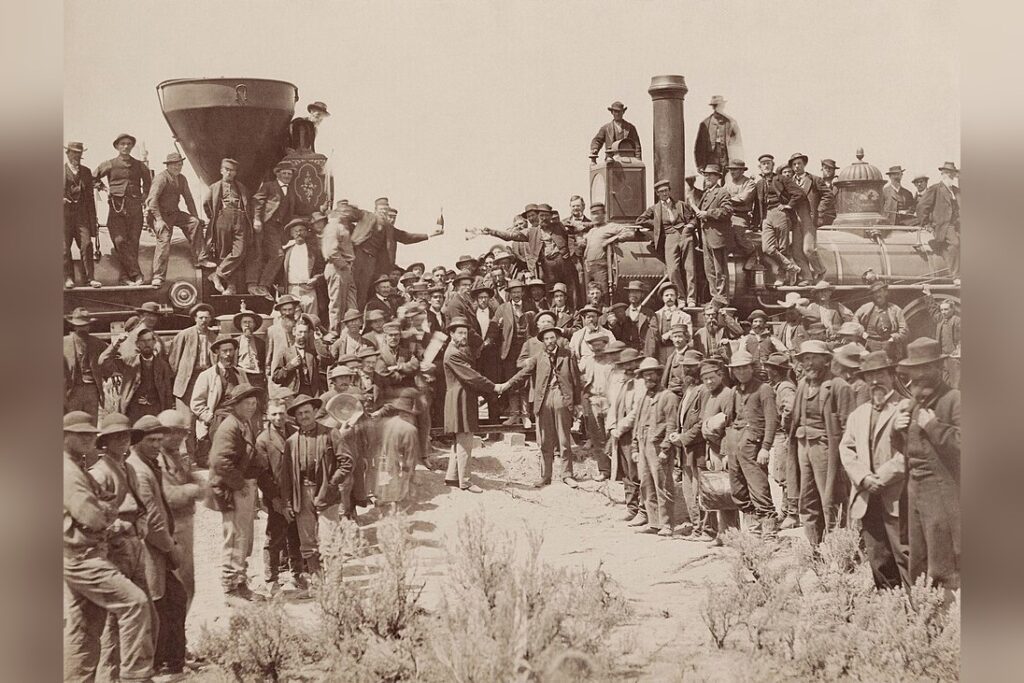
In an era when a cross-country wagon journey consumed four to six months, the completion of the First Transcontinental Railroad in 1869 slashed that transit to roughly seven days. The project, often called the Pacific Railroad, was built between 1863 and 1869 by three private companies. The Central Pacific Railroad pushed east from California, the Union Pacific drove west from Council Bluffs, Iowa, and the Western Pacific completed the final segment to San Francisco Bay.
The total construction cost reached $115 million — equivalent to about $2.5 billion in 2023 — for a continuous line stretching 1,912 miles from the Missouri River to the bay.
Public-Private Partnership on an Unprecedented Scale
The federal government played a massive role in financing and enabling the enterprise. Through the Pacific Railroad Acts of 1862, 1864, and 1867, Congress granted over 130 million acres of public land and $64 million in 30-year bonds bearing 6 percent interest.
Those land grants and loans provided the financial foundation for a project that, before its completion, had no precedent in the United States. Europe already possessed dense rail networks, but those were generally not viewed as transcontinental in the same sense. Earlier continental crossings elsewhere remained limited or unfinished, underscoring the difficulty of the undertaking.
The American approach followed private companies building toward each other with federal land and loans behind them. The Central Pacific was run by the ‘Big Four’ — Leland Stanford, Collis P.
Huntington, Mark Hopkins, and Charles Crocker. At peak construction, the company employed up to 12,000 Chinese immigrant workers. The Union Pacific, led by Thomas C. Durant, relied on Irish immigrants, Civil War veterans, and Mormon laborers.
The two lines finally met at Promontory Summit, Utah Territory, on May 10, 1869. Stanford drove the ceremonial golden spike — the ‘Last Spike’ — into the rail, marking the culmination of six years of intensive construction during and immediately after the Civil War.
Transforming a Continent
The railroad’s impact extended far beyond faster travel. It spurred rapid settlement of the American West, opening vast interior lands that had previously been reachable only by wagon or boat.
The line enabled the cattle industry to ship beef to eastern markets and made large-scale mining operations economically viable by providing reliable freight routes. It also facilitated the displacement of Native American tribes — a consequence that investors and historians alike must weigh alongside the economic gains. The completed line reshaped how a large country could be governed, settled, and supplied. Similar rail corridors on other continents later opened remote areas to movement and commerce where wagons or boats had been the only options.
Standardized time zones followed in 1883, a direct result of the need to coordinate train schedules across the vast distances the railroad now connected. The railroad was a key factor in the United States becoming an industrial and continental power, binding its distant coasts and interior regions into a single economic and political unit.
Enduring Legacy
For investors and business analysts, the Transcontinental Railroad remains a case study in public-private partnership, massive land grants, and infrastructure-driven economic transformation. The $115 million price tag, the 130 million acres of land grants, and the seven-day cross-country transit time are the numbers that still define the project’s scale and impact. Readers today live with its legacy in the nation’s freight routes, time standards, and the uneven costs borne by Native communities during western expansion.
The idea of binding distant coasts by rail had long attracted attention before the United States completed its first such line; the American project proved that a continuous rail line crossing a continent with endpoints at separate oceans was not only possible but transformative. The bottom line: the Pacific Railroad, built by private companies with federal backing, fundamentally altered the course of American history.




