
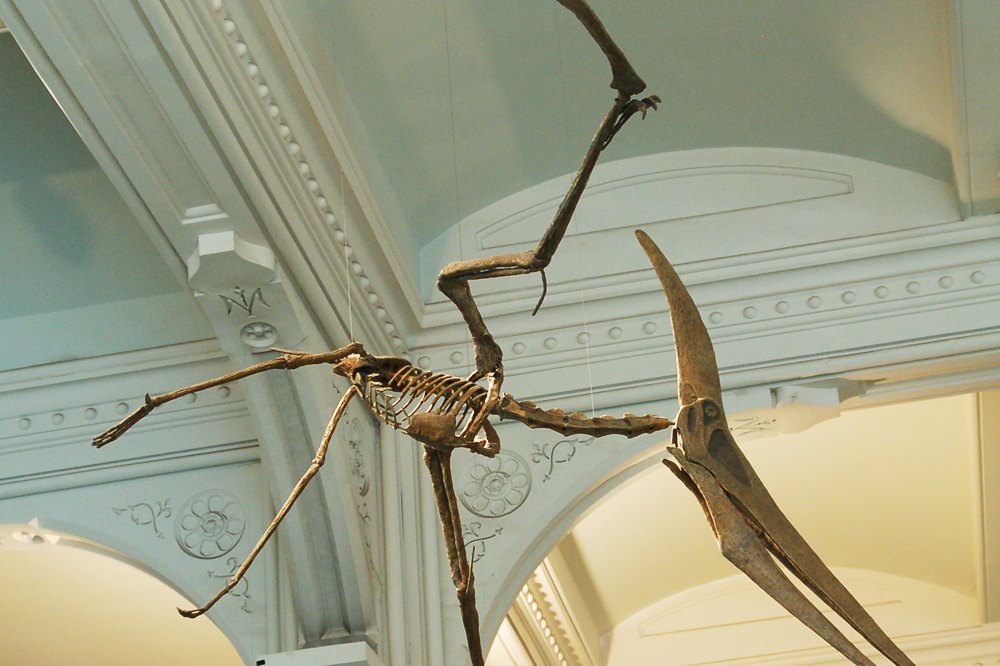
A new examination of a fossil from northeastern China has provided evidence that at least one species of pterosaur displayed iridescent coloring, a trait previously associated primarily with modern birds. The specimen, belonging to the species Sinopterus dongi, was unearthed in Liaoning Province and has preserved detailed structures in its body covering.
Pterosaurs were flying reptiles, not birds, and represent the first vertebrates to achieve powered flight. The fossil’s preservation allowed researchers to study hair-like fibers called pycnofibers, which covered the creature’s body. Within these fibers, scientists identified layered arrays of melanosomes, which are pigment-bearing structures. In contemporary birds, precise layering of melanosomes produces iridescent effects, and the arrangement found in the pterosaur’s pycnofibers matched that pattern.
The discovery carries implications beyond ancient aesthetics. The organization of melanosomes in the pterosaur’s fibers suggests the animal was endothermic, or warm-blooded.
Warm-blooded animals such as birds and mammals typically have densely packed melanosomes in their feathers and fur, while cold-blooded reptiles do not. Paleontologists have long debated whether pterosaurs were endothermic, and this fossil provides new evidence supporting that hypothesis.
Color as a Social Signal
Computer simulations based on the melanosome structure predict that Sinopterus dongi would have appeared in shifting shades of deep green and magenta, depending on the viewing angle. Producing such iridescent displays requires significant energy, and animals typically do not invest that energy in camouflage.
Instead, such displays are used for communication, likely in courtship or competition with rivals. Modern birds use iridescent feathers in elaborate mating rituals, and the pterosaur’s pycnofibers appear to have served a similar function, indicating a more complex social structure than simple predator-prey dynamics. The fossil originates from the Jehol Biota in northeastern China, a Lagerstätte known for exceptionally well-preserved specimens of feathered dinosaurs and early birds.
The preservation was detailed enough that scanning electron microscopy could resolve the internal structure of individual melanosomes, a rare level of detail that enabled this analysis.
Implications for Future Research
The finding suggests that if one pterosaur species had iridescent pycnofibers, others likely did as well. Many pterosaur fossils with preserved soft tissue exist, and re-examining them for melanosome structure could reveal a wider distribution of iridescent coloration and potentially clarify whether pterosaurs exhibited sexual dimorphism in color.
A deeper implication involves convergent evolution. Iridescence in modern birds is tied to feather structure, but pterosaurs had pycnofibers, which are structurally different. Yet the melanosome arrangement producing the color effect is the same, suggesting two separate lineages arrived at the same solution for visual signaling.
The mechanism predates feathers entirely. The discovery adds a color dimension to understanding the first flying vertebrates, indicating they were not drab or lizard-like but iridescent, with that shimmer carrying social meaning.




