
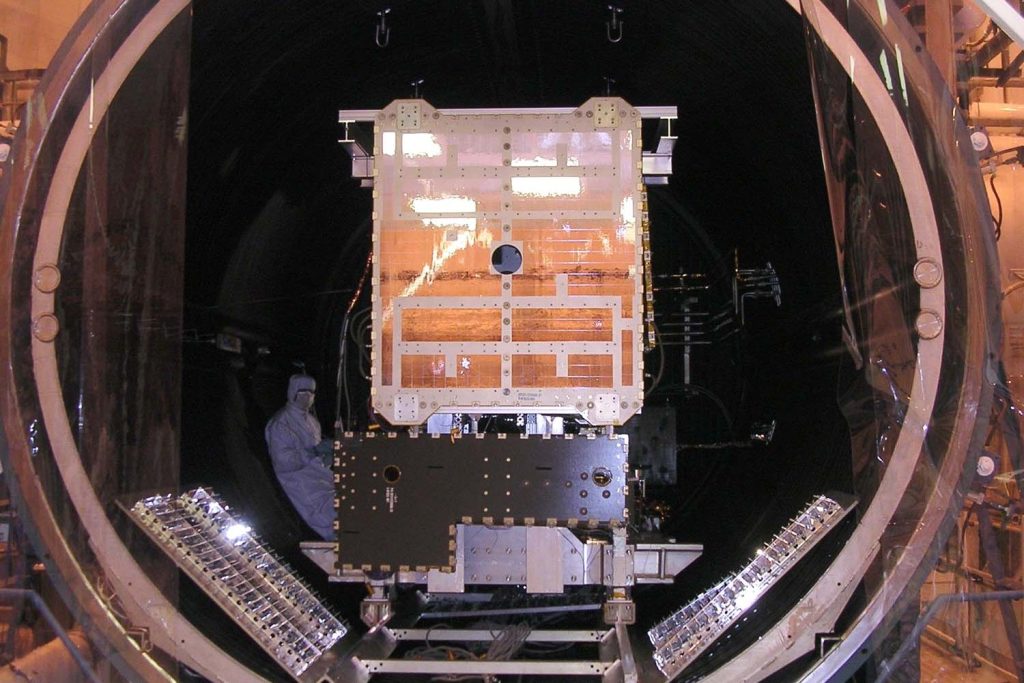
At full throttle, it would take the ion propulsion system on NASA’s Dawn spacecraft four days to go from 0 to 60 MPH. NASA offers that comparison itself, with some relish. Each of Dawn’s engines at maximum thrust produces 91 millinewtons, roughly the force of holding a single sheet of notebook paper in your hand.
For all that, the spacecraft went into orbit around two different bodies in the solar system, a first for any probe, and NASA says the mission would have been impossible without ion engines.
The principle
An ion engine does not burn anything. It uses an electrical charge to accelerate ions of xenon fuel to a speed that NASA puts at 7-10 times that of chemical engines. Xenon was chosen because it is chemically inert, stores compactly and has heavy atoms that give relatively large thrust. Power level and fuel feed can be adjusted, so each engine can be throttled up or down.
The fuel bill is tiny. At maximum thrust, a Dawn engine uses about 3.25 milligrams of xenon per second. The spacecraft left Earth with 425 kilograms (937 pounds) of the stuff.
Patience does the rest. Dawn’s thrusters were due to run for 979 days to reach the first science orbit and for more than 2,000 days across the whole mission. Deep Space 1, which proved the technology on a trip to an asteroid and a comet while testing 11 other technologies, managed 678 days of ion propulsion. Over that span, NASA says, the total change in Dawn’s velocity is comparable to the push from the Delta II rocket that lifted it, nine solid boosters and three stages included. The rocket delivers its shove in minutes. The ion engine takes thousands of days.
Dawn carried three 30-centimeter-diameter (12-inch) thrust units. Two were needed to give enough thruster lifetime for the mission, and the third was a spare. Each unit can be moved in two axes, which lets the engines help steer the spacecraft too.
Hall thrusters and the X3
A close relative, the Hall thruster, is the version now heading into wider use. SlashGear describes the Hall-effect design as using an electric field from solar panels to accelerate a propellant, usually xenon gas. The idea was first studied in the 1960s in the United States and the Soviet Union, and NASA first used the technology in satellites in 1998.
The commercial side is younger. Orbion Space Technology began developing its own Hall-effect thrusters in 2016 with help from NASA’s Glenn Research Center, and has since sold them to the Department of Defense and, for weather satellites, to General Atomics.
The larger experiment is the X3, developed at the University of Michigan with NASA and the US Air Force. In tests reported by ScienceAlert in 2017, it ran at over 100kW of power and produced 5.4 Newtons of thrust, a record for an ionic plasma thruster. A chemical rocket tops out at around five kilometers per second, the report says, while a Hall thruster can reach up to 40 kilometers per second. Alec Gallimore, the project lead, said ionic propulsion can go around ten times farther on a similar amount of fuel.
The catch
Low thrust means these engines are no use for launch. They have to run a very long time to match a chemical system’s acceleration. The X3 has a size problem as well: most Hall thrusters can be carried around a lab with ease, but this one needs a crane. The team planned a continuous 100-hour run in 2018 and was working on a shield to keep plasma from eroding the thruster walls, which could let it operate for several years at a stretch.
NASA experts, SlashGear notes, think ion propulsion combined with nuclear electric propulsion is how humans reach Mars. That is a long way off.
Sources
- NASA's New Ion Thruster Engine Is Breaking Some Important Records : ScienceAlert
- Here's How NASA's Ion Thrusters Keep Satellites Flying
- Ion Propulsion – NASA Science




