
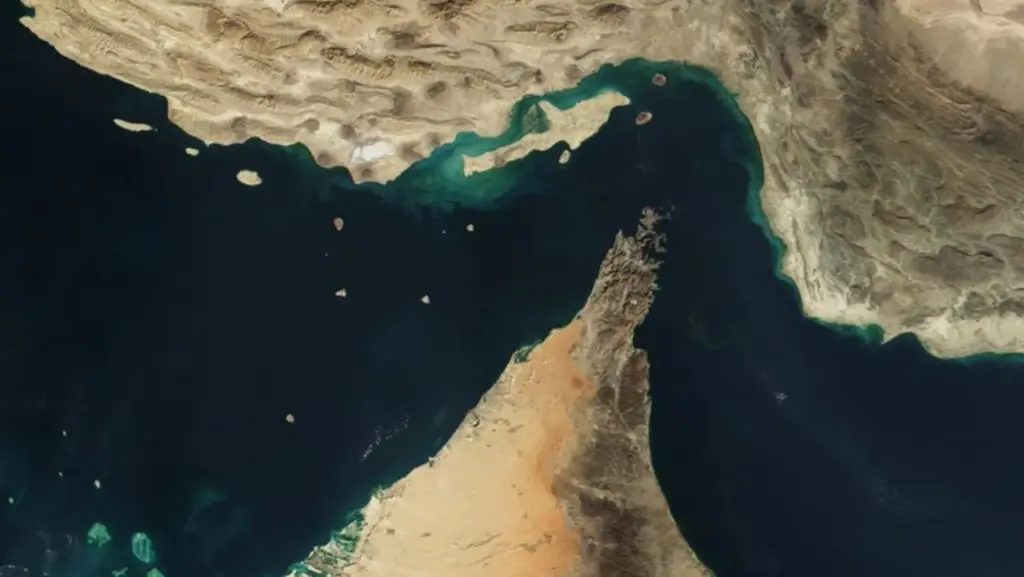
Before the war, about 130 ships a day passed through the Strait of Hormuz. By March 10 the number was four.
The collapse followed 28 February 2026, when US-Israeli strikes killed Iran’s Supreme Leader, Ali Khamenei, and the Revolutionary Guards answered by declaring the waterway shut over VHF radio. Iran formally confirmed the closure on March 4. Traffic fell 97%, and roughly 10 million barrels of oil a day dropped out of the market at the peak, according to Universalnest. The World Bank has called it the largest oil supply shock in the history of the global oil market.
A narrow corridor
The strait is 104 miles long and about 21 miles wide, with Iran on the northern shore and Oman’s Musandam Peninsula to the south. Ships use two shipping lanes, each 2 miles wide. It is the only sea exit from the Persian Gulf for oil from Saudi Arabia, Iraq, Iran, Kuwait, Qatar, Bahrain and the United Arab Emirates.
About 20 million barrels of oil moved through it daily in peacetime, or 20 to 25% of seaborne oil trade. It also carries 20% of the world’s liquefied natural gas, including 95% of Qatar’s LNG exports, and around 30% of internationally traded fertilizer. The International Energy Agency says Bangladesh, India and Pakistan took almost two-thirds of their LNG through the strait in 2025.
The bypasses do not come close. Saudi Arabia’s East-West pipeline and the UAE’s Abu Dhabi Crude Oil Pipeline have a combined 3.5 to 5.5 million barrels a day of spare capacity, leaving a gap of about 14.5 million barrels a day. For LNG there is no alternative route at all.
What closure did
Brent crude rose from $68 a barrel before the conflict to a peak of $126, and Dubai crude hit a record $166 on March 19. QatarEnergy stopped LNG production at Ras Laffan on March 2 and declared force majeure two days later. Iraq declared force majeure on all foreign-operated oilfields on March 17. Saudi Arabia cut output by 20%, from 10 to 8 million barrels a day, because it could not ship. By mid-March, combined Gulf oil exports were down by at least 60%. On April 21 the International Maritime Organization said about 2,000 ships and 20,000 mariners were stranded inside the Gulf.
Pakistan took 99% of its LNG from Qatar and the UAE in 2025. It suspended gas deliveries to its fertilizer sector, closed schools and put an emergency gas plan in place. The IEA coordinated a release of 400 million barrels from strategic reserves, far above the 182 million released after Russia invaded Ukraine in 2022. Relief was only partial. The IMF’s April outlook put global growth at 3.0% for 2026 in its reference case, and 2.5% if the closure drags on.
The Tanker War of the 1980s is the usual comparison. It damaged or destroyed more than 400 ships, but the strait stayed open because Iran and Iraq both needed it for their own exports. The 2026 crisis is the first time it has actually closed.
Where things stand
A memorandum of understanding between the US and Iran on June 17 brought a brief reopening, with transits climbing toward 30 ships a day. It fell apart after Iran struck a Qatari LNG tanker and a Saudi supertanker on July 7 and 8, and the US reimposed its naval blockade of Iranian ports on July 15. As of August 1, Kpler data showed fewer than five transits a day.
On May 5, Iran created the Persian Gulf Strait Authority to regulate passage and charge fees. Ships must apply for permits, use Iran-designated routes and pay service charges. Legal experts cite Article 37 of the UN Convention on the Law of the Sea, which prohibits charges on transit passage through international straits. Iran has not ratified the convention, and the dispute is unresolved.
Sources
- Strait of Hormuz: The 21-Mile Chokepoint Carrying 20% of World Oil and the Global Energy Shock It Triggered in 2026
- Stress Test: The Hormuz Crisis and the Fracturing of the Global Energy Order




